
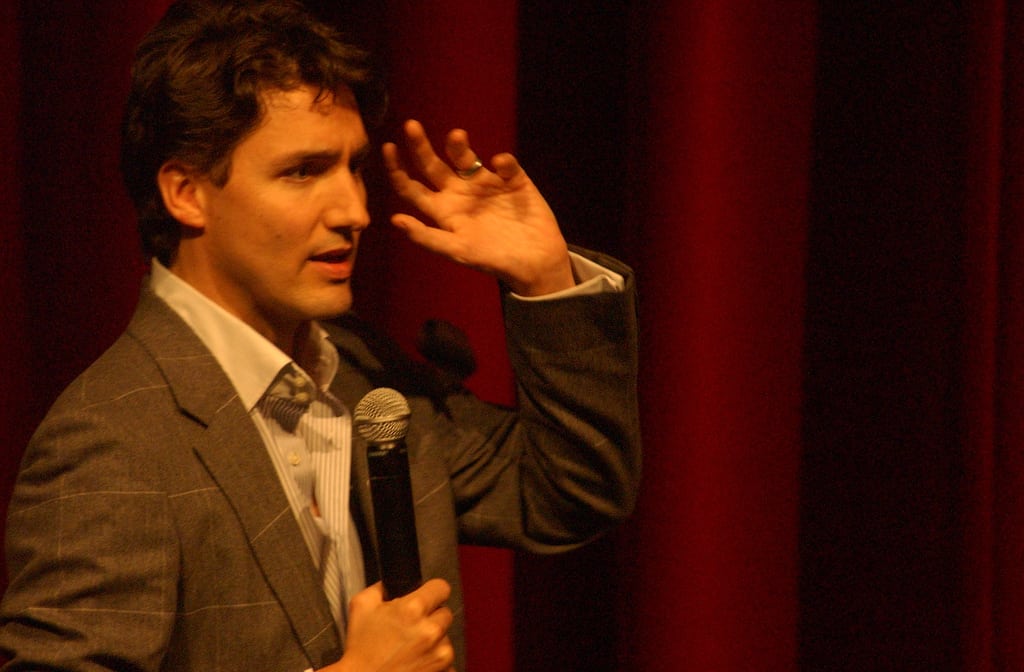
The rumour mill swirled out of control last week with media reports suggesting that Justin Trudeau would announce his candidacy for the leadership of the Liberal Party. The eldest son of Canada’s former Prime Minister, Pierre Trudeau — Justin has long been the subject of speculation as to when, or if, he would try to follow in his father’s footsteps. Such speculation can now be put to rest, as Canadians seem to have received an answer from the Trudeau heir.
Elected in 2008 to represent the Montreal riding of Papineau, Trudeau is the last of a dying Liberal breed in Quebec following the disastrous election of 2011. The failure of Michael Ignatieff and the party brass to take the Liberals from opposition to government status, resulting in the loss of Ignatieff’s own seat and a third-party status in the House of Commons, sent a clear message to Liberals that major reforms were necessary if the Liberals want to be “Canada’s natural governing party.”
Justin Trudeau stands a very good chance of being elected leader of the Liberal Party during next year’s leadership convention. For one, Trudeau is a household name all over Canada, despite the controversy that still surrounds the policies of his father. A new Angus Reid poll, released last week, revealed that Pierre Trudeau remains Canada’s most popular Prime Minister. Justin Trudeau’s popularity across Canada is reflected by the number of supporters he has garnered through social media networks such as Facebook — approx. 50,000 — and Twitter — approx. 150,000.
The Liberal Party has established new measures to draw in interest and support as they attempt to rebuild. Among these new measures are the expansion of who is able to vote for the next leader. Prior to the Liberal Biennial Convention, only card-carrying members that pledged allegiance to the party had an opportunity to vote for a new leader. Now, the party is allowing for outside supporters to vote without having to be formally affiliated with the Liberal brand.
Trudeau, who has served as the Liberal Party Critic for Youth, Post Secondary Education and Amateur Sports, has done an excellent job connecting with the younger electorate. In an article for the Globe and Mail earlier this year Michael Ignatieff wrote, “The leadership candidates who step forward should be judged on one key question: Do they offer young Canadians a vision of Canada that is both realistic and inspiring?” Justin Trudeau does just that.
For all the benefits that Trudeau will be able to bestow on the party, however, he has plenty of shortcomings when it comes to being able to win in a general election and become Prime Minister. Trudeau is seen by many to lack reasonable credentials that would qualify him for Canada’s top job. Those who oppose his campaign and character will paint him as an individual that has rode to fame on the coattails of his father.
It is not just the credentials that Trudeau lacks. In fact, this objection might be overlooked if Trudeau offered substantive policy ideas that would change the existing political landscape. Instead, Trudeau has progressed through his now four years of Parliamentary service without a definitive policy direction. Trudeau must stand for something beyond typical Canadian clichés.
Trudeau’s arrival on a more prominent stage comes at a unique time in Canadian political history. The NDP lead the opposition with their newly elected leader from Quebec, Thomas Mulcair. Mulcair currently enjoys fervent support from his home province. It is difficult to determine at this point whether Quebec will swing in favour of Mulcair or embrace the son of a Prime Minister who polarized the province.
Irrespective of his lack of substance, or the other challenges that he will face during a general election, Trudeau is generating a buzz found at only one other time in Canadian history. There was a time when women hunted for a chance sighting, and that many filled stadiums to the brim to hear a Canadian politician speak. That was 1968. This is 2012. Headlines deal almost exclusively with the prospect of there being a Canadian political dynasty in the works; Twitter trends his name worldwide. Trudeaumania seems to have returned to Canada.
