
Dalton McGuinty’s abrupt announcement that he will step down as Liberal leader once a successor is selected brought a close his nine-year premiership. He is now a lame-duck leader, with a recently-initiated process of higher education reform only halfway finished, and its future uncertain.
Post-secondary education has undergone a rapid expansion since the 1960s, from educating an elite five per cent of the population, to nearly half today. A study by the Martin Prosperity Institute reports the higher education “participation rate [in Ontario] will likely need to reach 60 per cent to meet the educational requirements for future jobs.” Within the next decade or so, Ontario will need about 25 per cent more university and college spaces than it has today. An increase of about 100,000 more spaces for baccalaureate students.
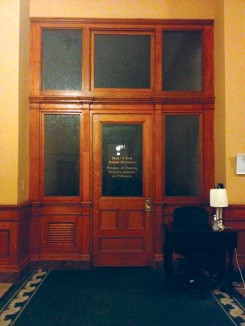
Dalton McGuinty's soon-to-be-vacated office. BERNARDA GOSPIC/THE VARSITY
When he became premier in 2003, undergraduate enrolment in the province was just over 300,000. As McGuinty exits office, that number has climbed to 400,000. Most experts suggest that to meet future demand, the province will need to increase capacity by at least another 100,000.
McGuinty’s government has a good record — he rebuilt public services eroded by former Conservative premier Mike Harris. He has also assiduously cultivated his reputation as the “education premier,” and could have survived as the bearer of bad news, weathering political storm with a bedrock of support among a generation of parents and students who believed he salvaged a K-12 system eroded under Mike Harris’ “Common Sense Revolution.”
But while he righted the ship, he leaves office without realizing the fundamental reforms he seems to have believed to be necessary.
Developments in other provinces, many of which unfolded during McGuinty’s term, suggest a future Ontario premier is now left with the difficult job of telling the province’s 24 colleges and 20 universities that they are not all equal. With every university in the province still scrambling to distinguish itself as a research institution, the government is left with the unsavoury task of telling some schools that their focus must shift to teaching and away from research.
Other premiers have already told their constituents such hard truths. In 2007, Alberta’s Conservative premier Ed Stelmach formed distinct categories of post-secondary institutions in the province. Reform in British Columbia also followed a familiar pattern. First came the report by former Attorney-General Geoff Platt. Premier Gordon Campbell then passed legislation to create “special purpose teaching universities” as a distinct class of institutions. In Nova Scotia, NDP premier Darrell Dexter similarly reformed the province’s system, based on the austerity recommendations of economist Tim O’Neill.
In Ontario, McGuinty commissioned former NDP premier Bob Rae to conduct a similar review in 2005. But Rae, now the interim federal Liberal leader, stopped short of calling for the creation of a tiered system of research versus teaching universities. Instead, he suggested changes to funding formulae and new quality-control measures.
Five years later, in 2010, deputy minister of Training, Colleges and Universities Deborah Newman — the Ministry’s most senior bureaucrat — raised the issue once again, and began to explore whether “a more strongly differentiated set of universities would help improve the overall performance and sustainability of the system.”
A discussion paper released this June by Minister Training, Colleges, and Universities Glen Murray hints at possible sweeping reforms to come. Murray and others have repeatedly the discussion paper is for discussion, not claimed determining policy. Yet as the opening salvo in a process of reform that could take years to unfold in full, the discussion paper seems to suggest the provincial government is prepared to overhaul the delivery of higher education in Ontario. With Murray rumoured to be contemplating a run to succeed McGuinty as Liberal leader, the future of the consultative process is in question.
But, if two classes of universities are ever created in Ontario, there is every indication the University of Toronto would remain a research university. It has long been the crown jewel of Ontario’s higher education system, the only university in the province to break into the top 20 of reputable global rankings.
In a recent meeting with student leaders from this university, Murray claimed the Liberals have increased U of T’s funding by 100 per cent. Murray praised U of T as an “elite” research institution and indicated that he was prepared to defend and maintain that distinction. But he also harkened back to Rae’s suggestion about the need for “quality control” around funding, to make sure it is actually improving the student experience, suggesting that may not be the case at U of T.
The theme throughout the meeting between student leaders and the Ministry was that good work has been done, but more progress is required. The conversation may now shift away from one between bureaucrats and stakeholders and into the political arena of a Liberal leadership race. Interestingly, three of the likely top-tier candidates are uniquely positioned to ensure a substantive discussion of the issue, from three differing perspectives: Murray, the Universities minister; Kathleen Wynne, the much-celebrated former education minister; and Dwight Duncan, the finance minister whose recent programme has shifted the government away from a paradigm of Liberal investment and into an austerity agenda. As all three contemplate and perhaps campaign to succeed Dalton McGuinty, they’ll bring three distinct perspectives to his unfinished agenda on post-secondary education.
