
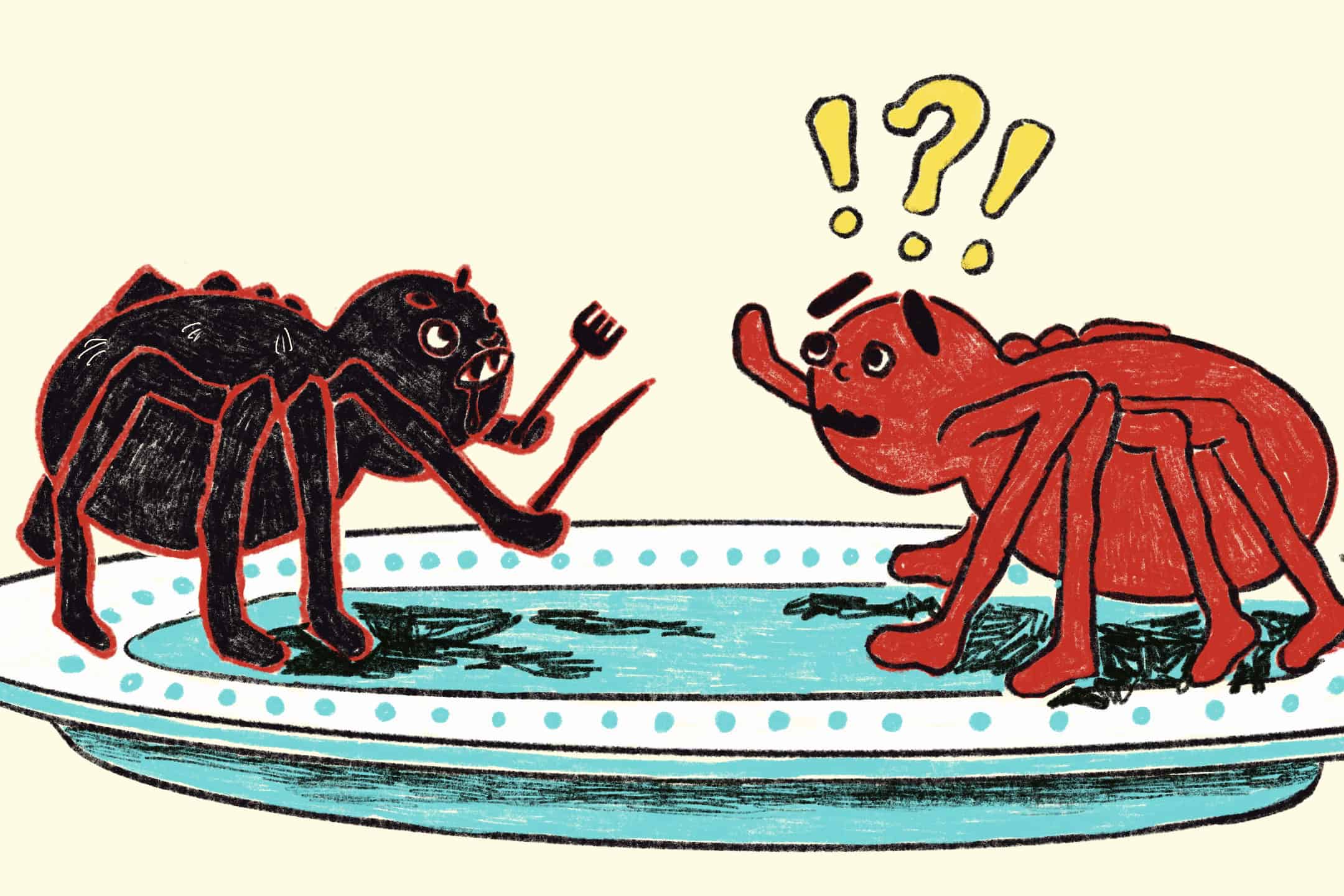
Inside Professor Maydianne Andrade’s lab at the Department of Biological Sciences at UTSC, four undergraduate research students uncovered the mysteries behind one of nature’s most unsettling phenomena: sibling cannibalism.
These BIOC99H3: Biology Team Research students probed the behaviour of redback spiders under the guidance of PhD candidate Isaiah Box. They studied how cannibalism in the spiders’ early life stages may be helping them thrive as an invasive species.
The Varsity sat down with Samia Saif, studying life science biology; Jenny Nguyen, studying human biology and molecular biology, immunology and disease; Sakura Fujii, studying molecular biology and biotechnology; and Lauren Pearo, studying integrative biology, to discuss their research project and the challenges they faced in their four-month lab course.
The spider of focus
The redback spider, otherwise known as the Australian black widow, has been rapidly expanding its range from Australia as an invasive species, appearing in New Zealand, Japan, and Belgium. It is a fairly venomous species that can be somewhat dangerous to humans, with the main symptom of its venom being severe, persistent pain that can last hours to days.
Female redback spiders are known to cannibalize the considerably smaller males during mating. The males actively encourage this, as their unique reproductive biology allows them to transfer sperm while being eaten, which increases the likelihood of fertilizing the female.
While the Andrade Lab has done considerable research on sexual cannibalism, these four students investigated another trait observed in redback spiders: early-life sibling cannibalism, where hatchlings cannibalize each other shortly after birth.
Early-life sibling cannibalism is not as researched as sexual cannibalism. Possible factors for cannibalism include competition for prey and resources, varying individual cannibalistic tendencies, and the environment — which these four students studied.
A day in the spider lab
A typical day began by checking in with Box and discussing their research progress, followed by running experiments on urban and rural samples of redback spider hatchlings to study the significance of the environment as a factor in sibling cannibalism.
The students did not generate a specific hypothesis to avoid confirmation bias — the tendency to interpret results to fit pre-existing expectations — but they had some tentative expectations that urban spiders would fare better at survival than rural ones. Since redback spiders are expanding into urban environments, it is possible that urban spiders possess traits that helped them thrive.
To set up the trials, the students collected egg sacs from adult females. As soon as the spiders hatched, they were given flies and water for a week before they were moved into the varying treatment conditions.
Spiders were placed into cages individually or in groups of five. Spiders that had their own cage were treated as a control group, with their survivorship being compared to the spiders caged together. Each day, they tracked whether cannibalism had occurred and categorized the cause of death as natural, potential cannibalism, or confirmed cannibalism.
Spiders in individual cages were fed two fruit flies for the week, which is typically enough for a single spider. Grouped spiders were deliberately kept underfed with 1–2 fruit flies for the entire cage to see if it would lead to cannibalistic tendencies.
They were watched for an hour after feeding to record any instances of cannibalism. After this first hour, the students would check on their spiders each day for a week, recording any deaths, instances of cannibalism, and moulting — the shedding of the exoskeleton as the spider grows.
After that first week, spiders that were initially grouped together in cages were also moved to individual cages and given a regular feeding schedule. This was done to mimic the natural behaviour of redback spiders, where spiderlings disperse and spread apart from one another as they grow older.
The students then tracked natural deaths and moults for another two weeks to see if any spiders were developing faster than others; however, because of time constraints, they only observed a handful of moults, which did not indicate any significant findings.
According to Saif, the spiders were also separated by urban or rural origin in the original groups. They were also labelled by which adult female gave birth to them to indicate lineage to track any genetic trends.
Morbid observations
“Often, spiders who died of natural causes were found [on] the floor of their cage, while [live] spiders in the cage were actually located in webbing,” Saif elaborated.
Since redback spiders are sit-and-wait predators, meaning that they build a trap and wait for their prey, web building is crucial for their survival. Even in the lab environment, with adequate food, spiders have to be provided with live flies, which requires them to be trapped.
Due to their poor eyesight, a dead fly in front of a redback will be dismissed as something random that might have fallen into the cage and disregarded as a meal. If a spider cannot build a proper web, they cannot catch food or detect that food is present at all, leading them to starve to death. Thus, the dead spiders found at the bottom of the cage most likely died of starvation.
Interestingly, the overall rate of survivorship for grouped spiders was much higher than individual spiders one week post the start of the trial. Survivorship was defined simply as whether at least one spider in a cage was still alive, regardless of the total number of survivors.
Cages with groups of spiders had a survival rate of about 86 per cent of cages compared to 41 per cent of the individual spiders; this was true even though there were twice the amount of solo spider cages as group ones. The students hypothesized that this might have something to do with group living, allowing for spiders to depend on those around them for help with web building, but more research is needed to definitively determine the reason for this.
“There were some cases where the spiders were clearly cannibalizing each other — one spider was literally sitting on top of another and eating it,” Saif continued. “Sometimes one spider would literally die while trying to consume a sibling — our hypothesis here is that the victim bit its sibling as a final defensive measure. These cases were also easy to mark as cannibalism.”
“Some other cases […] were more confusing. Sometimes we would find natural-death spiders in webbing and assume they were cannibalized, and sometimes we would find spiders which looked cannibalized but actually hadn’t been. [These] cases were marked as ‘potentially cannibalized’ to indicate uncertainty, such that we could verify their status under the microscope later,” Saif concluded.
While these students were responsible for collecting the data, analysis of the results themselves was Box’s responsibility. Ultimately, though, the students’ research suggests that cannibalism may not be the defining beneficial trait responsible for the urban spiders’ higher survivorship. The deeper investigation into the urban redback spider’s higher degree of survivorship will be conducted by Box throughout the course of his PhD.
Challenges in research
While the research itself is thrilling, the process is not without hurdles.
“I find balancing [the project] with my other courses that I’m taking in the semester pretty challenging,” said Nguyen.
Resource limitations and equipment funding also come into play, as the lab only has one microscope and one scale for weighing spiders. “[There’s] four of us, so if we had more supplies […] we might be able to move things faster,” said Fujii. Additionally, as Saif later added, the lab is decades old, and there are a lot of cages that are old and liable to crack, which is risky when working with hatchlings, as any crack is a potential escape.
Another big constraint brought up was simply time. “BIOC99 is a one-semester long course, which meant we were only able to handle our spiders for a few months at best. Adult females can only lay so many eggs, and baby spiders can only grow so fast,” wrote Saif.
“There were plenty of other tests we’d have liked to have run,” she wrote, as if there were any marked differences in behaviour between males and females. “But you can’t determine the sex of a spider until they mature past a certain point, so we weren’t able to track this.”
Additionally, spiders have an innate sensitivity to vibrations, which became a challenge in the shared lab: “It’s important to have no vibrations [in the room] because [they] can trigger cannibalism in the spiders when we’re not expecting it. So, ideally, we would have our own space where we can control every variable, but that’s not realistic,” said Pearo, addressing how their lab space is shared with many different people working on various projects.
However, despite juggling academic coursework with part-time lab work and all the challenges that come with it, the students’ passion for their work is very clear.
“We’re working with Isaiah,” who’s just at the beginning of his PhD, and knowing “what we’re doing is eventually going to be a part of something bigger […] it’s just exciting,” said Pearo.

No comments to display.