
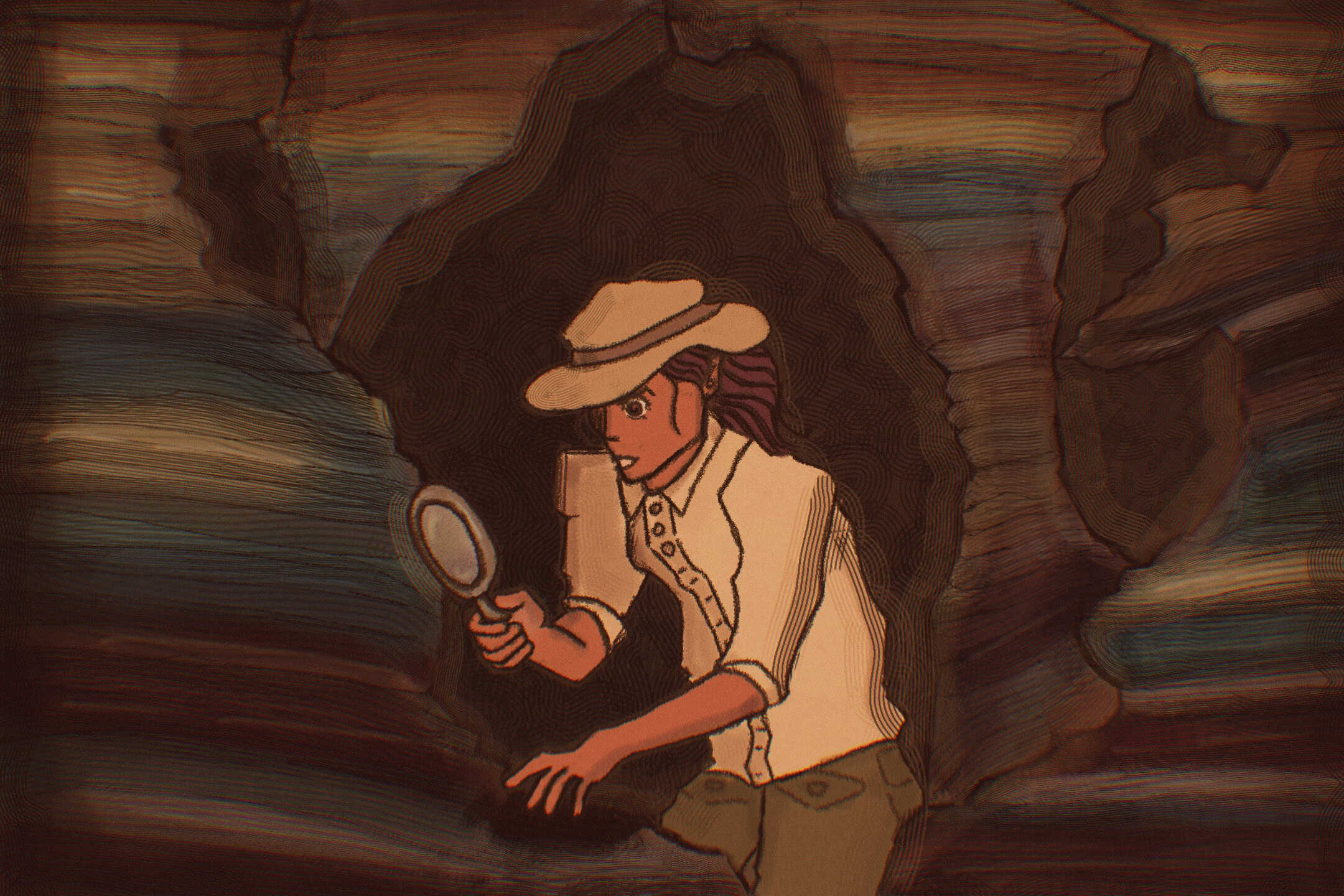
“If you meet a stone wall you don’t pit yourself against it, you go around it and find a weakness.” — Alice Wilson, on the discrimination of women in the field of geology.
When the Geological Survey of Canada (GSC) — a national organization responsible for the dissemination of geoscientific information and research within Canada — was first established in 1842, it was composed entirely of men. Seven decades later, in 1938, Alice Evelyn Wilson joined the GSC and became Canada’s first woman geologist and paleontologist.
The brave steps Wilson took carved the way for future women geologists to come, such as Jenna McKenzie, geophysicist and co-founder of Ronacher McKenzie Geoscience, and Natalie Chu, geologist at Orix Geoscience Inc. However, the gender gap still exists, exposing fundamental education and societal inequalities that shape the experience of many women in the field today.
The first woman geologist
Wilson began her undergraduate career at U of T in 1901, studying languages and history in preparation for pursuing a career as a teacher — one of the few professions considered suitable for women at the time. Throughout her studies, Wilson became ill with anemia, forcing her to take a leave.
Wilson’s interest in geology was sparked long before university, during the many summers outdoors with her family, exploring rocks and invertebrate fossils. After recovering from anemia, she pursued that interest and held various small positions in institutions related to that interest. She completed her degree in 1911 and secured a permanent position at the GSC.
After working for the GSC for four years, Wilson wished to further her education and pursue a PhD in geology. At the time, the GSC regularly granted paid leave to their employees who were men so that they could further their education, but Wilson’s requests were continuously denied.
Eventually, in 1926, the Canadian Federation of University Women (CFUW) intervened and granted Wilson a scholarship to complete her PhD. Even then, the GSC refused to allow Wilson a leave of academic absence while she studied. The CFUW fought for Wilson’s right to education, and in 1929, at the age of 49, Wilson completed her PhD on the geology and paleontology of Cornwall, Ontario, from the University of Chicago.
After graduating, she continued working at the GSC as an assistant geologist. Since the term geologist was deemed a higher-ranking position reserved for men, the fight for equal rights was not over yet for Wilson.
Until 1970, the GSC barred women from all fieldwork. Wilson, however, convinced them to allow her to investigate the Ottawa–St. Lawrence Valley rock layers and invertebrate fossils by foot or by bike, as opposed to by car, which was a resource provided only to her coworkers who were men.
In 1940, Wilson was finally deemed a geologist, only six years before her retirement in 1946, when her work, Geology of the St. Lawrence Lowlands, Ontario and Quebec, was published. This 80-page paper covered rock beds, drinkable water, economic geology, and the tectonic plates that make up the region. This behemoth of a publication was based on Wilson’s own fieldwork from 1925–1941.
Not only was it the most comprehensive publication about the St. Lawrence Lowlands at the time, but it was the first to relate the land’s features and resources with its Paleozoic geology, which comprises some of the earliest forms of primitive life. Wilson not only advanced the knowledge of the geology of the Ottawa–St. Lawrence Valley, but also broke down barriers for women in the field. By challenging the institutional restrictions that marked her career, she became a role model and trailblazer, paving the way for future generations of women in geology.
Women-led geology organizations
The barriers Wilson faced in the geology industry, dominated by men in the 1900s, persist today. Women in geology are still trying to push against the gendered expectations and systemic bias that torments the industry. Among them is Canadian geophysicist Jenna McKenzie.
McKenzie earned her Bachelor of Science in Physics with a Specialist in Geophysics in 2002 from U of T. After working in the field for many years, McKenzie observed that most geological consulting companies in Canada were run by men. Seeing this, McKenzie and her colleague and friend, Elizabeth Ronacher, started their own geological and geophysical consulting company, Ronacher McKenzie Geoscience.
When asked about her experience starting this company, in an interview with The Varsity, McKenzie says it was “novel to people because there’s only a few handful of women-owned companies.” McKenzie further explained that there’s “a bit of an old boy’s club [in the geology industry.]” Many clients ignored Ronacher’s and McKenzie’s pitches not only because they were women, but because clients always had “this guy” they used for decades. This led McKenzie and Ronacher to always be “competing against somebody’s buddy.”
In 2018, Ronacher McKenzie Geoscience won a $100,000 grant from the government of Canada for the Women’s Entrepreneurship Fund, a fund given to women entrepreneurs all across Canada. McKenzie details that this fund was a “big booster” for their company as it was primarily used for increasing their marketing, hiring new employees, and increasing strategic review, all of which helped gain new clients.
In addition to starting her own geological and geophysical consulting company, McKenzie is a co-founder of Women Geoscientists in Canada (WGC) — an organization whose goal is to provide women with the support needed to pursue successful careers in geoscience.
The idea of starting this non-profit organization occurred to McKenzie in 2017, while attending the Geology and Mining Conference Exploration ‘17. Sitting in a crowd of over 200 people, McKenzie noticed that there was not a single woman speaker at the entire conference.
Suddenly, a woman in the audience stood up in front of all the men speakers and stated exactly what McKenzie was feeling: “I don’t feel represented.” McKenzie describes this moment as the catalyst for founding Women Geoscientists in Canada (WGC), which “advocates for increased gender balance” within geoscience fields all over the world.
The hard work continues
Natalie Chu graduated from U of T with a master’s thesis in syenites — a type of igneous rock — and currently works as a geologist. During her studies, she had applied to a summer field mapping program with a professor, but was rejected. When she asked why, the professor’s initial response was “because [she] was a female… and the position is pretty physically demanding and therefore he doesn’t think [she would be] up for it.”
Chu went on to explain that the professor “heard himself say that and so felt a bit bad and then added that the candidate he chose actually has field experience.” At the time, Chu had no prior field experience and so accepted this reason; however, that first comment stayed with her. She thought that “the fact that the female comment was said before the field experience comment was interesting.”
After this early setback, she was accepted to do research at the Royal Ontario Museum in the mineralogy department under Dr. Kimberly Tait, the mineralogy curator of the museum and a professor at U of T. As Chu pursued her master’s, Tait connected Chu to the co-founder of a geological consulting company called Orix Geoscience Incorporated, where Chu has been working ever since graduating from U of T in 2012.
Gender-based barriers in academia
A statement made by the Geological Society of America in 2023, Removing Gender Barriers to Career Progression in the Geosciences, revealed that the “geosciences are the least diverse of any of the STEM fields” and that only one-third of geoscientists are women.
Additionally, a paper published in 2021 by researchers from the Massachusetts Institute of Technology, revealed a downward trend of women staying in the geosciences as tenure-track faculty at universities throughout the United States. The study showed that while overall recruitment of women faculty has increased, there are still only a few women in higher-ranked positions of expertise.
There is a deep-rooted prejudice set within the hierarchical culture that allows sexism and bias within academia to persist. Fewer women geoscience professors means fewer role models to encourage women to pursue the field.
In Canada, there is limited research on the number of women academic faculty members in the geosciences at Canadian universities. There is also a lack of data on the number of women-owned and men-owned geological consulting companies within Canada. The limited studies on the role of women in geosciences academia and industry highlight an ignorance of the gender gap within this field.
Another potential reason for the lack of women professors could be explained by the disproportionate familial responsibilities they often have in comparison to men. According to the Geological Society of America, this is especially true when it comes to workplaces that “[lack] family-friendly policies and flexible career paths for women.”
McKenzie’s WGC wants to remove these injustices and ensure women stay in the geosciences by ensuring that conferences are diversifying their members and speakers, inspecting and reconstructing policies that perpetuate bias, and supporting initiatives such as pre- and post-paternal leave.
As systemic barriers are continuously challenged by women like Wilson and McKenzie, the number of women who will be able to become a part of the geosciences increases. However, just as Wilson was encouraged to complete her schooling because of the CFUW, Ronacher McKenzie Geoscience received the Women Entrepreneurship Fund, and Chu was connected to her first job with help from her supervisor.
Progress requires coordination with institutions and other colleagues. Members of the geosciences must acknowledge the obstacles in the way of progress and listen to the stories of women who have come face-to-face with and overcome these barriers. Only then will equal opportunities at all stages of geoscience careers be achieved.

No comments to display.