
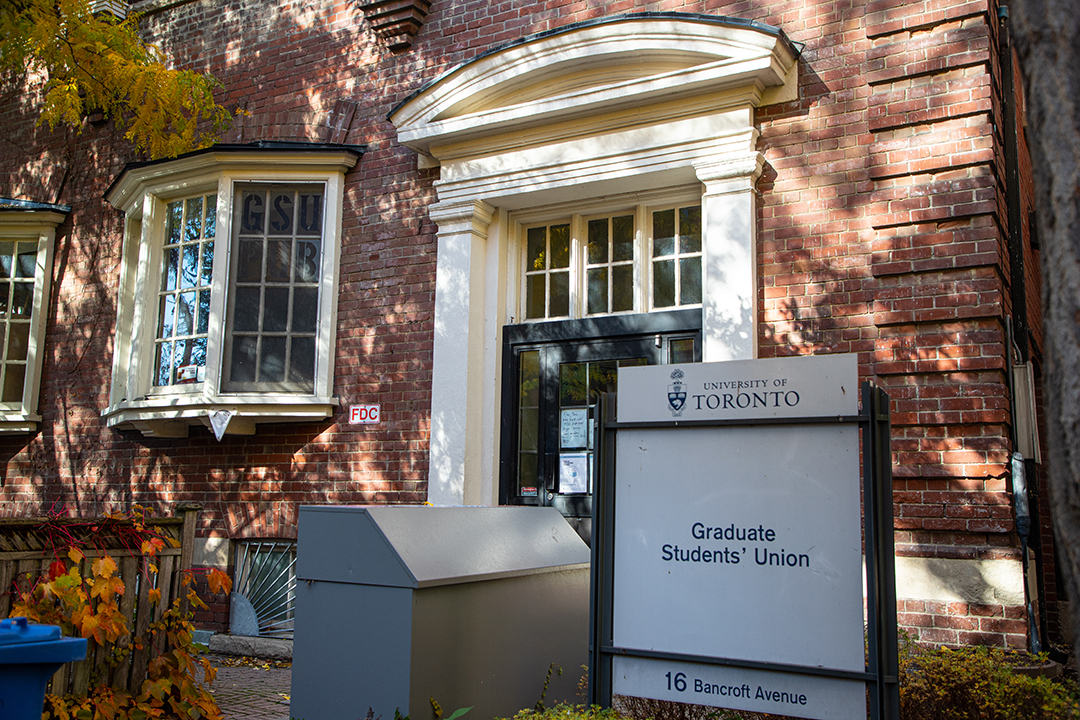
On October 9, the University of Toronto Graduate Students’ Union (UTGSU) announced the results of the byelection for Division 1: Humanities Director spots. All five candidates who ran were elected to the five spots available: Jasmin Smith, Keturah Gray, Sadaf Sohrab, Thomas Vukovic, and Yvette-Yuefan Wu.
This byelection is the first in recent UTGSU history that has resulted in a full set of directors for Division 1. While STEM divisions, like Division Three (Physical Sciences) and Division Four (Life Sciences), often have all or most available positions filled, Division 1 has consistently struggled with student participation.
In the March 2025 general elections, no candidates came forward for Division 1 slots. After the 2025–2026 elections, the UTGSU prioritized outreach in an attempt to add interim directors to the board, only for interim director Aditi Kolloru to resign on July 14, leaving the division vacant once again.
Build-a-Board
This sudden change is no coincidence. In an interview with The Varsity, UTGSU President Amir Moghadam wrote, “Building on our ongoing policy reforms and outreach initiatives, we identified several specific hypotheses for the historically lower representation of Division One: limited UTGSU engagement within these departments, smaller membership numbers from this division and relatively small departments, and accessibility barriers such as the 15-signature requirement for nominations.”
In response, the union implemented “targeted strategies,” such as reducing the number of signatures from 15 to five to be nominated, and increased outreach to the relevant departments in the form of postering, tabling, and email campaigns. Moghadam credits these efforts for the drastic increase in Division 1 engagement in October’s byelection.
Looking ahead at a full slate of directors, Moghadam expressed optimism for the term ahead. “Having a complete Board brings diverse perspectives that will strengthen our governance and better represent our entire membership.”
In an email with The Varsity, newly elected Division 1 Director Jasmin Smith drew on her experience as a U of T undergrad and as a volunteer with Amnesty International to emphasize her commitment to advocating for and voicing the concerns and needs of Division 1 in UTGSU. As a Division 1 director, Smith will focus on running events and hopes to foster a stronger sense of community among humanities students.
“In academic spaces, it can be so easy for students in the humanities to be overlooked, particularly given the prioritization of STEM and the misconceptions that humanities are not as valuable as other disciplines,” Smith wrote to The Varsity. “The humanities have been, and will always be, incredibly valuable in both academic and non-academic spaces, and the voices of humanities students should be represented in student unions to ensure that choices made for the broader graduate student population reflect their needs as well.”
For Smith, a humanities education lends itself to leadership naturally. “So much of the curriculum in humanities programs focuses on representation, culture, and the ability to be critical, and I believe those voices should be represented in leadership on the UTGSU.”
Stronger together
For a term and a half, only one Director, Kanika Lawton, represented the entire Division 1 constituency. A fifth-year PhD Candidate in Cinema Studies and Sexual Diversity Studies, Lawton first started thinking about running for a seat on the BOD after they began getting involved in their course union. They were elected to a Director position in an emergency by-election in Winter 2024, and won re-election as a Director for a full term for the 2024–2025 year.
Reflecting on their experience on the Board of Directors (BOD), Lawton spoke to The Varsity about a few of the specific challenges that humanities students face when getting involved with UTGSU. Lawton pinpointed the individualism in humanities spaces and the increased isolation graduate students feel as they complete their degrees — experiences that are less common in STEM fields, which are inherently more collaborative.
Lawton explained that the culture of isolation among humanities graduate students “doesn’t bode well when it comes to… collective action, or when it comes to advocating for higher funding packages, or their health care, or things that actually affect us materially in the classroom.”
To the newly elected set of directors, Lawton offered words of advice for advocating for the humanities. In the face of the challenges of student governance, funding schemes, and the “wave of fascism in the United States… brushing up against our shores,” they urged Directors to not take things personally and to remember that unions work because of their membership.
“We need each other, even if we tell ourselves we don’t. But when it really comes down to it, we do,” Lawton said, “Our ability to actually enact change as an individual, it comes from working together towards a common goal that will help all of us.”
