
According to a Governing Council (GC) presentation on December 11, 2025, the reduced international student permit targets are “unlikely to affect U of T.”
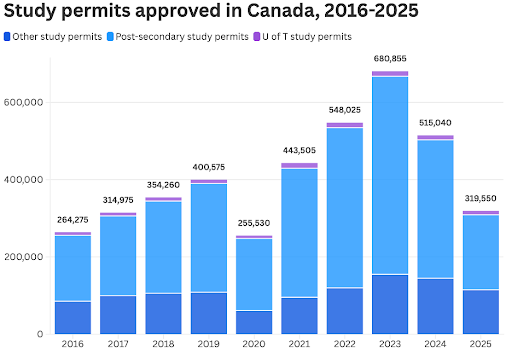
This is in response to the 2026–2028 Immigration Levels Plan, which decreases the federal government’s target for new international students by about half, from 305,900 to 155,000 permits. Immigration, Refugees and Citizenship Canada (IRCC) plans on issuing 408,000 total study permits in 2026, which includes the new study permits as well as 253,000 permit extensions for current and returning students.
The cap on international students was first imposed in January 2024, and since then, the number of active study permit holders has dropped from over 1,000,000 to about 725,000 by September 2025.
Joseph Wong, U of T’s vice-president, international, told U of T News in an interview that the university is “moving ahead with the same intake plan we had before the federal budget announcement, and our teams continue to provide robust support to students preparing their study permit applications.”
According to the GC presentation, the approval rate for U of T international student study permits from 2022–2024 was 88 per cent, which was significantly higher than the national average of 54 per cent. According to Wong, this is the highest approval rate of international study permits across institutions in Canada.
PALs at U of T
For 2026, Ontario is allocated 104,780 Provincial Attestation Letters (PALs) — documents confirming a student position is allocated for in the province’s study permit limits, which are now required for most international students applying for study permits, but they do not guarantee approval. Ontario’s study permit maximum is 70,074 — only 67 per cent of the maximum PALs — to account for rejected applications.
U of T consistently uses all of its provincially allocated PALs and has received additional letters beyond its base allocation in previous years. In 2024, U of T was initially allocated 10,713 and received a total of 12,338 PALs, according to the Toronto Star.
Comparatively, public universities across Ontario used 82 per cent of 35,460 allocated PALs, and public colleges used 55 per cent of 189,416 allocated PALs in 2024. Schools can opt to return unused PALs to be redistributed, which includes a total of 10,500 PALs in 2024.
Effective this year, IRCC announced that master’s and doctoral degree students do not need to submit PALs. However, international graduate students are still capped under the study permit limit.

No comments to display.