
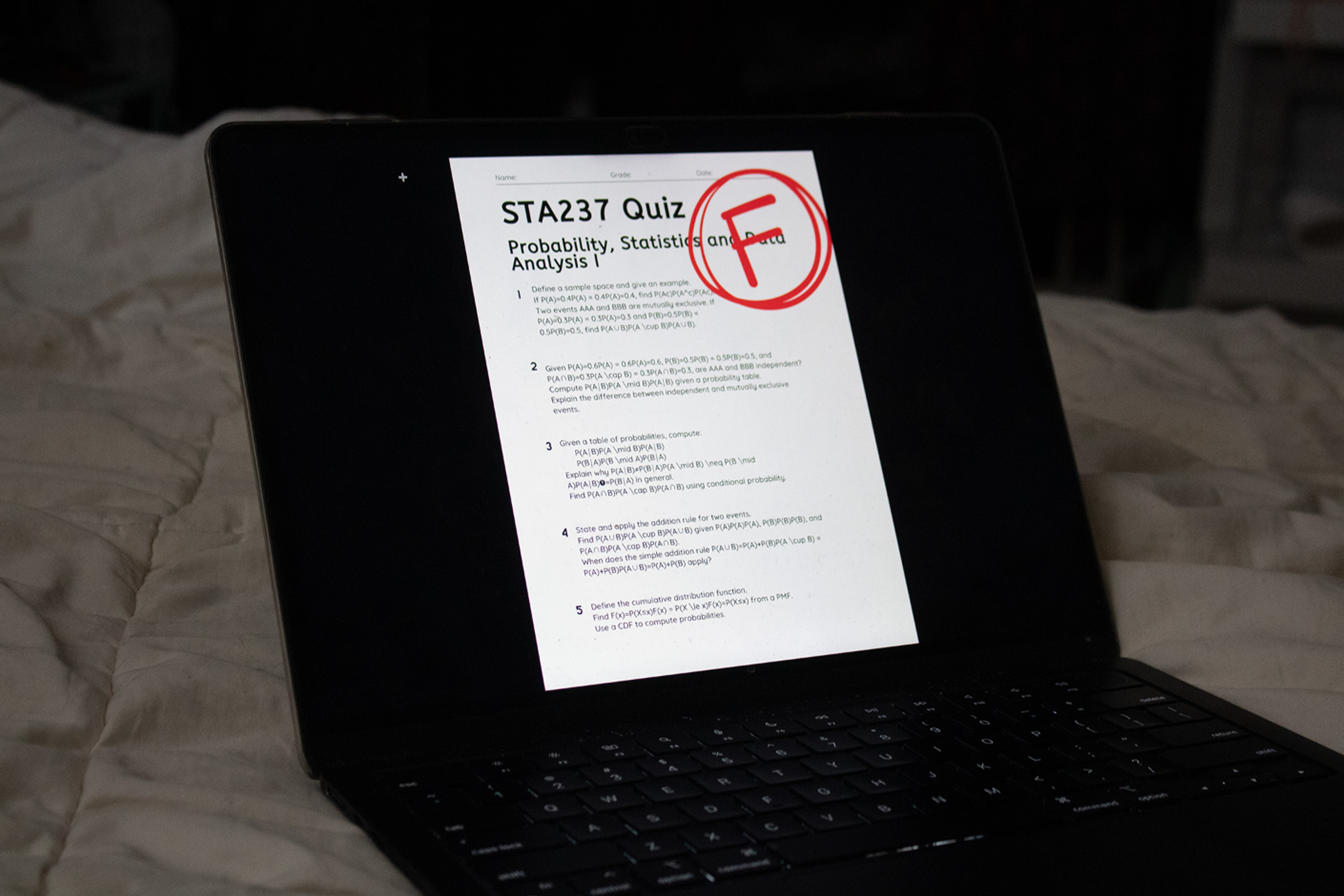
After final grades were released on January 5, many students in STA237: Probability, Statistics and Data Analysis I woke up to an F on their transcript. For the first time, STA237 had a minimum passing requirement policy, under which students who scored below 50 per cent on the final exam failed the course outright.
STA237, coordinated last semester by Professor Karen Huynh Wong, is an accepted statistics course requirement for multiple programs, including statistics, computer science, economics, and Rotman Commerce. The course has also become infamous for its difficulty online, particularly on the subreddit r/UofT.
This year, the final exam had an average of 61.4 per cent and a standard deviation of 23.3 per cent. This means that while the average student passed, many students scored both significantly higher and significantly lower than 61.4 per cent.
Students have posted on the r/UofT subreddit claiming that, based on these statistics, roughly one-third of students failed. However, these calculations assume a normal, symmetrical distribution of grades, which would imply scores beyond the maximum grade possible. With the information available, the actual number of students who failed cannot be reliably determined.
U of T Media Relations wrote in an email to The Varsity that the assertion that a third of the class failed “has no basis in fact,” but declined to verify how many students failed the course.
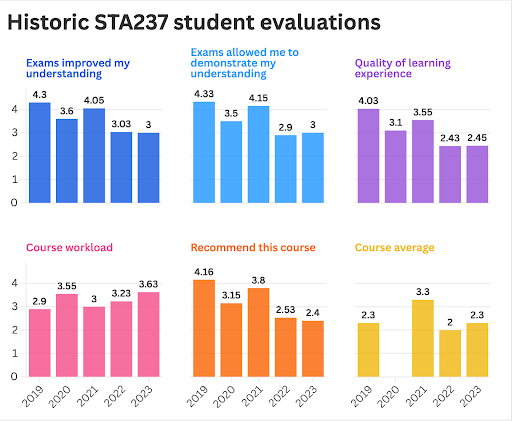
STA237 in fall 2025
This year, a minimum passing requirement policy was added to the STA237 syllabus for the first time: “Students must pass the final exam (≥ 50%) to be eligible to pass this course. There are no make-up tutorials or quizzes.” The policy also states that students affected by extenuating circumstances should contact the instructor and their college registrar.
One STA237 student wrote to The Varsity: “I thought [auto-fail policies] were meant for project oriented courses where it’s possible to do well without a good understanding of the content, but most of our marks came from things like tutorial quizzes and the midterm, which were all closed book and supervised.”
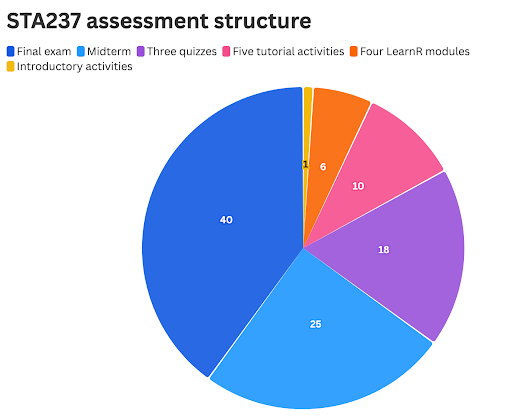
The final exam was worth 40 per cent, with the midterm exam worth 25 per cent; three quizzes contributed a total of 18 per cent, tutorial activities for 10 per cent, and homework modules and other miscellaneous assessments seven per cent. There were also two surveys providing a total of one per cent in bonus marks.
Andy Chen, a second-year mathematics student, wrote to The Varsity that STA237 was one of the most demanding courses they had taken so far. “The content wasn’t super challenging… but the practice questions and tutorial questions did not reflect the difficulty of the midterm and final.”
Chen continued, “I was told that [the midterm exam average of 58 per cent] was an expected average. This concerned me during that time, as we were required to have at least a 50% on the final to pass the course, many students had significant risk of failing due to the average being so close to the cut off.”
The course announcement for the midterm exam grades read, “While the test average may appear a bit low, it is very much in line with past midterm grades for a first course in probability. The midterm questions were fair and reflective of the course learning outcomes.”
The announcement pointed to students focusing too heavily on practicing or memorizing calculations without understanding the underlying statistical concepts: “You need to be able to read and understand questions carefully, identify what the question is asking, and select the appropriate concepts to apply to the problem before you can use any formulas or perform any calculations.”
In 2024, the STA237 midterm exam average was 56.5 per cent, described to students as “consistent with typical midterm performance in foundational STA courses such as STA237H1.” In 2022, the average midterm grade was 48 per cent.
Another STA237 student wrote to The Varsity that their professor “really tried to answer questions, but most of the kids weren’t even able to understand the content in the first place to be able to ask good enough questions,” and that the students were not “given enough practice problems relevant to the types of questions they asked on that final.”
In response to students’ performance in STA237, a Faculty of Arts & Science spokesperson wrote to The Varsity, “Many courses serve as preparation for program completion, and expectations for student success are provided both through the syllabus and as classes begin.” They also listed resources that students can consult, including their college registrar, learning strategists, instructors, and TAs.
U of T grading policies
The Arts & Science Academic Handbook for Instructors states, “Although it is unusual, it is permissible for instructors to require a minimum mark on a final exam for a student to pass their course… This requirement should only be used when there are relevant pedagogical principles at play.” Listed examples include cases where the final exam is cumulative while previous assessments were not, or where the exam carries a heavy weight in the course.
The handbook also advises, “instructors proposing a percentage of Fs greater than 10% should consider those grades carefully. An individual instructor should reflect on whether the assessments have been scaled appropriately.”
While it is against U of T policy to limit grade distribution by quotas, divisions can provide a “reasonable distribution” of grades and request explanations from instructors when courses do not meet the standard. Since STA237 final grades have been released on Acorn, they have been approved by the chair of the Department of Statistical Sciences and the Dean.
Statistics department and historic minimum passing requirements
There was no minimum passing requirement for STA237 from fall 2019, according to past syllabi published by the Department of Statistical Sciences. This semester, STA238: Probability, Statistics, and Data Analysis II is also taught by Wong and does not have a minimum passing requirement.
Last semester, STA302: Methods of Data Analysis I also had a minimum passing policy for the first time. The minimum grade required was an average of 40 per cent between the term test and final exam to pass the course.
Karen Huynh Wong declined The Varsity’s interview request.
