
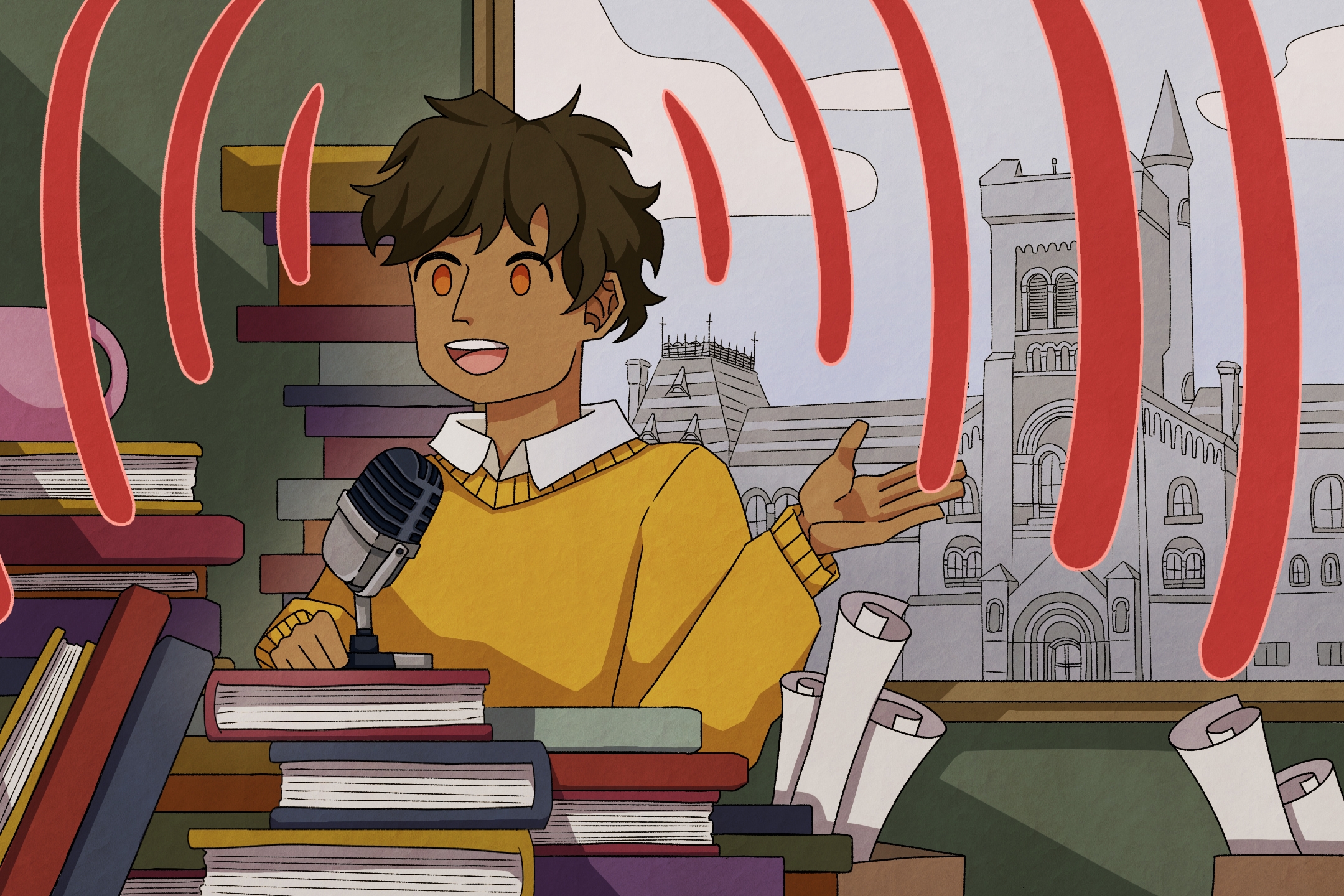
I first stumbled upon CIUT by accident, tuning in one afternoon after my then-favourite station started repeating the same Top 40 hits over and over (if I had to hear “Pink Pony Club” one more time, I might have lost it). Through the static came a voice promising to be “the sound of your city,” followed by a Peruvian folk song and then an energetic EDM track.
I was hooked. I hadn’t just found another station — I’d found CIUT 89.5 FM, the U of T’s campus and community radio.
The station isn’t defined by a single genre, but by a mission: to be a non-commercial mosaic of Toronto itself, built by volunteers, alumni, and students. CIUT celebrates Toronto not as a brand or a playlist, but as a city constantly rediscovering itself.
CIUT is a living, breathing reflection of the city itself. In an era dominated by algorithmic playlists and homogenized media, it offers something increasingly rare: a window into the city’s diversity, a refuge for human curation, and a dynamic archive of Toronto’s cultural memory. Its programming gives sustained airtime to voices, genres, and communities that mainstream radio often tokenizes — or silences entirely.
CIUT explores and captures Toronto’s diversity not as a slogan, but as a practice.
Global Rhythms, a weekly CIUT program that invites listeners to “travel the world through music without leaving your living room,” mirrors Toronto’s essence as a city continually shaped by arrival, exchange, and overlapping identities.
Like the city itself, the radio station is organized around a constellation of communities — Little Portugal alongside Little Jamaica, the cacophony of Kensington Market beside the quiet of the Annex. Global Rhythms might pair a Haitian rara track such as “Rara (Ti Celia)” with a Toronto-based Afrobeat producer (check out “Move it Slow” by Moncliche), or juxtapose a Lebanese folk song with South Asian classical rhythms.
Human programming over algorithms
To be clear, I enjoy Top 40. Familiarity has its pleasures, and “Espresso” is undeniably a bop. But even Spotify’s flagship Top 40 playlists, which may have human editors, are ultimately steered by algorithms optimized for sameness, not surprise; for retention, not interpretation. Streaming playlists can reinforce the popularity of a hit song, but they cannot curate the unexpected, the delight that comes from a guiding human ear.
However, CIUT’s commitment to thoughtful programming extends beyond representation — it thrives on human curation. Dave O Rama’s The Lovecast, an almost 20-year masterclass in personality-driven radio, embarks on a broad-spectrum exploration of “positive music,” a deceptively simple premise that allows for breathtaking genre blends. A Motown classic might be followed by an upbeat indie pop track you’ve never heard but instantly love.
Listeners return to The Lovecast each Saturday not for a predictable algorithm, but to hear something they know will be new and interesting, guided by Rama’s taste, ethos, and desire to delight. By curating each track with attention to mood, story, and surprise, he reminds listeners that music is more than data — it’s a human experience.
In my view, this kind of trust‑based listening relationship is increasingly endangered. Streaming hasn’t entirely killed the radio star, but it has largely replaced the human DJ with data‑driven curation. Spotify’s monolithic playlists, like “Today’s Top Hits,” exist in a constant state of churn, reshaped by engagement metrics rather than any sustained curatorial vision.
On CIUT, human creativity reaches its peak in shows like Phil’s Inn. Constructing a two-hour set around a certain theme, host Brad Reed might weave a haunting Appalachian ballad into roaring 1940s big band and twangy surf rock. Half the fun is trying to crack the theme yourself, following Reed’s logic from track to track and enjoying the small triumph when it finally clicks — an experience no “You Might Also Like” algorithm can offer.
CIUT as a growing archive
Beyond its music programming, CIUT serves as a living archive for Toronto’s political and cultural memory — a role that feels increasingly vital as mainstream media often prioritizes quick, surface‑level reporting over deeper context.
One clear example is the station’s daily broadcast of Democracy Now!, an independent, hour‑long global news program hosted by journalists Amy Goodman and Juan González. Democracy Now features breaking news, investigative reporting, and in‑depth interviews with people on the front lines of pressing international issues.
CIUT is also an active audio archive. Alternative Radio incorporates pre-recorded speeches, academic talks, and public forum discussions — preserving moments of discourse that might otherwise vanish. When a figure like Bernie Sanders speaks at a university, the broadcast captures, contextualizes, and saves the conversation, transforming an ephemeral event into a permanent public record.
I believe this work meets a real audience need. A 2023 Reuters Institute study found that 39 per cent of respondents across 46 markets prefer explanatory, analytical reports over superficial news bites.
CIUT brings that demographic to life. By broadcasting and preserving interviews and cultural conversations as they happen, the station captures the city’s intellectual heartbeat in real time, offering depth and context that much of today’s fast-moving media often overlooks.
CIUT and the U of T community
However, an archive is only as alive as its community. CIUT serves as a rare and vital bridge between U of T and its sprawling alumni. Shows like Radio Recall invite alumni back to the mic to share music intertwined with their campus memories, creating a living dialogue between generations of students.
Here, CIUT demonstrates how campus radio can transcend its “student media” label to become a vessel for an institution’s ongoing narrative, a place where the past is not sealed in a yearbook but remains a conversant voice in the present.
To encounter CIUT is to rediscover what radio can be. In a city increasingly shaped by corporate development and commercial homogenization, CIUT is a bulwark against the isolating, algorithmic sorting of our digital lives.
If you’ve never listened, make today the day. Tune in to 89.5 FM. Listen online while you work. Walk into its home at Hart House, where the hum of broadcasting equipment is a reminder of media created by hands and minds.
And if you find yourself, as I did, hearing your city anew — richer, stranger, and more connected than you knew — then act. Become a member. Donate. Volunteer. Tell a friend. CIUT survives because people care enough to show up, not just to listen, but to participate in its survival.
The sound of your city is already on the air, weaving together stories, songs, and struggles. It is a testament to who we are. All you have to do is listen — to help keep it from fading back into static.
Sophie Richards is a first-year student at the University of Toronto with a passion for cultural storytelling and exploring the richness of Toronto’s arts and community life. She enjoys uncovering the stories, voices, and spaces that make the city unique, and sharing them with a wider audience.
