
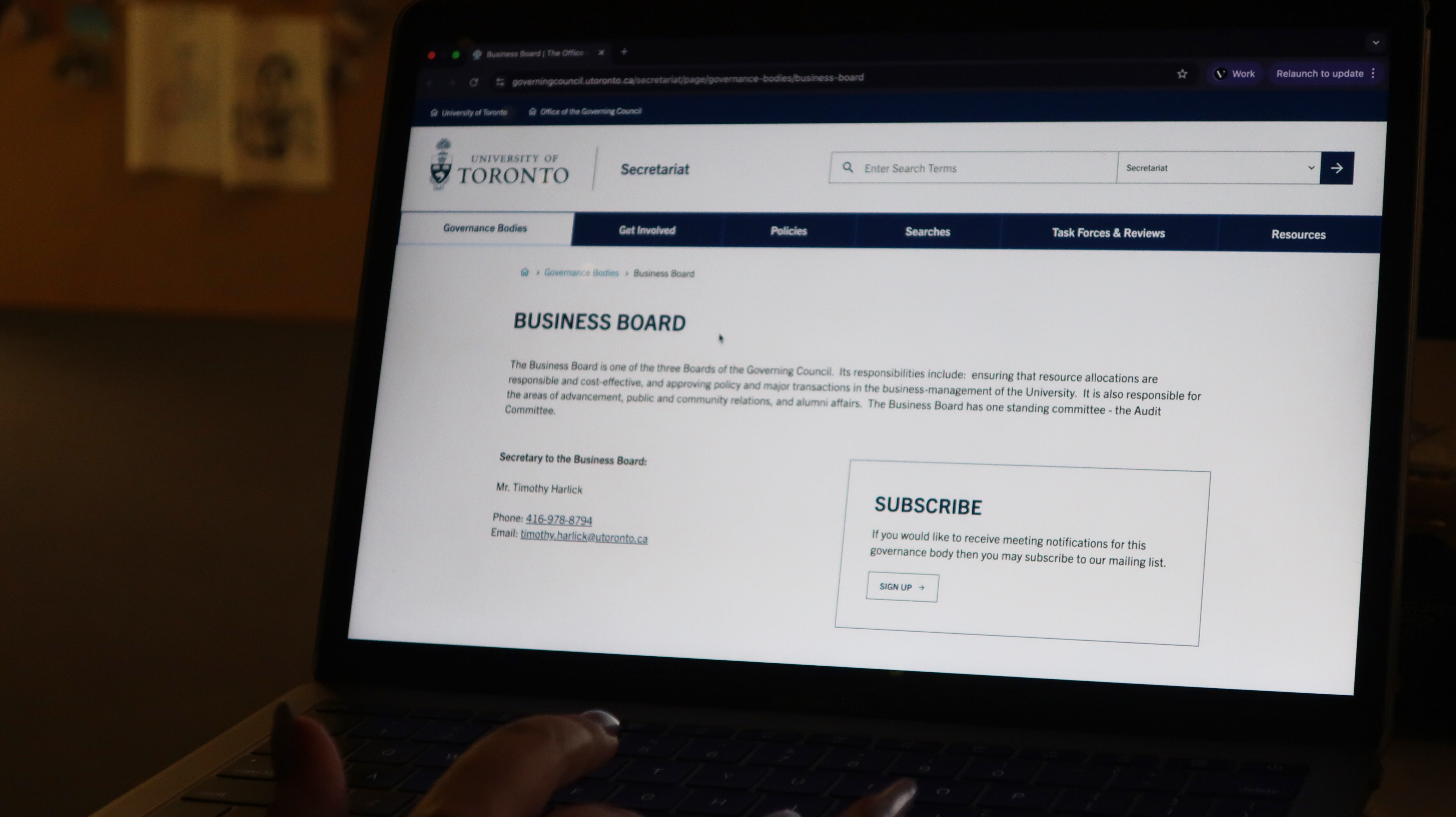
U of T’s Business Board is a group that meets multiple times a year to present, discuss, and vote on issues related to university resource allocation, physical capital management, financial investments, workplace policies, and more. The committee is composed of members from a range of representative backgrounds, including government-appointed members and undergraduate students.
The first meeting of 2026 took place in late January, during which several U of T employees presented on behalf of their respective areas of expertise and departments.
Deferred maintenance
Starting the evening, the Chief Operating Officer of U of T’s Property Services and Management, Ron Saporta, presented on deferred maintenance. Despite its name, deferred maintenance does not refer to operation-related tasks, but rather the postponed upkeep of capital assets — such as buildings or elevators — due to budget constraints. It is a resource-intensive area, driven by the university’s aging infrastructure, rising costs of materials, equipment, and labour, as well as climate-related impacts such as extreme weather.
A significant portion of the presentation focused on how projects within the maintenance backlog are assessed and prioritized. When an infrastructure issue arises, it is audited and evaluated using weighted categories — physical condition, impact on users, system-wide impacts of failure, and building use, in that order. Based on its score, the issue is placed on a prioritized waiting list for repair.
U of T’s deferred maintenance backlog was $1.5 billion in 2025, marking an increase of $46.4 million from 2024. This might be due to limited provincial funding — last year, U of T received nine million dollars from the provincial government for facility renewal, while most of the approximate $130 million that McGill spends on construction and renovation annually comes from Québec government funding.
The department’s key objective is to slow the growth of the maintenance backlog through strategic investments, including the $300 million Revitalizing Infrastructure, Strengthening Education program launched in 2025. This program aims to reduce the safety risks associated with campus operations, with a particular focus on areas such as fire prevention.
Additional independent capital investments — such as major renewal projects and new construction — are also expected to help curb the growth of the university’s maintenance backlog. For example, the James and Louise Temerty building will address $20 million in replacement costs from the existing backlog.
Current debt status report
As of the 2025–2026 school year, U of T’s debt policy limit for both internal and external borrowing is $3.1 billion. At the time, the university had approximately $1.1 billion remaining for additional allocations, including external direct, indirect, and internal borrowing.
External borrowing refers to loans from organizations outside of the university, such as banks. Indirect borrowing refers to debt not explicitly taken on by U of T but for which the university may ultimately be responsible — for example, loans issued to affiliated partners. Internal borrowing occurs when units within U of T draw from university funds, such as when a department uses internal financing to support a new project.
By the end of 2025, U of T projected that its debt burden ratio — a measure of financial health calculated by dividing interest plus principal by total expenditures — would rise to around 3.6 per cent if all approved debt were issued. While this represents an increase, the ratio remains relatively low, indicating a manageable level of risk and continued borrowing capacity.
Quarterly donations over $250,000
The university received nearly $100 million from high-value pledges, donations, and gifts exceeding $250,000.
Almost 80 per cent of this total came from Henry N.R. Jackman, the billionaire philanthropist after whom the Jackman Faculty of Law is named. A U of T law graduate from 1956, Jackman has been one of the university’s most consistent and generous donors for decades. His $80 million contribution will support the construction of a new Jackman Law Building, the expansion of scholarship funding, and other initiatives.
The Faculty of Arts & Science and Rotman Commerce received the second-highest amount of donations. Worth a total of $3 million, RBC contributed money to continue its support for Rotman’s Sustainable Finance Program and Competition and the John Hull Financial Innovation Fund.
Ultimately, the U of T Business Board’s January 2026 meeting reflected the complex financial decisions involved in running one of Canada’s largest universities. With discussions spanning maintenance, debt, and donations, U of T entered the new year with a financial agenda that must balance past obligations, present needs, and future priorities.

No comments to display.