
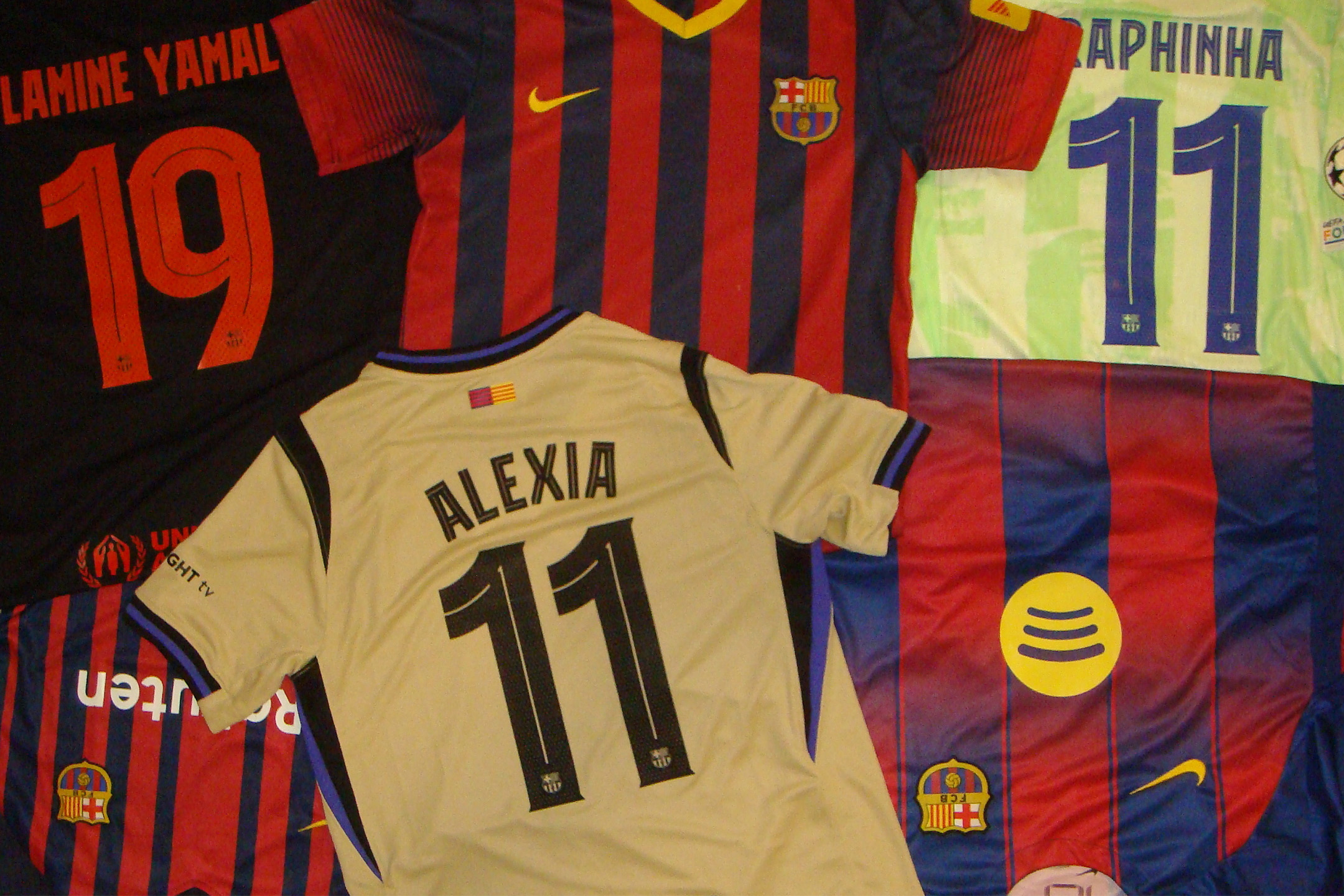
I don’t remember choosing you. I didn’t weigh options or look at stats, deciding which team to love most. I don’t even know how long it’s been since I first donned your colours.
A cheap, often faulty, blue and garnet jersey, bought off the racks of a small shop somewhere overseas, and flown to Canada in a family member’s suitcase. Something for me to wear proudly, once my brother had grown out of it, of course.
If romcoms are to be believed, true love is undeniable. It fills you with emotion, and it cannot be manufactured. It just… shows up. That’s what Barça is to me.
Where do diehard sports fans get their passion? Why put your energy and passion into caring about a result that doesn’t really impact your life?
I spent a fair amount of time asking these questions as a teenager, not even realizing I did the same when World Cup knockouts brought me to tears in high school. The emotion and investment in what most see as just a game. Wasn’t this the same passion that compelled nine-year-old me to argue with the boys in class on the side of FC Barcelona (FCB)? Looking back, the only explanation for this connection that truly made sense was the convention as old as the game itself, birthright.
Sometime in the late ’80s, my father had learned why they call football the beautiful game. He was drawn to the Brazilian style of play. Joga Bonito, Portuguese for “play beautifully,” Brazilian football was expressive, skillful and creative. A mindset that emphasizes individual flair, countless legends of football have emerged from the Brazilian game, often landing in Barcelona during their club careers.
At the same time, the Spanish game had its own way of captivating young fans like my dad; Tiki-Taka, a game of short passes, constant movement, possession and precision. A style that became synonymous with FC Barcelona’s identity as a club.
Arguably, two completely opposite styles of the game, Brazilian and Spanish football, come to a crossroads at Barça. The club became home to the likes of Ronaldo Nazário and Ronaldinho Gaúcho, stars my dad had followed eagerly. South American finesse became at home, blending seamlessly with Spanish strategy. To my father, Barcelona was home to the true sport of football, and this was a belief he might as well have passed to his kids in their genes.
Barça has been my team for as long as I can remember. Loving the team felt natural, like it really was in my blood. FCB was my introduction to football, and it became a part of my identity, my personality. From second grade to undergrad, there perhaps isn’t a single person who knows me who wouldn’t associate me with the sport. Without Barcelona, I don’t know who I would have been.
In 2014, I spent every recess at school playing soccer. Rain, snow, or sun, I was outside repping my team, practically arguing on Messi’s behalf, when other kids walked on with Ronaldo kits and a whole lot of audacity.
In reality, it’s a difficult concept to grasp, but if not for a childhood with Lionel Messi, Luis Suárez, and Neymar Jr. (MSN), Barcelona’s golden trio, I would’ve led a different life.
In April of 2017, I sat at my desk in class, hiding a sports streaming tab on the school Chromebook. Watching intently as the most iconic football rivalry, the greatest El Clásico of all time began to unfold. In the game that gave me bragging rights for the rest of the year, prime Barcelona took on the equally prime Real Madrid. A game nothing short of suspense, left tied in added time, and closed in Lionel Messi’s iconic fashion, scoring his 500th goal at Barcelona, he won it all for the club at our rival’s own home stadium.
All that time and energy, the better part of my adolescence, I had spent watching, arguing, playing soccer, falling short, or pushing myself, shaped me. The people I’ve met, goals I’ve set, and memories that fill my head when sleep doesn’t come — I have this club to thank for all of it.
January 14, 2026, nearly 10 years after the El Clásico that pulled Barcelona back up to the top of their league, I find myself in the same position. At the back of my tutorial in UTSC’s Arts & Administration building, watching the game with DAZN open on my laptop.
Only this time, I watch intently as Barcelona’s Femení team, a team that has set a precedent for the future of women’s football, takes on Atlético Madrid in their own division. I’m no longer 11, cheering on Messi’s opening goal. Instead, I’m 19 watching Alexia Putellas bury that opener in the back of the net. The setting may have changed, but the feeling definitely hasn’t.
FCB’s story, like my own, has always been one of resilience. A club that has suffered, grown, and conquered, staying true to the beauty of the game. Barça perseveres.
Més Que un Club.

No comments to display.