
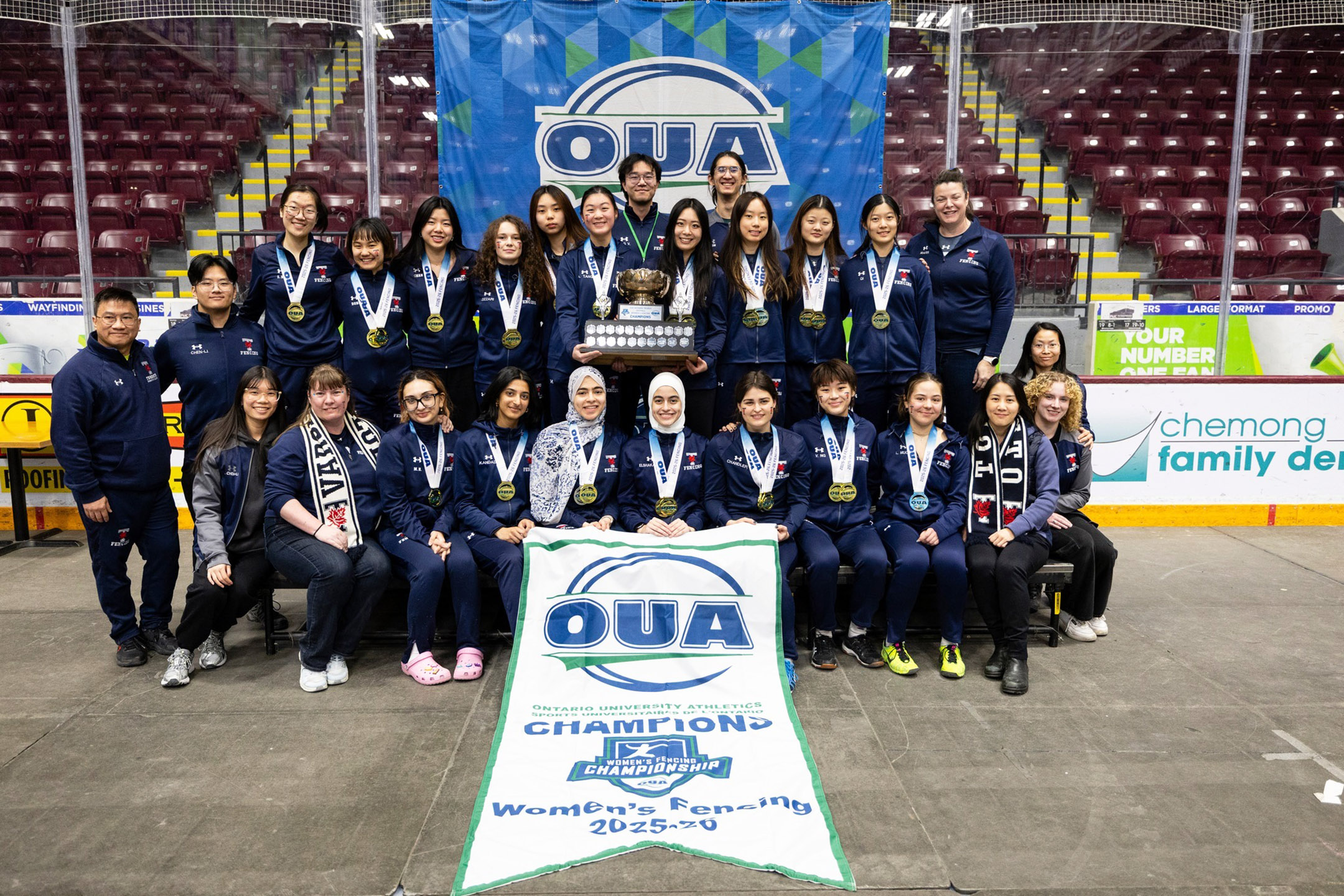
From last-touch victories, to 45-point leads, to 0–6 comebacks, the U of T’s fencing team proves that its dominance and success are built on more than consecutive Ontario University Athletics (OUA) championship banners. With collective “abilities to adapt,” strong coaching, intrinsic motivation, and unwavering support, the Varsity Blues fencing team has cultivated a tight-knit, ambitious team culture.
Back-to-back season highlights
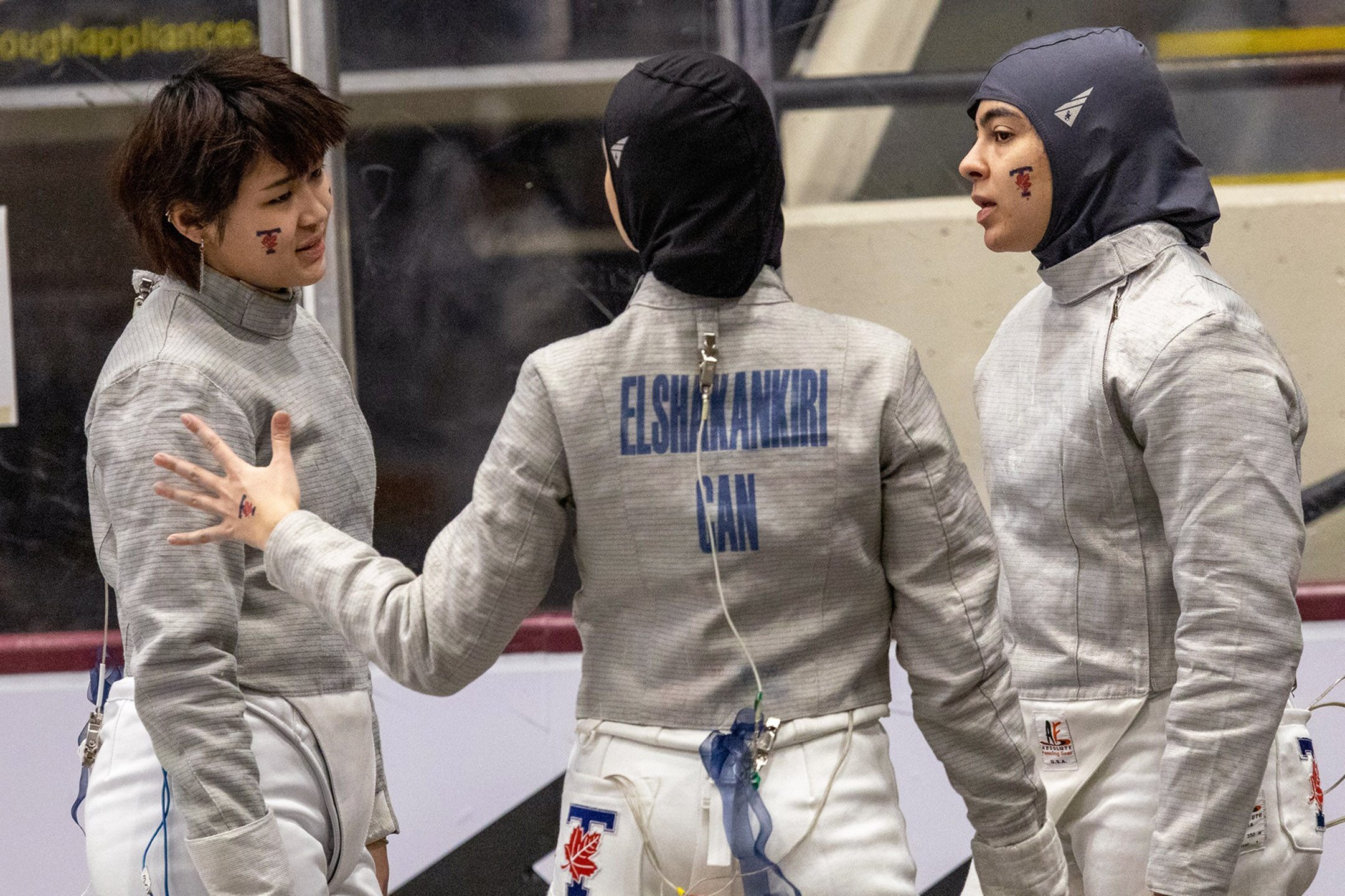
Janna Elshakankiri, the team captain, has been on the team for the past four years and is currently in her first year of her Master of Health Science (MHSc) in U of T’s Medical Physiology program. When interviewed by The Varsity, Elshakankiri mentioned that her most memorable moment was during the OUA sabre team final when she won the final touch. As soon as the final ended, Elshakankiri said, “All of my teammates ran onto the piste, and we hugged each other.” This powerful moment commemorated all of their “shared effort, emotion, and celebration that [she’ll] always remember.”
At the OUA, Elshakankiri experienced a setback while competing in the individual sabre competition quarterfinal when she found herself down 0–6. But with her strength, trust, and resilience, she was able to turn it around into something even better. With the stakes and pressure building for Elshakankiri, she looked back to her side of the piste to see her “coach and teammates still cheering [her] on.”
That vital moment reminded her that she had a “huge support system behind [her], even when I wasn’t winning,” and this had allowed her to “clear [her] mind, trust [her]self, and fence the way [she] always [did].” Elshakankiri fought hard, allowing her to not only win that bout but also go on to win the semifinal.
Catherine Wu is a fourth-year student athlete who is majoring in psychology and political science. Wu wrote that “it definitely means a lot to [herself] and the team to have won the [OUA] banner for the second time,” in an email to The Varsity.
The team faced steep competition from Waterloo and Western women’s foil teams. However, on the second day, the U of T was able to pull ahead of Western by 45 points and defeat Western in the foil finals. Wu further expressed just how hard the Varsity fencing team has been working on their strategic and technical skills this season, noting how “nice [it was] to have this hard work validated by our dominant performance during OUA weekend.” U of T went on to win medals in each individual event as well as gold in all three team events on the second day of competition.
Community: Both on and off the piste
The Varsity Blues fencing team recruits talented fencers from both national and international backgrounds. When asked what contributed to their success, Wu wrote that their global recruitment process and “abilities to adapt mid-match and catch up from behind are some of the best in the provincial circuit.”
Elshakankiri also shared that she was incredibly proud of the growth she has seen from the whole team this year, “not only as fencers but as people and teammates,” and that the team has “built a culture of support where everyone shows up for each other.”
What makes fencing special
Lilla Mucsi, a fourth-year double majoring in ethics, society, and law, and critical equity and solidarity studies, shared their holistic approach to their journey in an interview with The Varsity.
Mucsi reflected that “part of what makes a competition so fun is reframing how I view victory.” Despite being incredibly proud of themself and the fencing team for their performance, Mucsi also elucidates that “the most special [moment] to me as an athlete was when I could step out of the competitiveness and take the time to enjoy the community with my teammates and other fencers.”
When asked how Elshakankiri first became interested in fencing, she wrote she got interested “by following in my older brother’s footsteps,” and that fencing has a “unique combination of tactics, technique, and athleticism.” She describes every bout as a mental and physical challenge that created a long-lasting love for the sport. Further, Elshakankiri highlights that the university “truly values both academic and athletic excellence.” Elshakankiri wrote that after years of sacrifice and hard work, she is grateful for the opportunity to be a role model to younger aspiring athletes.
Familial support and special thanks
Mucsi shared a heart-warming message about the positive influence that her family has had on her athletic experience. Mucsi explained that her brother used to be on the fencing team throughout his time at U of T and that her sister is currently on the fencing roster as well. Mucsi wrote that, “all of my siblings [Eszter, Ben, Ryan, and Anna] are huge inspirations and motivations, and are constant reminders of why I work hard, both in fencing and outside of it.” Mucsi adds that without the support, “[they] would not be able to dedicate so much time and energy into the sport without them.”
Although challenging, Varsity athletes can experience empowerment, fulfillment, and rewards of thriving in academics and athletic performance with the right coaching support and leadership. When asked about the fencing coaches and staff’s influence on the team’s success, Wu expressed gratitude towards the Head Coach, Thomas Nguyen, as well as the Assistant Coaches and Assistant Managers, for all their commitment to training and coordinating schedules and competition accommodations to make the fencers’ remarkable performance possible.
“Blues on two”: What this season’s ending means
Mucsi describes the 2025–2026 fencing season as bittersweet. Fencing was a major part of Mucsi’s time in university, so “of course it [also] feels nice to secure the OUA banner one last time.”
Mucsi signed off with “all I have to say is: ‘Blues on two… one, two, Blues!’ ” This is the cheer that the fencing team does every team match, and Mucsi wrote that “we have tried to reimagine it over the years [but] I love that it has been the same for all three seasons of my Blues career.” The consistency of the cheer mirrors the steady culture of support and unity fostered, not only grounded in their consecutive OUA championship banners, but also in their unmistakable care for one another.
As Wu wraps up her final year at U of T, she has received the Maitre Ken Wood trophy for the second time in her undergraduate degree as individual foil champion. Wu explains that all of her Varsity training has paid off, and that she is especially grateful for “the sense of close community” that the Varsity Blues fencing program has offered. The support has inspired Wu to keep coming back to fence each year. Wu noted “[that her] opponents on the piste (friends off the piste) were especially strong this year,” showing her “how fun fencing truly can be as a team and individual sport when […] fellow athletes and coaches support you in […] both success and failure.”
Advice to incoming Varsity athletes
When asked what advice the fencing team had for incoming or aspiring future Varsity athletes, Mucsi asserted the realities that being a student-athlete comes with demands and strict routines, but it is crucial to remember that rest is okay. They wrote, “[It takes time to realize] that not every second of my day has to be productive […] sometimes what I need is to curl up in bed with a good show and that is okay.”
Elshakankiri shared that she “would tell my first-year self not to stress so much about results and outcomes.” Being a Varsity athlete is a long-term commitment in which you need to remember that “growth doesn’t always show up immediately on the scoreboard.” But “When you trust in the process, remain consistent, and work hard towards your goals, the results will come.”
Lastly, Elshakankiri wished to “remind [her first-year self and aspiring Varsity Blues athletes] to enjoy the journey more, the training, the teammates, and the everyday moments, because those end up meaning just as much as the medal.”

No comments to display.