
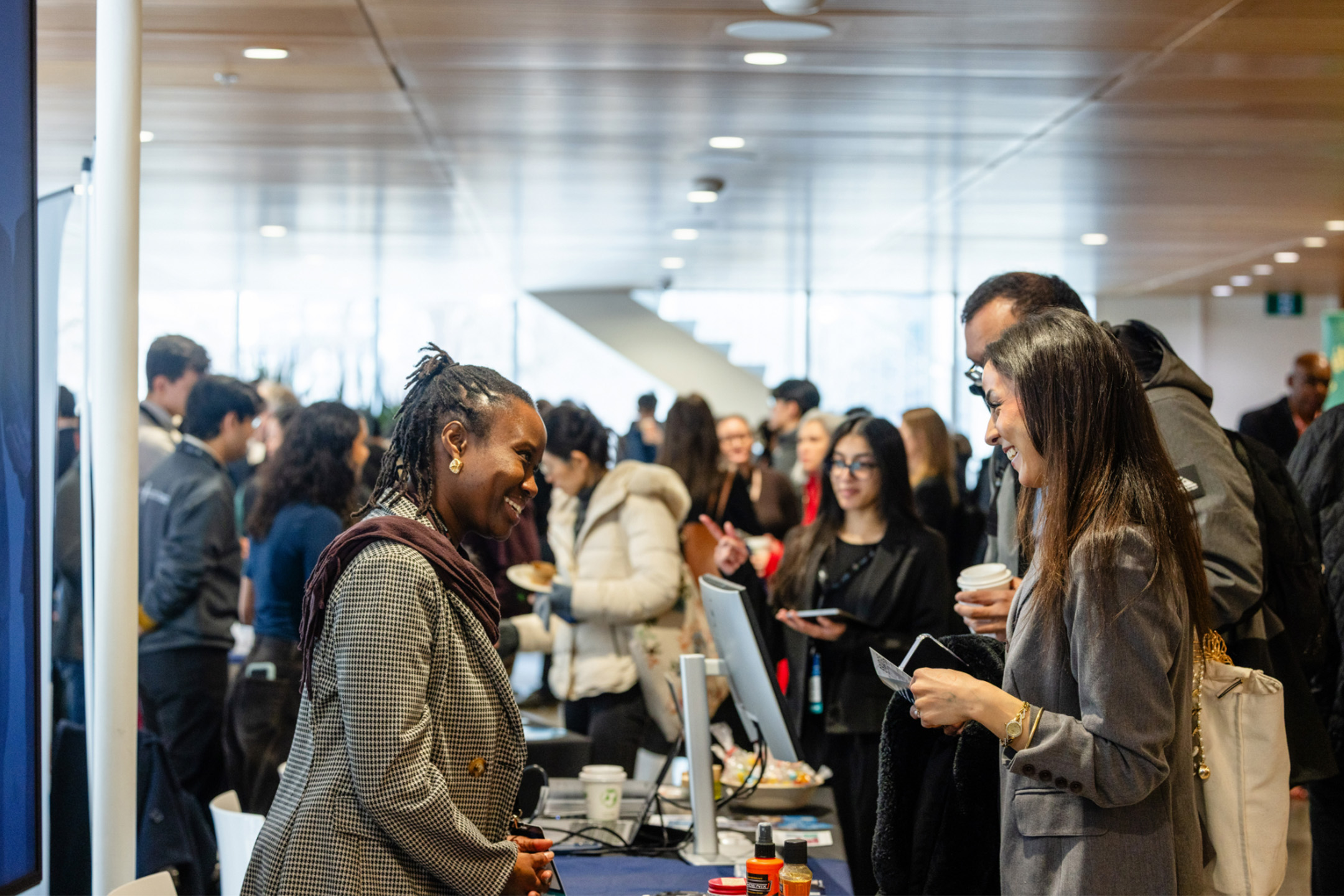
During U of T’s Entrepreneurship Week, the True Blue Expo brought together more than 40 startups and over a dozen campus accelerators.
Held as part of True Blue Impact Day on March 5, the event allowed student founders to present their ventures, connect with potential investors and collaborators, and engage with the university’s expanding entrepreneurship network. The exhibition floor featured founders pitching innovative solutions across a variety of challenges, alongside campus organizations connecting startups with mentorship, funding opportunities, and industry expertise.
The Desjardins Speaker Series took place later in the day, highlighting faculty entrepreneurs discussing Canada’s next ‘AI moment.’ The expo itself offered a closer look at how entrepreneurship is taking shape at the student and early-stage level. The Varsity spoke with participants throughout the event to gather first-hand perspectives on the opportunities and challenges facing early-stage founders.
Student problems becoming startup ideas
Across the exhibition floor, many of the ventures on display shared a similar story of origin: problems encountered in everyday student life.
Arlyne James, founder and CEO of MyDormStore and a U of T mechanical engineering alum, now pursuing a Rotman master’s degree, developed the idea after witnessing the challenges students face when moving into university residences. The startup now partners with universities to simplify the move-in process by offering curated dorm packages delivered directly to student housing.
“Every year, millions of students move into dorms, and it’s a disaster: they don’t know what they need, they end up buying the wrong things, and it’s chaos for universities,” James said in an interview with The Varsity at the True Blue Expo.
What began as a small venture has since expanded beyond U of T to residences across Canada. James credits U of T’s entrepreneurship ecosystem with helping the company grow from a campus idea into a broader venture.
“[U of T] has been a tremendous supporter, notably the accelerators we partnered with — The Bridge, ICUBE, the [Entrepreneurship] Hatchery, and the Centre for Entrepreneurship — we have been involved with quite a few. They’ve all provided a lot of guidance and mentorship and, with my background in engineering, helped me learn how a business works and how to get one started,” James added.
Other startups reflect emerging lifestyle trends among younger consumers. Bianci Mensah, a Rotman Commerce alum, is co-founder of Ginny, a non-alcoholic beverage brand aimed at young adults who are increasingly reducing their alcohol consumption for health and wellness reasons.
Events like the True Blue Expo create opportunities for founders to not only expand their networks but also test ideas with potential customers. “A big part of [the] beverage [business] is what we call ‘liquid to lips’ — really having people try the beverage — and U of T has given us a platform to do that without having to look elsewhere,” Mensah said in an interview with The Varsity.
The role of campus accelerators
Behind many of these ventures is a network of incubators and accelerators — programs that provide startups with mentorship, workspace, and access to funding — designed to help founders move from ideas to viable businesses. U of T has steadily built one of the largest university entrepreneurship ecosystems in Canada, with more than a dozen incubators and accelerators operating across its campuses and faculties.
This evolving ecosystem has already helped create more than 1,500 venture-backed companies, generating over 20,000 jobs and raising more than $14 billion in funding.
U of T is also ranked first in Canada for research-based startups and among the top five universities globally for startup incubators, reflecting the growing role universities play in driving Canada’s innovation economy.
Katherine Redpath, Operations Lead of U of T’s Entrepreneurship Hatchery, described the program’s venture studio model — a structured approach to building startups from idea to investment — which supports founders through several stages: identifying business opportunities, forming teams, defining business models, and preparing for seed funding.
One of the key challenges founders face, Redpath said in an interview with The Varsity, “is transitioning from a student mindset with really clear deliverables and next steps… To an entrepreneurial mindset where no one can tell you the right answers, because there is no right answer.”
Across campus, accelerators often operate collaboratively rather than competitively. Ignacio Mongrell, assistant director at ICUBE, explained that while its incubator provides resources like co-working spaces, mentorship, and investor connections, similar to other campus organizations, it also specifically target a different demographic of entrepreneurs: “We focus on supporting social entrepreneurs, so folks who are creating companies that are for-profit, but also have a social mission, so they want to create some sort of impact,” Mongrell said in an interview with The Varsity.
Together, the conversations at the True Blue Expo highlighted the growing entrepreneurial culture and spirit at U of T. As founders, accelerators, and ecosystem partners gathered in one space, the event offered a snapshot into how the university is positioning itself as a hub for entrepreneurship in Canada.

No comments to display.