
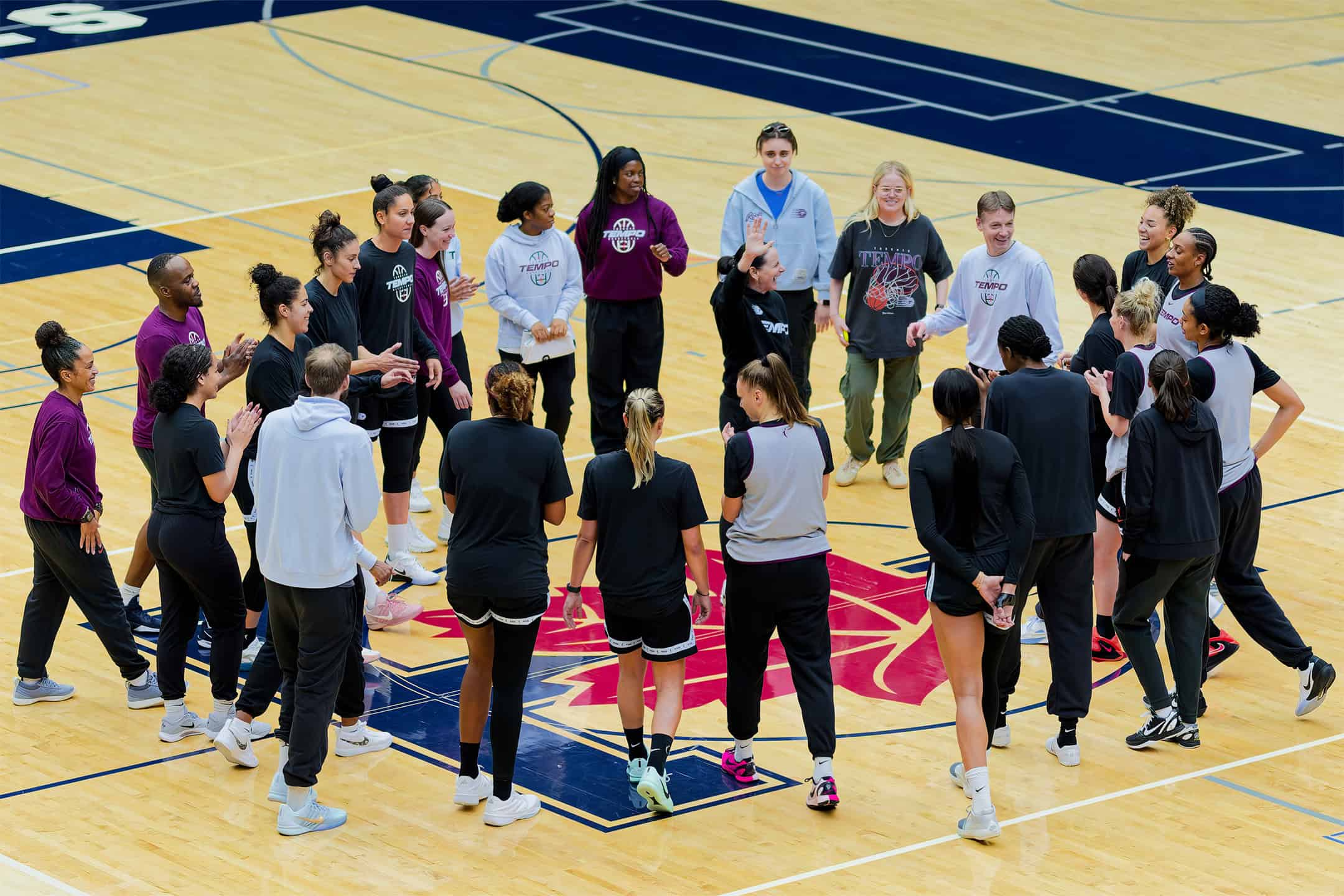
The Toronto Tempo have arrived, and they are bringing the explosive energy of the WNBA straight to U of T.
Officially awarded as an expansion franchise in May 2024 and unveiled with the “Tempo” moniker that December, Canada’s first WNBA franchise has finally begun play in its inaugural 2026 season in May. The Tempo are regularly selling out Coca-Cola Coliseum, contributing to the immense sports enthusiasm in Toronto this summer, and the foundational work of this historic franchise is occurring right here on our downtown campus, UTSG.
Through a partnership with the U of T’s Faculty of Kinesiology & Physical Education (KPE), the Tempo have adopted the Goldring Centre for High Performance Sport as their official temporary training home until early fall 2026.
Amidst the excitement that the Tempo are bringing to the city, The Varsity had the opportunity to delve deeper into the team’s identity by attending practices and media sessions.
Built by ambition
In modern professional sports, expansion teams are typically met with low expectations. In the first year, the goal is often to establish team culture and get fans in the stands.
In a place like Toronto, however, the standard is much higher. This city is built on ambition, and majority owner Larry Tanenbaum wanted to ensure that this team would be designed to compete as soon as it hit the hardwood.
The team’s ambition is shown in the franchise’s accompanying ownership group, including Serena Williams, the greatest women’s tennis player ever, and Masai Ujiri, the architect of the 2019 Toronto Raptors championship team. It’s shown in the appointment of head coach Sandy Brondello, one of only two coaches in WNBA history to win a championship with multiple franchises. Most importantly, it’s shown in how general manager Monica Wright Rogers decided to build the Tempo roster.
As the two new franchises entering the WNBA in 2026, the Tempo and the Portland Fire participated in an expansion draft, where the teams took turns selecting from a league-designated pool of available players to fill their rosters.
In their draft, Toronto emphasized selecting players who could help them develop a competitive culture, with Rogers highlighting the qualities of “versatility, toughness, and winning experience.” The expansion draft allowed the Tempo to acquire arguably their most important asset: veteran guard Marina Mabrey.
Renowned as a flamethrower from beyond the arc and armed with a fierce competitive edge, Mabrey has immediately established herself as the focal point of Toronto’s offence. She is a lethal scorer capable of single-handedly changing the tide of a match, and has partnered with free agent acquisition Brittney Sykes to create a formidable duo on the court.
Sykes is another veteran guard who specializes in on-ball defence and slashing, using speed and aggression to create offensive chances at the rim. Her capacity to draw help defenders allows shooters like Mabrey to get open and knock down long-range baskets.
The duo’s playstyles are a hallmark of the Tempo’s “0.5 mentality” — a basketball philosophy requiring players to decide whether to shoot, pass, or drive within a half-second of catching the ball. It enforces a high-velocity offence and prevents stagnation.
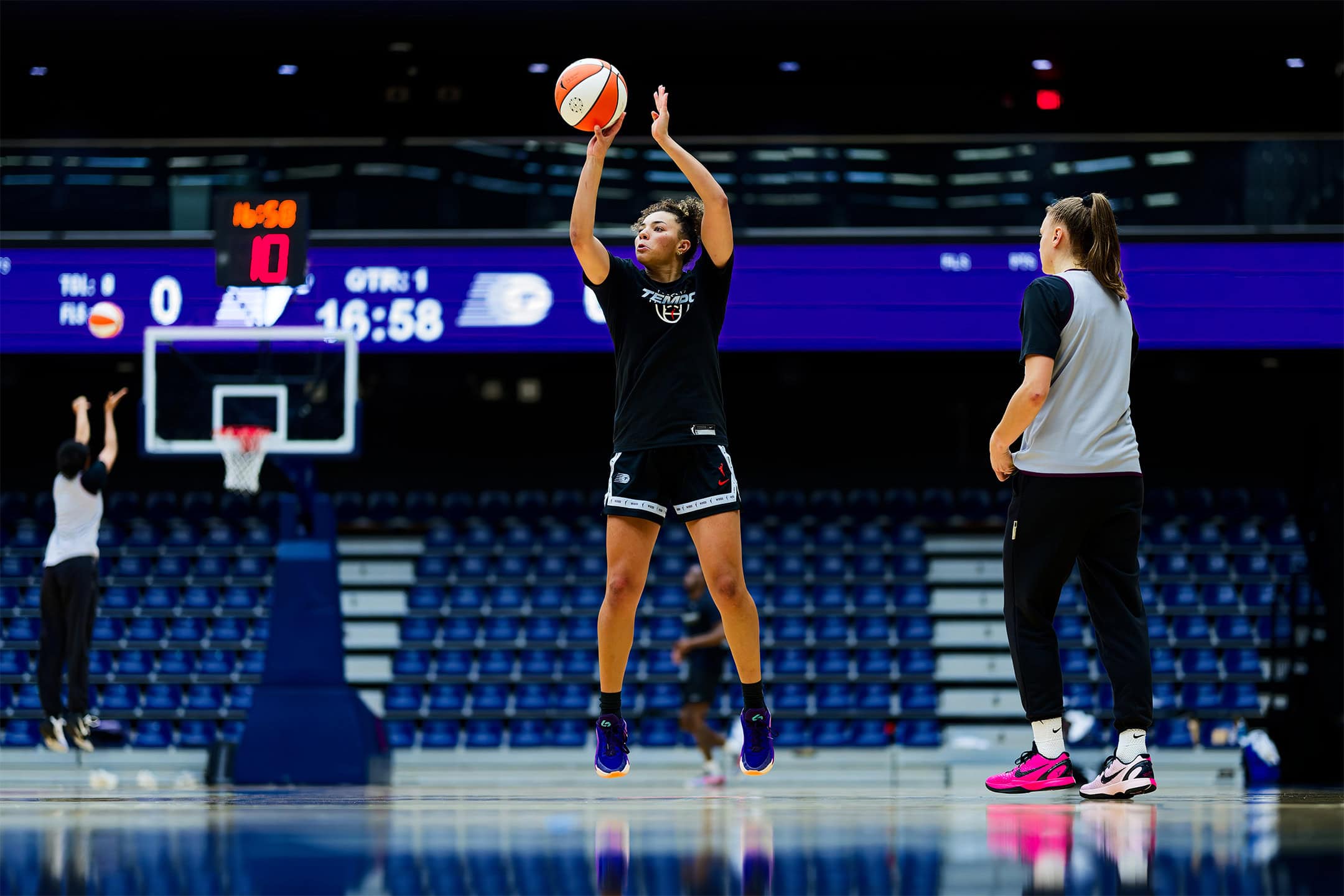
Rookie guard Kiki Rice perfecting her jump shot. WILLIAM KUK/THE VARSITY
While the explosive chemistry between Mabrey and Sykes has been instrumental to the Tempo’s success so far, the true cornerstone of the team’s long-term vision is rookie guard Kiki Rice.
Drafted sixth overall in the 2026 WNBA Draft after winning a national championship with the UCLA Bruins, Rice has been a revelation. She dictates the flow of the game with her court vision and applies relentless defensive pressure when out of possession.
The perceptive Torontonian will get a sense of nostalgia in watching Rice play: her winning mentality and gritty playstyle resemble Raptors legend Kyle Lowry. With a well-rounded roster led by a star trio, the Tempo organization’s ambitious strategy can make the franchise a mainstay in WNBA competition for the foreseeable future.
Establishing the Tempo
An elite blueprint for establishing an expansion basketball franchise requires a world-class training ground, which is what makes the Tempo’s partnership with U of T a natural corporate marriage. The Goldring Centre is arguably the perfect place for the team to sharpen its tools while navigating its rigorous inaugural season.
Step inside the Kimel Family Field House during a Tempo practice, and you’ll witness an atmosphere of intensity and collective determination. Even from the upper lobby, the building echoes with the bounces of basketballs and the squeaks of shoes biting the court. Descending into the gym reveals a loud environment that, despite being rife with infectious energy, is strictly business.
According to Sykes, a key mindset of this Tempo team is to “keep getting one per cent better every day,” and it absolutely radiates through their approach to training. Just as a silence falls upon the court when practice-squad players score in a drill against the starters, an eruption of cheers breaks out when a shot gets swatted in a blocking drill. Players are committed to their craft and the fine details of the game.
Most importantly, the Tempo are grounded in their demeanour. They have cultivated a tight-knit culture, where staff members will flash the building reception a smile as if they were lifelong friends, and players will regularly laugh and celebrate in between high-intensity repetitions.
When asked about her experience training at Goldring, Lithuanian forward Laura Juškaitė — a WNBA rookie currently adjusting to North American media culture after a successful European career — offered a humorously blunt insight pulled straight from Serbian superstar Nikola Jokić’s playbook.
“It’s just a gym… it’s the same anywhere else,” she quipped, letting her delivery signal that the focus is strictly on basketball. She later added that the team was lucky to have the facilities available to them and to call the gym their home — and joked that the reporters’ questions had her sweating. Juškaitė’s pragmatic mindset captures the core identity of the Tempo project: one rooted in championship-level ambitions and driven by a ground-level approach.
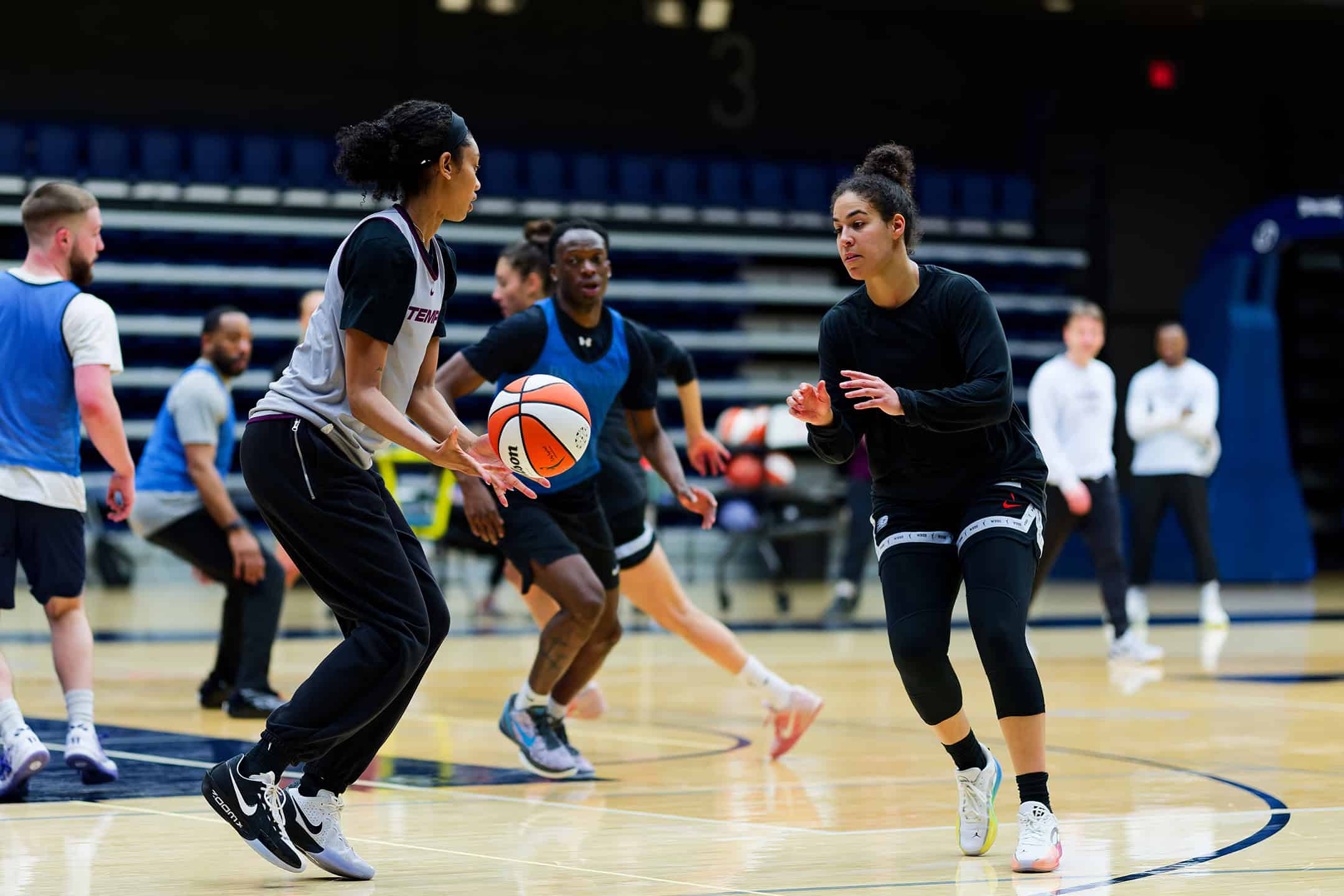
Forward Teonni Key hands the ball off to guard Kia Nurse. WILLIAM KUK/THE VARSITY
A huge win for Canadian women’s sports
The Tempo’s residency at U of T is fundamentally a symbol for the continued growth of women’s sports nationally. Dean of KPE Gretchen Kerr wrote in a statement to The Varsity that it reflects a “strong commitment to advancing visibility, opportunity and investment in women and girls.” This sentiment is equally shared in the Tempo locker room.
“You go to a different country to allow young girls and young women to dream,” Brondello said. The head coach notes that the team is indeed operating as role models for the leaders of tomorrow. She said, “Now [that] we have the visibility [of] these young girls… we’re role models. You’ve got to dare to dream.”
The team’s impact extends far beyond downtown Toronto. “We feel like all of Canada is behind us, which is really, really exciting,” former Tempo guard Lexi Held expressed. “Being able to be the face of new generations to come has been really special… [and] makes it bigger than just the X’s and O’s on the court.”
The Toronto Tempo might be one of the WNBA’s newest teams, but they’re already breaking ground and establishing records in just their first year of play. From guard Julie Allemand’s shared tally of 14 assists in a game without a turnover to Mabrey’s explosive 53-point night, the team is making itself a household name in women’s basketball. Potentially adding to their growing list of accolades, the team is about to play in the Tempo Cross-Canada Series in Montreal on July 10, where they have the opportunity to break the all-time WNBA attendance record with a sold-out crowd.
The Tempo are quickly becoming a special part of Canadian basketball, and it is incredible to see U of T acting as a catalyst for an organization that is leading the meteoric rise of the sport nationally.
With reporting by Cate Woodhead, The Varsity’s Deputy Senior Copy Editor, who attended Toronto Tempo practices at the Goldring Centre for High Performance Sport on May 25 and 26.

No comments to display.