

On June 24, the Governing Council (GC) approved three procedural and two sanction amendments to the Code of Behaviour on Academic Matters (CBAM), the first major substantive change since 1995. The policy review was prompted by the 2022–2023 Annual Report of the University Ombudsperson’s recommendation to better reflect “the ever-increasing size of the institution, and the prevalence of resources to assist students in academic dishonesty.”
Professor Heather Boon, Vice-Provost, Faculty & Academic Life, led the consultation. She connected with administrators, faculty, staff, and students through targeted surveys, meetings, and memos to collect feedback on proposed changes. The main problems identified in the existing CBAM were “burdensome procedures, delays in resolving cases, inconsistent sanctions, and the impact of generative AI.”
Key revisions
Academic offence notices provided to students must now include the date and summary of the allegation, the recommended sanctions, a meeting invitation, procedural details, and a deadline to respond to the notice.
If a student fails to respond by the deadline, it is deemed as an admission of guilt and sanctions are imposed. Students can withdraw from deemed admission by discussing with the dean up to three months after the imposed sanctions. If a student did not receive the notice through no fault of their own, this three-month deadline does not apply, but they must still meet with the dean “within a reasonable period of time.” The notice will include an explanation of this process.
Department chairs may now resolve academic offences committed on assignments worth up to 15 per cent of the course’s final grade, up from 10 per cent. If the student admits guilt, and the assignment or exam is worth 15 per cent or less, the department chair can choose to settle the case internally instead of escalating to an academic tribunal.
U of T prosecutes academic misconduct cases in a tribunal if the student has not admitted guilt and if the instructor, the dean, and the Provost believe that an offence was committed. Cases are escalated to a tribunal if the offences are particularly egregious. Only 10 students have ever been acquitted at a tribunal. The last case was dismissed just this June, the first dismissal since 2021.
Academic units and divisions can now suspend a student for up to two years without escalating to a tribunal, subject to provost approval. In comparison, tribunal sanctions normally begin with a two-year suspension.
The recommended sanctions for unauthorized aid now include forfeiture of said aid(s). Unauthorized aid is possessing or obtaining prohibited forms of assistance, such as notes, phones, calculators, paid third parties, or collaborating with other students. Professors must communicate what is authorized or not, and invigilators warn against these unauthorized aids before every proctored exam.
Per the new CBAM, unauthorized items will be confiscated upon first notice, although this is not recommended for a student’s personal phone.
Spread of spyware
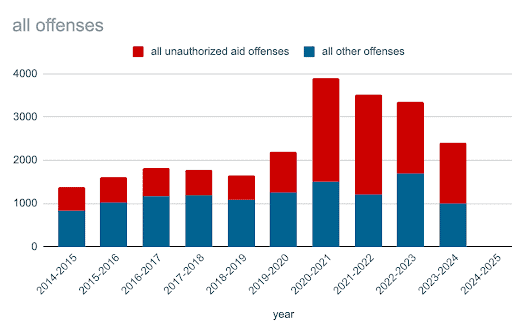
During Boon’s presentation to GC on the CBAM revisions, she stated, “We’ve seen quite a substantial rise in the use of unauthorized aids technology, and primarily in coordinating cheating cases on exams.” Both the volume and complexity of unauthorized aid offences at U of T have grown significantly in the past few years.
Between the 2019–2020 and 2020–2021 academic years, unauthorized aid offences increased by 150 per cent, and have since made up two-thirds of all academic offences. While the total number of offences has decreased since the pandemic high, the number of unauthorized aid offences has still remained significant. In the 2023–2024 year, there were 1,423 unauthorized aid offences out of a total of 2,415 offences.
A new kind of unauthorized aid technology has arrived on campus: spyware. Spyware is disguised technology that allows students to receive real-time responses to exam questions, with cameras hidden as innocuous objects like buttons or pens.
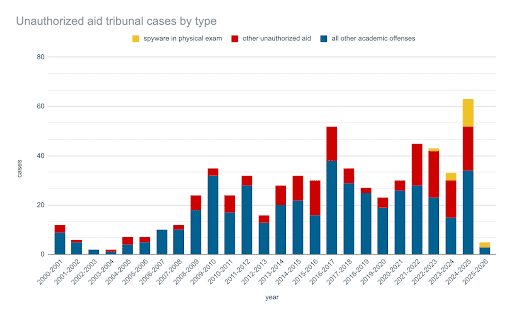
At the time of reporting, there have been 17 public tribunal cases of cheating on exams using spyware, 11 from the 2024–2025 academic year alone. The final tally may increase as more cases from this year are published. Out of the 18 exams in the 17 different cases, nine were economics exams, four were economics or finance management exams, two were statistics exams, and one exam each in linguistics, math, and psychology.
In the first appearance of spyware –– case 1505 in 2023 –– the University’s counsel stated this was “the first case brought to the Tribunal that involved a student using a real-time camera and earpieces during a test or exam, but it will not be the last.” The tribunal wrote that spyware takes unauthorized assistance to “a new level.”
Students have been frequently caught with cameras disguised as a black button and a small Bluetooth earpiece. The button camera can be added to their sleeve or the front of their shirt, and livestreams the exam to a paid third party, who then provides answers through the earpiece.
For the third party to read and answer the exam questions, the student must hold their exam paper parallel to the camera. In case 1560, the invigilator noticed the student repeatedly lifting her exam “parallel to her torso (and parallel to the large button on her shirt) for approximately 30 seconds. The exam paper was not angled towards the Student’s face.”
Disguising the button and wires has been a difficult task for some of the students. In case 1559, the student added the button to the front of her hoodie, claiming she was “wearing a fashion project with wires and buttons.”
For spyware cases, the most common punishment is a grade of zero in the course, a five-year suspension, and a seven-year academic record and transcript notation. Five students have been recommended for expulsion due to a combination of prior offences, not cooperating with the academic offence process, and a lack of mitigating circumstances, such as mental health crises or family emergencies.
Companies have been advertising spyware and exam answers as a bundled service to U of T students, with some charging up to $1,000 per exam. If you have any information about commercial spyware or cheating companies, contact the news team at [email protected] or anonymously through our tip form.

No comments to display.