
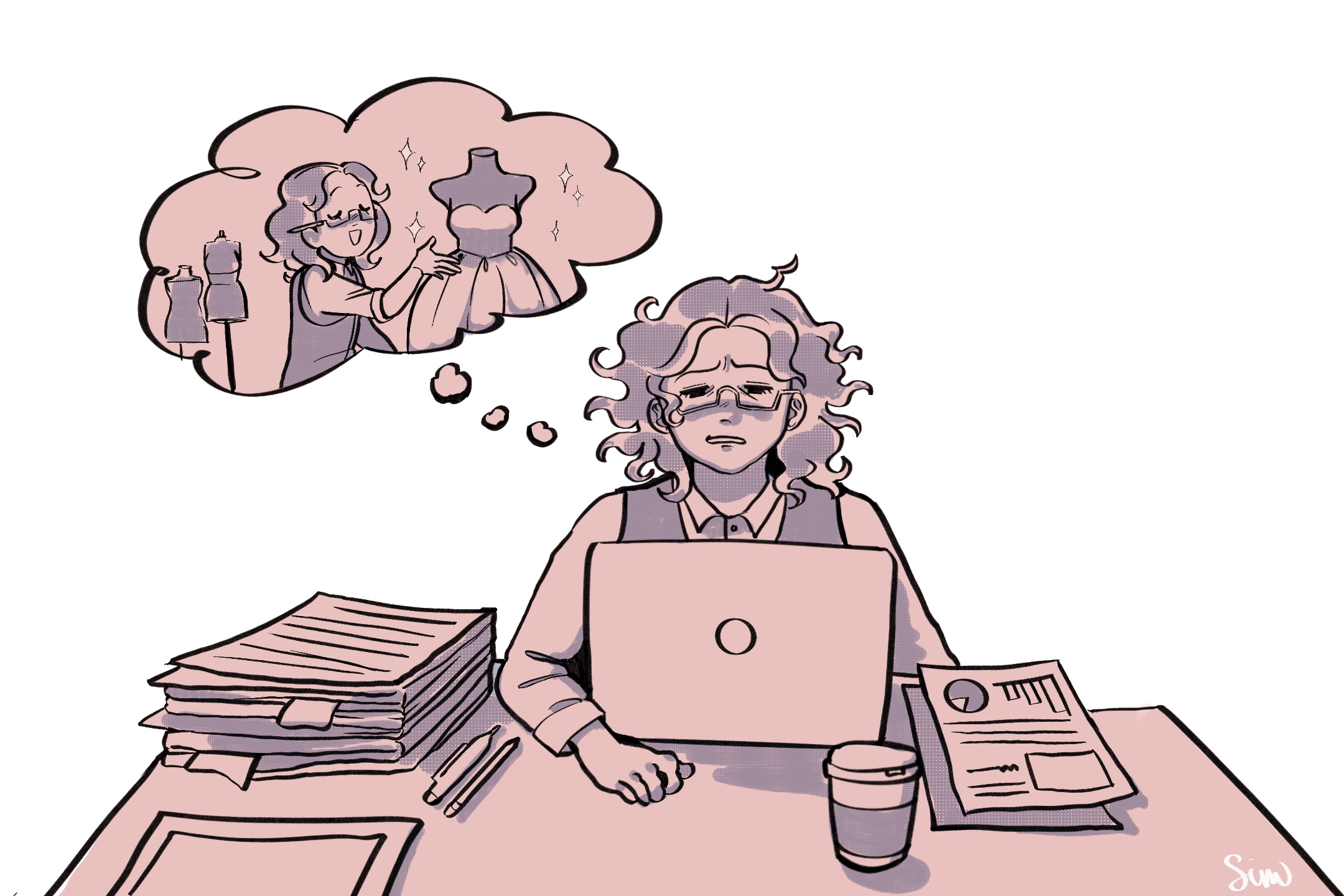
Let’s say, hypothetically, Leonardo da Vinci had been born in the 21st century. Upon reaching young adulthood, he would choose a career. The young da Vinci would likely recognize his own aptitude for the arts and invention. However, in today’s world, it’s difficult to be an artist, let alone a Renaissance man — one who seeks to master a variety of disciplines. Faced with the need to be ‘practical,’ da Vinci might not have spent so much time on painting, and might have chosen to focus his life’s work on engineering or science. The world would have never known the “Vitruvian Man” or the “Mona Lisa.”
The Toronto Star recently wrote that the Toronto International Film Festival (TIFF) runs on the basis of thousands of unpaid volunteers each year. But being underpaid in the arts scene is not unique to Toronto. In New York, the popular fashion podcast “The Cutting Room Floor” recently posted a job listing for a role which “combines the responsibilities of [both] a bookings administrator and studio coordinator.” The salary for this role is the equivalent of $76,200 CAD, a wage now considered unlivable in New York.
The modern world treats art as surplus labour, existing only because of and for the passion of those who create it. In a world that demands new technologies, medicines, and efficiencies, the arts have become an expendable luxury. I believe this to be both historically unusual, and culturally dangerous.
The era of the artisan
Since the early days of our history, art has been central to human society. The creation of art evolved in parallel to pivotal developments in language and social grouping, which are driven by evolutionary changes in our neural structures.
Once civilizations rose, artists belonged to a class of citizens, grouped with craftsmen, smiths, and similarly skilled labourers called artisans. Typically hierarchically situated somewhere between peasants and the nobility, the artisan class existed in many societies, from Ancient Mesopotamia to Imperial China to Medieval Europe.
Historically, artisans promoted the depth and pride of their respective cultures, creating local traditions and amassing collections. They hold a long history in political radicalism, where they defended values through their work and relationships to the community and higher classes.
Notably, during the French Revolution of 1789, artisans headed the sans-culottes, a group of working-class radicals who wore long pants instead of the half-pants of the bourgeoisie in protest of economic recession.
Modern artists continue to carry out this legacy. In the ’60s, during the American Civil Rights Movement, artists such as Jacob Lawrence and Faith Ringgold used the visual arts to illustrate the injustices experienced by Black Americans.
The cost of undervaluing art
Modern artists face different struggles than the artisans of the past. The legitimacy afforded to artisans gave them the power to ask for more. William M. Reddy argues, in his book The Rise of Market Culture, that workers in the nineteenth century campaigned more successfully for higher compensation because they still saw themselves as individual artisans, rather than nameless cogs in a greater machine.
A great artist has the ability to influence behaviours and attitudes. We can know facts to be true, but when we are confronted with artistic works that leverage and manifest these facts, we come to a deeper understanding of their significance.
When passion becomes free labour
It doesn’t matter whether working in the arts is your dream job or not. The fact is, not everyone has the ability to create truly great art. It’s an elusive, hard-earned skill.
Rather, we are faced with a symptom of a greater issue: that this generation is living far from the practices that have sustained us for millennia. It isn’t entirely surprising that, as a society, our primary focus isn’t uplifting the arts, as there are many pressing issues on our collective consciousness. But by stripping the arts of their due respect, we stifle the human ability to imagine something better.
By choosing to pay fairly for the art we consume, treating art as labour rather than leisure and demanding that corporations do the same, we give our artists autonomy and the room to create purposefully. For creative visionaries to exist, artists must be recognized and fairly compensated for what they are: essential architects of the cultural fabric of society.
