
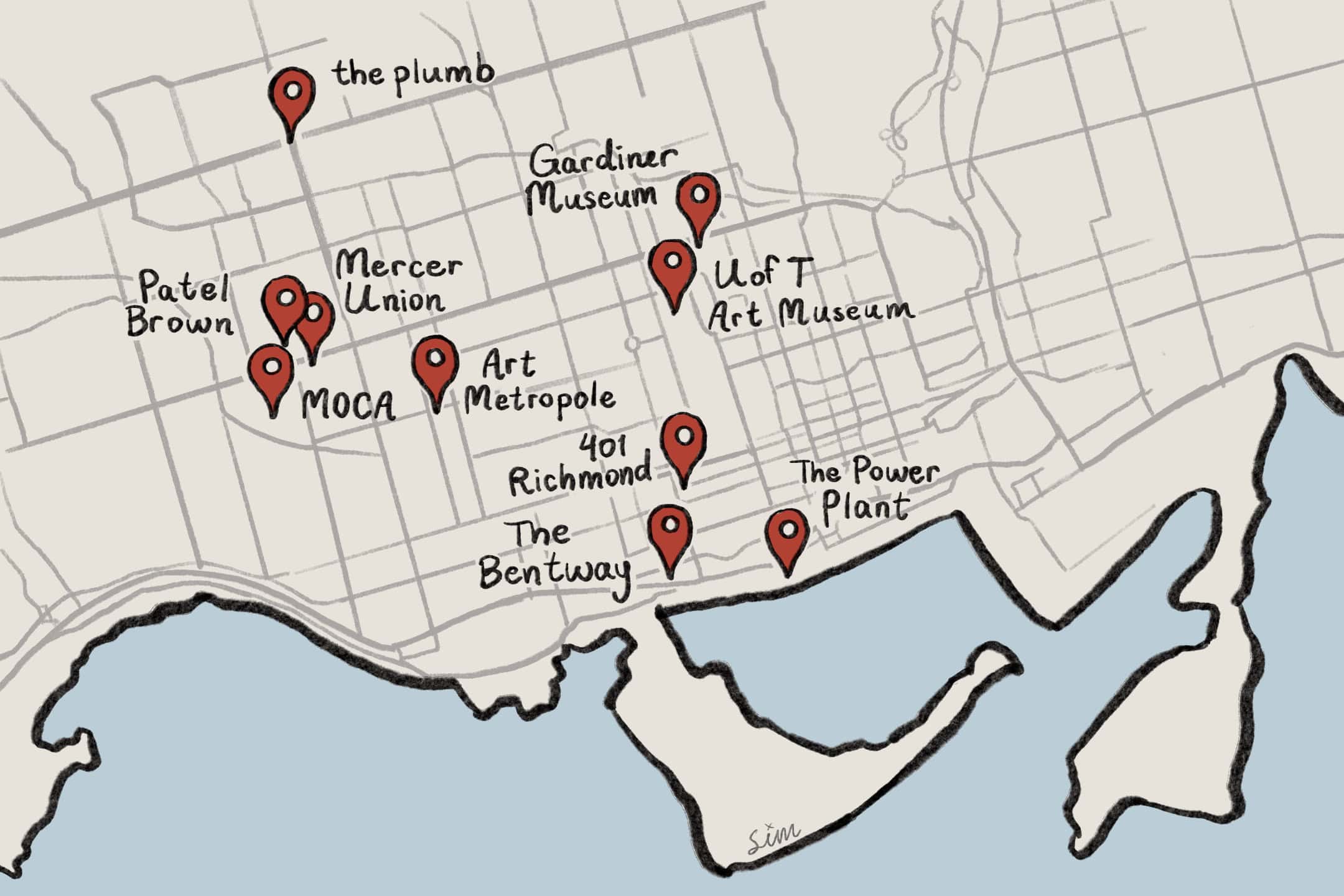
Thanks to the Art Gallery of Ontario (AGO) and the Royal Ontario Museum (ROM), Toronto has well-known and well-established public arts programs. But the Toronto arts scene is much bigger than those two institutions.
The city is home to many smaller galleries and organizations that support both established and emerging artists. With cheaper or even free entry, as opposed to both the AGO and the ROM, these galleries around the city give the public access to the arts and programming, keeping local arts alive.
Museum of Contemporary Art (MOCA)
One of the largest galleries in the city, the MOCA has rotating exhibitions of contemporary art from both Canadian and international artists. The gallery’s three floors host either several exhibitions at once, or one larger one — such as the current Jeff Wall exhibition.
Large and financially accessible, MOCA is a hub for contemporary art in the city, putting on experimental installations that push the limits of art display. Each floor is completely transformed for the projects it features, creating a new, immersive experience surrounding each artwork, unlike anything at the AGO. You can find MOCA near Bloor and Dundas West.
Newly renovated and located right next to U of T, the Gardiner is a ceramics museum that exhibits historical and contemporary works. With both permanent collections and temporary exhibitions, the museum features a wide range of objects and art that span across time and place.
Through the display of historical artifacts and contemporary art, they provide a mix of historical and artistic insight into ceramics, showing how the two worlds intersect. The Gardiner also hosts various classes and programs for the public, offering many ways to get involved with the museum.
With two galleries — one in University College and another in Hart House — the Art Museum generally shows student work in summertime graduate exhibitions, and contemporary art from established artists during the academic year. Featuring local and international artists, the galleries provide students and the general public free access to a range of exhibitions in the core of U of T’s St. George campus.
With plenty of programming and student-led tours, the galleries also give students paths into the art world through work-study or internships and integration of course material, as many classes tour the exhibition during the semester.
The Power Plant is a contemporary arts gallery located in the Harbourfront Centre. Generally consisting of two different larger exhibitions with one installation in the hallway, the gallery hosts various forms of art, from large-scale video installations to immersive painting exhibitions. With free access year-round and extensive programming, the Power Plant is devoted to developing contemporary art in the centre of the city.
While Art Metropole is not a conventional art gallery, it has been a cornerstone of the arts scene in Toronto for decades. Located on College, west of Little Italy, the centre is an archive for publications like zines, as well as books that document and provide commentary on art. The storefront shows small art exhibitions and provides various historical and contemporary publications for sale. Art Metropole is not only a base for new and developing artists, but also a place to find books that are not available elsewhere.
As one of the biggest artist-run centres in the city, Mercer Union, in Bloordale Village, commissions new work from both Canadian and international artists, showing art both indoors and outdoors on banners year-round. Their combination of developing and established artists means that their exhibitions continue to address contemporary issues while featuring the newest perspectives in art.
Mercer Union serves as a key example of how artist-run centres in Toronto and across the country are crucial to cultivating the characteristically Canadian — as they originated here with the growing Canadian arts scene in the ’60s and ’70s — art world that is not stifled by the bureaucracy of larger institutions.
Home to more than 40 artists’ studios as well as 17 art galleries and artist-run centres, 401 Richmond is a community in and of itself, functioning as a major pillar of supported and funded arts in the city. Hosting artist-run centres like Vtape — a technological archive of video and media art, and Tangled Arts — which focuses on supporting artists with disabilities, the centre is one of the most diverse spaces for art in the city.
Open to the public, the sheer number of institutions located at 401 Richmond means that there is always an exhibition or program open to visit.
A short walk from the MOCA, and right next door to Lansdowne Station, Patel Brown is a private gallery that is part of a network of smaller galleries and artist studios across the Lower Junction Triangle. With shorter exhibitions and a mix of group and solo exhibitions, the gallery has a constant rotation of varying contemporary artists.
As a private gallery, their representation of artists creates a specific but intentional curation of their exhibitions, comparing and contrasting work from across the world from working artists. Their established relationship with these artists means that the curators are familiar with and understand the artwork, which shows in their curation.
Focused on providing spaces for artists in a city where rent constantly seems to skyrocket, the plumb is a DIY artist-run collective on the corner of St. Clair and Dufferin that features developing artists in Toronto. Working with established artists and curators both in and out of the collective, these artists get a larger platform to show their work and create new insight.
Their DIY nature makes their practice unconventional at times, but also allows them to take approaches and uplift voices that would usually be sidelined by larger organizations.
Unlike any other institution on this list, The Bentway does not have any brick-and-mortar location. Instead, it is comprised of various programming across and under the length of the Gardiner Expressway.
From winter skate trails to rotating public art and ecological education, The Bentway is a hub for public education and activity alongside art display. Centred on public engagement, their featured art is some of the most accessible art in the city.

No comments to display.