
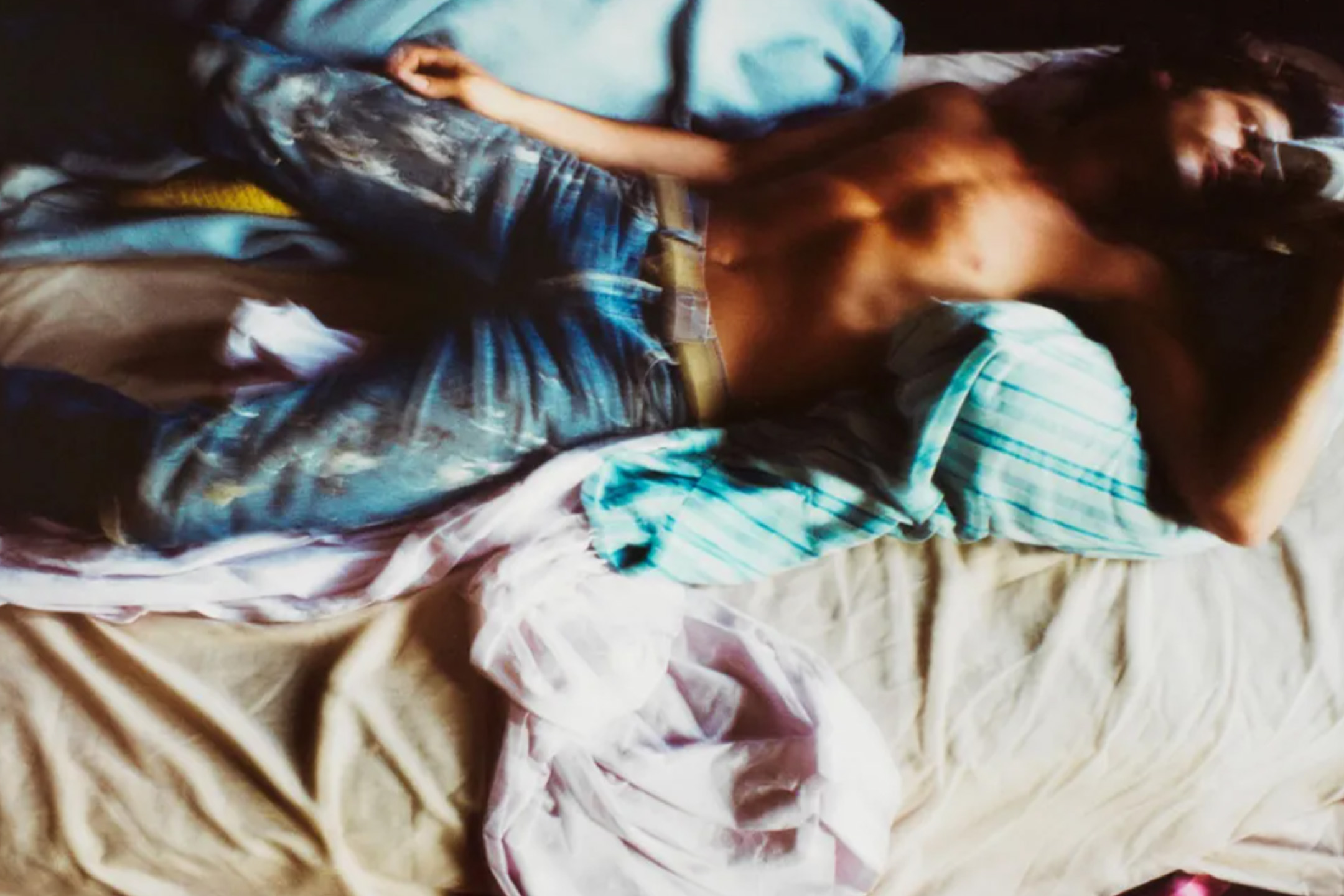
The Art Gallery of Ontario (AGO) is facing scrutiny this week. Details have emerged about the gallery’s Modern and Contemporary Curatorial Working Committee’s decision to pass on the joint acquisition of Jewish American photo and video artist Nan Goldin’s “Stendhal Syndrome,” as covered in a January 21 Globe and Mail article by Josh O’Kane.
Last spring, the committee voted 11–9 to not go forward with the purchase due to a characterization of the photographer from some board members as being ‘antisemitic’ for her speech against Israel’s attack on Gaza and Lebanon in 2024.
The AGO had been set to acquire the video artwork in a joint venture with the Vancouver Art Gallery and Minneapolis’s Walker Art Center last year. The piece presents Goldin’s photography in video slideshow format, paying homage to her signature 35 mm carousel slides set to music.
The single-channel video juxtaposes Goldin’s portraits of friends, family, and lovers over the last twenty years with her photographs of Classical, Renaissance, and Baroque masterpieces from major institutions around the world. The footage is accompanied by Goldin’s voiceover, a soundtrack composed by international experimental sound art group Soundwalk Collective, and a piece by English composer Mica Levi.
Goldin’s flirtation with photography began when she was handed a camera as a foster child in a progressive school, and she is now known for her political art. In the late 1980s and 1990s, Goldin’s work was focused on documenting and showcasing the impact of the HIV/AIDS crisis that tore through her queer and arts communities in New York City.
During this time, she curated her exhibition, Witnesses: Against Our Vanishing. This was the first exhibition in New York City that was centred around the experience of queer artists during the AIDS crisis, and how the disease had impacted them individually and as a community. It featured about two dozen artists impacted by AIDS, many of whom had previously been photographed by Goldin.
The exhibition was met with disapproval from the neo-conservative politics of the Reagan administration and had its funding pulled from the National Endowment for the Arts because it featured uncensored and unsanitized queer voices.
Goldin also set up Prescription Addiction Intervention Now (P.A.I.N.), after developing an addiction to OxyContin due to a prescription after a surgery. Her advocacy through P.A.I.N. was instrumental in counteracting the reputation laundering of the Sackler family, whose family owned the pharmaceutical corporation Purdue Pharma. The company was accused of hazardously mass-producing OxyContin, a synthetic opioid that has been a major contributor to the opioid crisis. The Sacklers used their various donations to arts institutions and museums around the world as a public relations tactic.
Goldin’s bold activism is why London’s National Portrait Gallery was the first major international institution to turn down a Sackler grant in 2019, which set the stage for many other prominent institutions to follow. All of this is to say that Goldin has a well-established reputation for effective political activism in the art world throughout her career.
In November 2024, at the opening of her retrospective, This Will Not End Well, at Berlin’s Neue Nationalgalerie, Goldin delivered a powerful speech denouncing the genocide in Gaza and the violent attacks on Lebanon carried out by Israel. Goldin delivered this message after the intense censorship of Palestinian and pro-Palestinian artists, particularly in Germany, but also in the West as a whole.
David Velasco was fired from his position as Editor-in-Chief of Artforum, a leading contemporary art magazine, for publishing an open letter calling for a ceasefire, passage of humanitarian aid into Gaza, and stopping the targeting of civilians by the Israeli military. Palestinian novelist Adania Shibli and her novel, Minor Detail, were meant to be awarded the 2023 LiBeraturpreis at the Frankfurt Book Fair, but the organizers of the award cancelled her ceremony.
Jewish American journalist and writer M. Gessen almost had their Hannah Arendt Prize for Political Thought rescinded by the German Heinrich Böll Foundation in December 2023. It was due to an essay they wrote in the New Yorker comparing the experience of the people in Gaza to the experience of Jewish people of the Warsaw Ghetto during WWII.
Goldin strongly asserted, “In declaring all criticism against Israel as antisemitic, it makes it harder to define and stop violent hatred against Jews. Meanwhile, Islamophobia is being ignored.” She also remarked that the images from Gaza reminded her of the anti-Jewish pogroms her grandparents had escaped in Russia. She stressed, “ ‘Never again’ means never again for anyone.”
A Jewish artist told Samira Mohyeddin, a Toronto journalist and Editor in Chief of On the Line Media, that “Judy Schulich is the one who lead [sic] the charge against Jewish artist Nan Goldin being antisemitic. She said Nan’s speech in Berlin was full of lies against Israel.” The source also said that Schulich, who is Executive Vice-President of the Schulich Foundation and is on the AGO’s Board of Trustees, compared Goldin to Leni Riefenstahl, a Nazi sympathizer who made propaganda films for the Nazi party and was close friends with Adolf Hitler.
Laura Quinn, a spokesperson for the AGO, acknowledged the involvement of biased politics by telling The Globe and Mail, “Personal political views were brought into the conversation. This is not intended to be part of the [acquisition] process.”
Goldin told Artnet News over the phone that she was informed of one board member leading the charge against the sale. Goldin was not surprised by this censorship of her work, as her sales drastically reduced at the Gagosian, the art gallery she is associated with, due to a WhatsApp chain targeting the careers of any artist who signed an open letter against the ousting of Velasco from Artforum.
The AGO’s modern and contemporary curator, John Zeppetelli, resigned from his full-time position because of the decision not to acquire Goldin’s work. Two members of the committee also followed with resignations for the same reason.
This is not the first time pro-Palestinian sentiment has been censored by the AGO. Wanda Nanibush, an Anishinaabe woman who was the curator of Indigenous art at the gallery, was allegedly pushed out in November 2023 for pro-Palestinian social media posts she shared on her private Instagram account. Pressure from supporters of Jerusalem’s Israel Museum played a role in the parting, as they wrote an angry letter to Stephen Jost, the Director and Chief Executive of the AGO.
The gallery already owns three of Goldin’s works, so this decision seems to be a bizarre breach of power if the allegations against Schulich hold. Goldin reiterated to Artnet, “I’m Jewish. I’ve always been Jewish. I’m still Jewish, and it’s part of my Jewish learning to show compassion. The idea that not supporting the policies of a nation can be called anti-Semitic is ridiculous.… Zionism isn’t even a religious construct. It’s a political one.”
The AGO has hired an independent governance expert to review the acquisition meeting. A spokesperson has said that the museum will “ensure that such discussions are focused on an artwork’s alignment to the AGO’s acquisition criteria, are healthy and productive, and welcome multiple perspectives.”
Until the results of the investigation are revealed, the AGO remains with this enormous stain on its reputation as one of the leading art institutions in Canada.
