
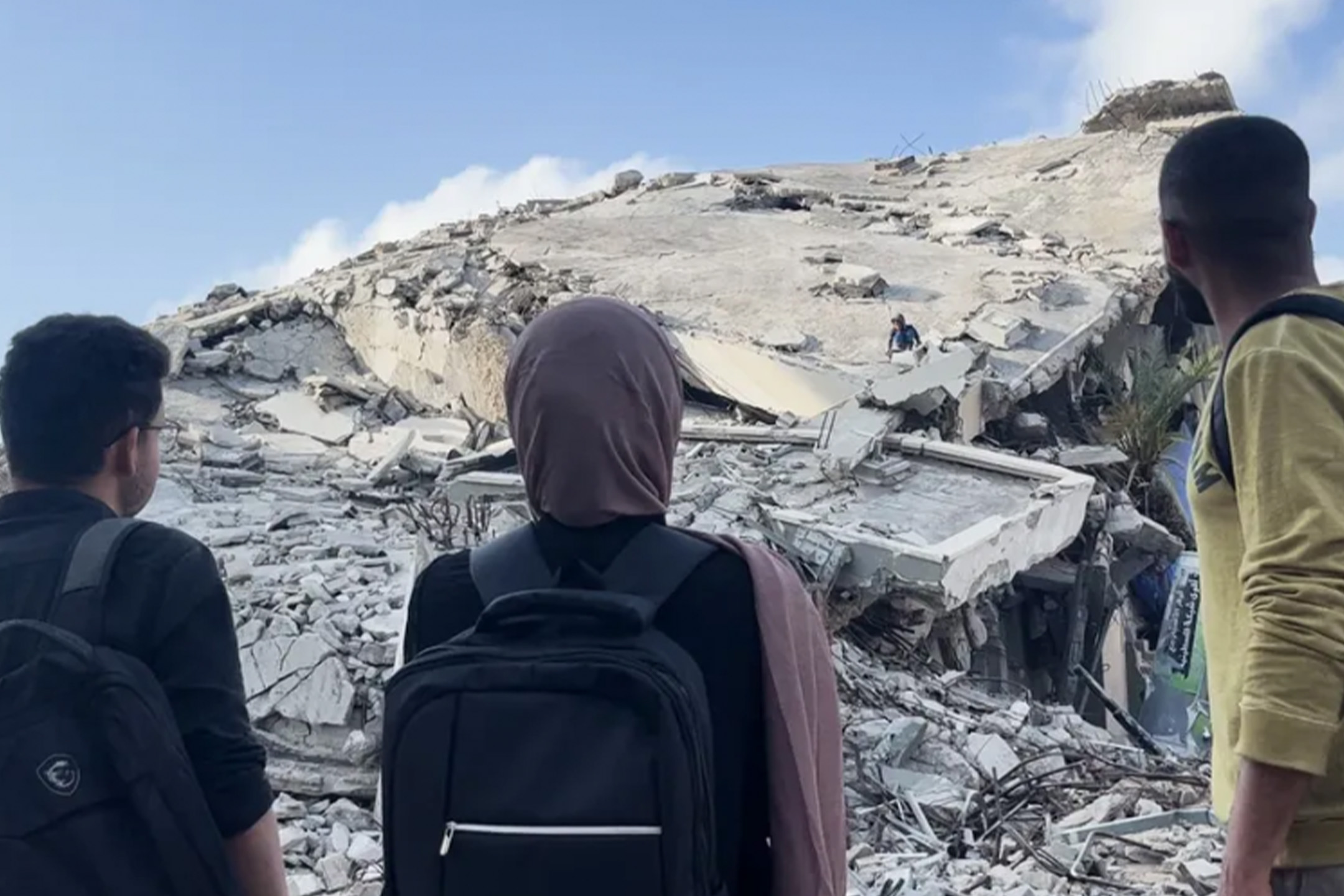
There are currently over 130 graduate students who have received offers of admission to Canadian universities, but cannot complete the biometrics assessment required for a Canadian study visa.
The Palestinian Students and Scholars at Risk (PSSAR) network is a nonprofit organization that has helped Palestinian students facing barriers to higher education following the destruction of Gaza’s universities. It helps connect Palestinian students with institutions abroad by forming a direct line of communication between professors and students from Palestine who share similar research interests.
Nada El-Falou, director of student services at the PSSAR network, shared that more than 130 Palestinian students who have been admitted to Canadian universities with full funding have “been waiting for nearly two years now… [and] there is no real justification for this delay,” El-Falou said in an interview with The Varsity.
According to El-Falou, approximately 12 admitted graduate students are waiting to begin programs at the University of Toronto. The Varsity reached out to the university to confirm this number, but did not receive confirmation.
Although students have been able to defer their academic enrollment to a later date, some have lost their admissions due to repeated deferrals clashing with university policies and expiring research grants. According to El-Falou, in certain cases, “the professor had no choice because the grant had a deadline and they were required to start a research project.”
Beyond academic uncertainty, many students remain displaced and unable to work or study while awaiting visa decisions. Some who fled from Gaza to Egypt lack permanent status or work authorization, leaving them in prolonged instability.
“Every day matters,” El-Falou said. “[There is a] risk of losing their admission, their health… [a] risk to their lives and a difficulty in trying to move on.”
El-Falou emphasized how a humanitarian effort is also necessary, mentioning the two Palestinian students admitted to the University of Waterloo who lost their lives in an airstrike in December 2024 before they were able to begin their studies.
Impossible requirement to obtain a student visa
Nour is one of the 12 graduate students admitted to U of T. She is enrolled in a PhD program, but has been unable to begin her studies for nearly two years as she remains trapped in Gaza, caught in what she describes as a “circle” of immigration requirements she cannot fulfill.
Nour, who asked that only her first name be used for privacy and safety purposes, was accepted to U of T’s Civil and Mineral Engineering PhD program at the St. George campus in May 2024.
After receiving her acceptance letter, Nour applied for a study permit through Immigration, Refugees and Citizenship Canada (IRCC) in June 2024. She applied with her family, explaining that she could not leave them behind in Gaza during the ongoing war.
However, the IRCC requires applicants to complete a biometrics assessment — providing fingerprints and a photograph for identity verification purposes — at a designated visa application centre. For Palestinians residing in Gaza, the nearest application centre is located in Cairo, Egypt.
Reaching Cairo would require crossing the Rafah border, a process dependent on authorization from Israeli authorities. Nour has been unable to secure permission to leave. Nour explained that she “[told the IRCC] I can’t go out of Gaza because we have to [do] the biometrics in Cairo.” She further added that the IRCC told her they would give her another time to do the biometrics once she gets out of Gaza.
“This is the main problem,” she said. “I can’t get the visa because of the biometrics, and I can’t go to the biometrics because of the visa… It’s a circle.”
Due to the ongoing struggle to fulfill a requirement that is currently impossible in her situation, Nour has deferred her admission multiple times. Her current enrollment date is September 2026.
Nour said that she feels “afraid to ask” U of T if she’ll be able to defer her enrollment once more if necessary, adding, “I hope that we can do it in September.”
Concerns regarding biometrics exemptions
El-Falou contends that Canada’s immigration framework already allows flexibility in exceptional circumstances. She emphasized that “the policy exists. It’s up to the minister to apply [it].”
Section 12.8 of the Immigration and Refugee Protection Regulations states that certain applicants listed under section 12.1 are not required to provide biometric information if collection is “impossible or not feasible.” An application for a study permit falls within section 12.1 (i).
Canada has introduced temporary biometric exemptions in the past. In 2022, the IRCC implemented a public policy under the Canada-Ukraine Authorization for Emergency Travel (CUAET) program to provide an exemption from the biometrics requirement. This was for “lower-risk” Ukrainian nationals who had applied for a temporary resident visa. It was done in an attempt to accelerate visa processing amidst biometrics collection capacity issues.
Calls for university advocacy
Nour said her department has allowed repeated deferrals and maintained her place in the program. She also contacted U of T’s Centre for International Experience and senior administration.
“The vice president’s office answered my email,” she said. “They said that they sympathize with me and they hope that we can overcome this issue.”
However, she believes more institutional advocacy is needed. “University of Toronto… [is] a very big university,” she said. “I think [the university] can push IRCC to expedite our visas.”
Regarding the other students admitted to U of T, El-Falou echoed Nour’s sentiment, saying, “The University of Toronto alone should advocate for these 12 students. You’ve admitted them based on merit. They met your requirements… They secured the admission.”
“I’ve seen ads by IRCC as well, saying that we need… international graduate students in… very highly skilled fields. We have these students,” El-Falou stressed.
In a statement to The Varsity, a spokesperson from the University of Toronto clarified that it’s the federal government — through the IRCC — who is responsible for setting requirements and assessing study permit applications for international students. They also added that the university maintains contact with the IRCC regarding study permit processing times for international students around the world.
The spokesperson expressed the university’s thoughts on the matter, stating, “we understand how stressful it is for students… to face delays or not be able to get study permits. We try to be as flexible as possible for international students [in these situations,] including deferring offers of admission.”
A dream deferred
Before the war, Nour worked as a teacher and part-time university instructor. She had been teaching since 2008. “Before the war… I was going to my work every day,” she said. “After the war, I don’t go to my work because many of the schools and entities have been destroyed, so I just stay at home doing any work at home.”
She described daily life as “not easy,” citing damaged infrastructure, unstable access to electricity and internet, and the constant risk of airstrikes.
“Everything here has been destroyed. My work — I don’t work. I don’t go to university to educate. Also, my family, my children, go to school… but the education is not the same… [way] as [it] was before the war. Our daily life here is complicated. So studying is not easy,” she said. “You have many things in your mind other than studying.”
Despite these conditions, Nour has continued renewing her passport, updating her acceptance letters, and maintaining communication with U of T and the IRCC.
Nour said that pursuing her PhD in Canada is not only a personal goal but part of a longer-term plan to help rebuild Gaza. She chose Canada because she wants to “go to a place where I can improve myself, improve my knowledge, improve my education, to get back to my country, to rebuild it.“
“This is my dream,” she said.
If she is able to come to Canada, she hopes to focus entirely on her studies and eventually return home to teach, saying, “If we get the visa… maybe half of our situation will be solved.”
For now, she waits.
Nour hopes that every Canadian will understand her case, further emphasizing that she “hope[s] that all Canadian people or students in the university can know about [her] situation.”

No comments to display.