
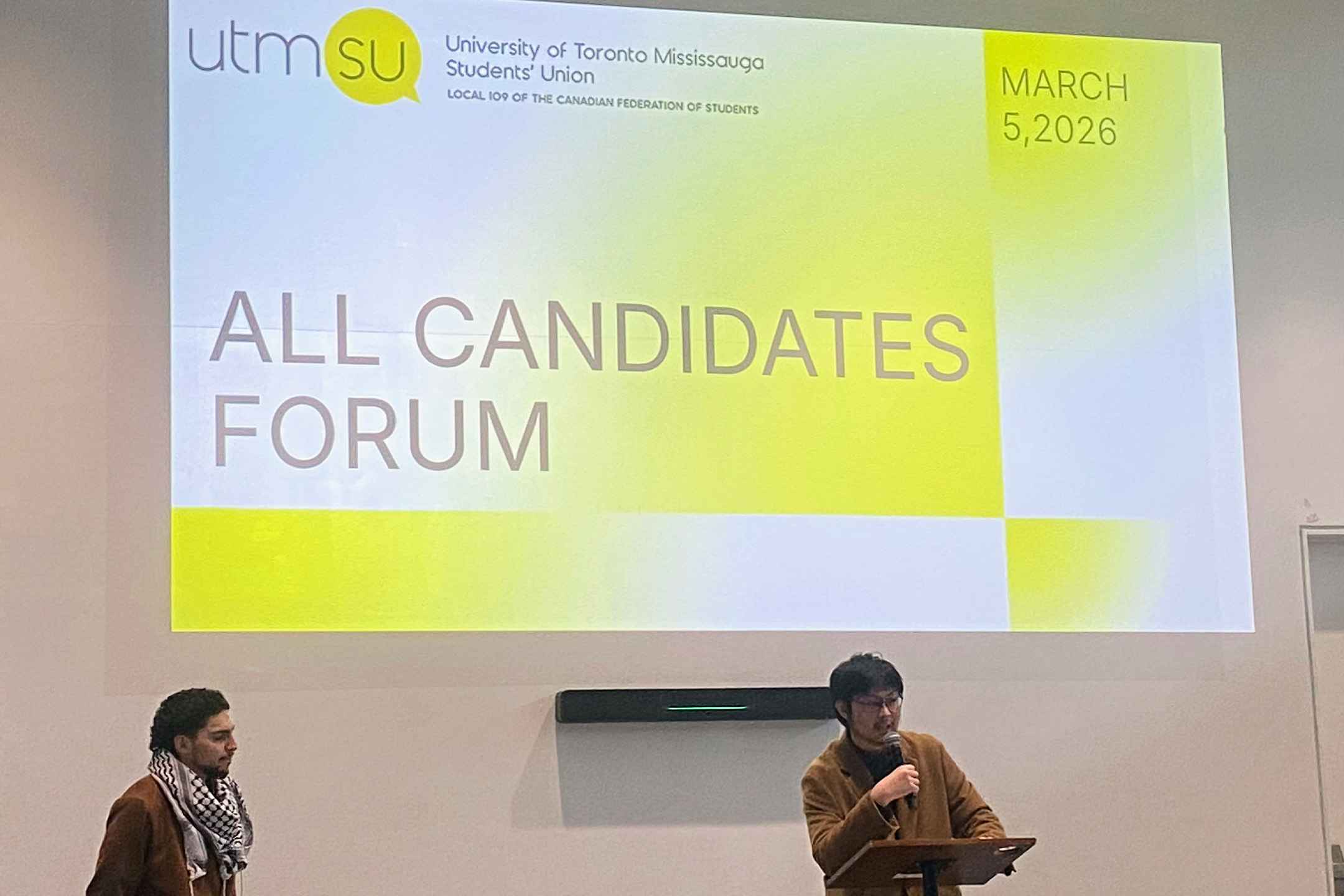
On March 5, candidates from the IgniteUTM and ServeUTM slates participated in an “all candidates forum” ahead of the UTMSU election. The entire debate can be viewed on the UTMSU’s Instagram page.
Voting will take place from March 10–12, with polling stations open each day from 9:00 am to 6:00 pm. Students can cast their ballots at five campus buildings: William G. Davis Building (DV), Communication, Culture, and Technology Building (CCT), Instructional Centre (IB), Deerfield Hall Building (DH), and Kaneff Centre (KN).
Presidential candidates
The presidential candidates were first asked whether they felt confident serving as the face and spokesperson of the UTMSU, and what experience prepared them for the role
ServeUTM’s XinChun (Oliver) Wang, a first-year student, framed his answer around his personal background and leadership experience before coming to UTM. Wang pointed to his experience founding a philosophy and social sciences club in high school, serving as vice president of Model United Nations, and leading a debate club.
“The job of the president… requires the ability to express himself precisely and clearly,” Wang said. “Based on [my] previous experiences, I would say I do have that ability.”
Ignite’s Adam El-Falou said his experience in student governance and advocacy made him the stronger candidate. “Yes, I am very confident,” El-Falou said, “The presidency position is not just a label, but it should actually reflect and prove that you have had the experience that’s relevant in your past.”
El-Falou pointed to his experience serving as UTMSU board director, where he said he learned how student union processes work and how to translate student concerns into action.
“In my time as a director on the board, I actually worked on two main things,” El-Falou said, citing the establishment of the Palestine Committee and the installation of bidets in the student centre.
The next question asked what the candidates believed should be the UTMSU’s top priority next year, given recent changes to post-secondary funding, including possible Ontario Student Assistance Program (OSAP) cuts.
El-Falou said OSAP should be the union’s main focus. “I’ll be very clear, for next year, the priority should be the OSAP,” he said, adding that “almost every single person that I have approached… their [priority] is the OSAP cuts.”
He said the union should focus on advocacy efforts, including petitions, protests, and pressure on provincial representatives. “The goal is coordinated advocacy, petition, public pressure and direct political action so students don’t absorb the cost of decisions made on top.”
Wang acknowledged the importance of OSAP but argued that building stronger student unity should come first. He said the union should focus on “building up solidarity across our campuses to prepare for future fight against Bill 33 and OSAP cuts.”
When an audience member challenged his priorities, Wang responded, “I never said that the student protest is not effective.” He argued instead that protest action would be stronger if the campus first built a closer community.
Audience members asked the candidates how they would ensure the bursary program continues to support students facing financial insecurity.
El-Falou said bursaries would remain important, but described them as only part of the solution. “The bursary program has been happening for years now, and it will continue to happen,” he said. “Giving financial bursaries is a great idea, but… it is a very short-term solution.”
Wang said the union may need to rely on its reserves in the short term. “The student union still has a very strong budget reserve,” he said, adding that it could serve “as a temporary assistance to the students who are facing actual problems.”
Wang was also asked how he would fund his campaign promise to provide daily mental health support in the student centre. “The student union has a relatively stable budget,” he said, adding that his team would “invite licensed professionals to establish a planning position… to give advice and help our students overcome mental issues.”
The candidates were later asked how they would ensure students’ concerns about global political crises are heard and acted on.
El-Falou said Ignite’s platform includes “establishing the global crisis community.” He added, “The student union is not the executive committee, it is the students themselves,” and said the committee would allow students to “come and raise their concerns, and they can work on these causes.”
In response to this question, Wang said his team would focus on “strengthening the ties between student unions and groups from all of U of T campuses, as well as those organizations and associations in our local community.”
VP Internal
The VP Internal candidates were asked what they would change regarding the way the UTMSU currently operates.
Xingyi (Freya) Gao from IgniteUTM emphasized the role of the UTMSU in fostering a community on campus. “Sometimes clubs may feel unsure about where to go for support or to navigate certain processes. As VP internal, I’ll focus on strengthening communication between UTMSU and student leaders, whether through clear resources, stronger outreach, or collaborative spaces where [the] clubs can share ideas and concerns.”
Manal Ali from ServeUTM said that she’d like to improve “the communication between the people that have a ton of ideas but just don’t really know where to go in order to voice them, or how to really navigate the process of actually putting their ideas out to people that can help them actually collect it into campus life and the general UTM community.”
VP University Affairs
One question asked of both VP University Affairs candidates was how they would approach a disagreement with senior officials at the university.
“The most effective approach is constructive advocacy that is grounded in communication and evidence,” said IgniteUTM’s Dana Al-Habash. She further explained that she would first “ensure that the student concerns are clearly understood.”
She would do this by “gathering feedback, listening to student testimonials, launching surveys, and gathering data on the various academic policies that students may be unhappy with,” and then approach “administration… in a professional and solution-oriented way, recognizing that universities also do have their policies and institutional constraints.”
Marim Botros from ServeUTM said she “would try to give [students] choices like a pilot program, a few courses, a temporary fix for this semester, or a phase change over time, so it’s easier to improve.”
If the administration declines, Botros wouldn’t just accept it and leave; she would ask direct questions like “What exactly is blocking this? Who has the authority to change it? What would need to happen for this to be approved?” She would be transparent in providing that information to students, so they “don’t feel like things are happening behind closed doors.”
VP Equity
This year, there is only one candidate running for the VP Equity position. The Chief Returning Officer (CRO) clarified that although the position is uncontested, that “does not mean it’s an easy win. [Students] will still have to go to the ballots and vote… in favour or [to] abstain.”
IgniteUTM’s Tiffany DaSilva was asked what equity means to her, and she responded, “Equity at UTM should be active, visible and institutionalized, not reactive. My goal is to ensure that equity is reflected in how decisions are made, how resources are distributed and how student voices are represented within the student union.”
Another question asked what action she would take to make the UTM campus more equitable. DaSilva proposed changes to the current catering restrictions since they “make it difficult for clubs to access affordable and culturally appropriate food options.” She expressed, “Many cultural clubs and student organizations rely heavily on food, celebrate traditions, host community events, and create spaces where students feel connected to their identity.”
“Equity is… not only about policies. It’s also about whether students from different cultures are respected and supported on campus.”
VP External
There are two candidates running for VP External, but only the IgniteUTM candidate — Rajas Dhamija — was present at the debate. The ServeUTM candidate — George Maafo — was taking a quiz. The ServeUTM team answered questions on his behalf.
One question to the candidates was about their plans for collaborating with other student unions across the province in light of Bill 33 and the potential cuts to OSAP.
Dhamija began by saying, “advocacy [is] strongest when student unions work together. Focus should be on putting together a coalition with other unions.” He added that in his past term as VP External, the UTMSU has already worked with other unions and “will continue doing so together against the policies that make students suffer.”
After uniting the unions, Dhamija said they “should then focus on a mass email campaign, alongside reaching out to their local MPPs to put some pressure on the government against these bills and OSAP cuts.”
A ServeUTM member read a text from Maafo, sharing how OSAP “is very critical for residents of Ontario, and most students who are funded by this program are from the marginalized groups in the society.”
The message further added that he sees “the potential of political engagement across all three campuses at our university,” and will “first reach out to the student unions from the other two campuses, collaborate with them, and take collective actions after gaining a unity of opinion.”

No comments to display.