
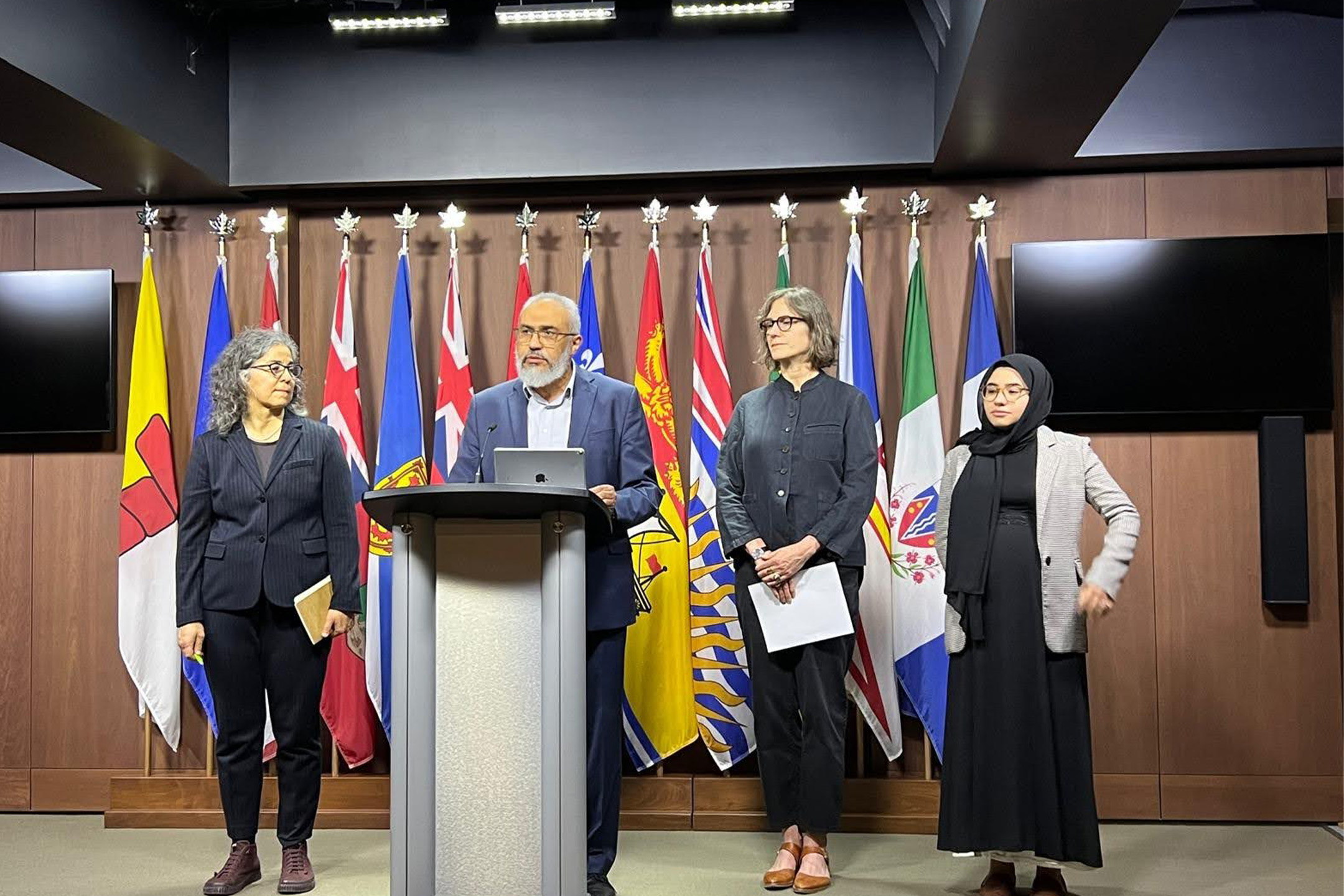
At a June 2 press conference on Parliament Hill, advocates called on Prime Minister Mark Carney and federal ministers to urgently resolve delayed study permit applications for students from Gaza. Representatives from the Palestinian Students and Scholars at Risk Network (PSSAR), the University of Toronto Faculty Association (UTFA), and the Legal Centre for Palestine (LCPal) attended.
According to these organizers, 15 faculty associations across Canada, including U of T’s UTFA, signed letters to the prime minister and the ministers of immigration, public safety, and global affairs, calling for “immediate accountability and resolve.”
The press conference marked the latest escalation in a months-long advocacy campaign for Palestinian students who have been accepted into Canadian graduate programs but are unable to secure a visa to begin their studies in Canada. This comes three weeks after The Varsity reported on advocates and members of the NDP calling on Ottawa to introduce flexible processing measures for Gazan students facing stalled applications and biometrics barriers.
Prior to the press conference, the Canadian Press reported that the federal government was expediting visa processing for 37 Gazan students and their families in other countries, according to an announcement from Immigration Minister Lena Diab’s office.
Advocates say some students have waited up to two years for a final permit decision, while others have lost funding or admission offers because of the delays.
Escalating pressure
Amer Shalaby, a professor in U of T’s Department of Civil and Mineral Engineering and a PSSAR board member, said the stalled permits have affected faculty members who are waiting for admitted students to join their research programs.
Dania Kassim, a representative from LCPal, said the organization is concerned that Palestinian students are facing “unreasonable delays and unjustified extra scrutiny,” including what she described as “accusatory interrogations.”
“Palestinian students are seemingly being presumed guilty with little opportunity to know what they’re being accused of by virtue of being Palestinian,” Kassim said.
Additionally, Kassim said students still in Gaza are unable to provide biometrics required for a visa because the nearest collection centre is in Egypt, and the borders remain closed. She argued that the federal government has the legal authority to waive or defer biometrics requirements when collection is impossible or not feasible.
Similarly, Terezia Zorić, president of UTFA, criticized Immigration, Refugees and Citizenship Canada (IRCC) for not considering biometrics waivers for Palestinian applicants, “unlike previous crises” such as some cases for Afghan and Ukrainian applicants. “This is a key reason why we allege a double standard in response to other crises,” said Zorić.
Government says processing is underway
According to the Canadian Press report, most of the 37 students have received a final decision, but Diab’s office did not say how many were approved or denied. Shalaby said advocates were also told by IRCC that there was no confirmed timeline for completing the expedited process.
The lack of a clear timeline is confirmed by IRCC’s online processing-time tool, which currently lists no available processing time for study permit applications from Gaza and the West Bank.
Shalaby said that resolving the permit delays is a “complex issue” that requires “collaboration and coordination of multiple [federal] departments.”
She said that they have tried speaking to individual departments separately in an attempt to facilitate collaboration, but that approach has not resolved the permit delays.
“This is not going to come, except from top down… [from] Prime Minister Carney to ask for the cooperation of the different departments, IRCC, Public Safety, and Global Affairs Canada, to work together to resolve this issue.”
Legal group raises concerns about interviews
Shalaby said that a group of Gazan students in Egypt were recently called in for interviews by IRCC, which advocates initially hoped would signal progress on their applications. Instead, he described the interviews as a “witch hunt.”
“The students were aggressively interrogated, and the bias of the officers was shown throughout the questioning process,” Shalaby alleged. “The students were asked about university affiliations and were made to feel guilty because they simply lived in Gaza, grew up in Gaza, and studied in Gaza.”
He said 11 students who graduated from one of Gaza’s top universities reported negative experiences after their interviews, leaving them feeling “intimidated” and “confused.” Some students have withdrawn from the process after losing hope in “the possibility of receiving a response, a favourable response from Canada, or at least a transparent process that they can understand,” he added.

No comments to display.