
Content warning: This article contains mentions of violence, war, and severe injury.
After more than two years of siege and catastrophic destruction, Gaza’s healthcare system is on the brink of collapse.
According to a United Nations article published in October, only 14 of the original 36 hospitals in Gaza remain partially functional, with many on the brink of closure. Those hospitals continue to be overwhelmed with patients, and critical shortages of medicine, fuel, and essential medical equipment have left a quarter of the population with life-altering injuries.
In particular, over 5,000 people have been reported to have experienced severe injuries to their limbs and spinal cord, or have undergone amputations. Amid this crisis, 23-year-old Palestinian student and refugee Yasser Alostath has turned to engineering to develop simple, low-cost prosthetics for patients with amputations in Gaza.
Alostath’s background
Raised under the Israeli occupation and blockade, Alostath pursued engineering out of a deep interest in science and a relentless desire to understand the world around him. His story reflects a generation of Palestinian engineers determined to transform adversity into opportunity.
“Since childhood, I have been captivated by inventions and science,” Alostath wrote to The Varsity. In school, he built mechanical models and spent his breaks in the lab conducting experiments, working with limited materials but driven by boundless curiosity and a passion for innovation.
Alostath does not only consider engineering a profession, but a philosophy of purpose. “To me, engineering is more than just a field of study; it’s a way of life.”
His studies, however, unfolded under the constant shadow of conflict. “I grew up in an environment of constant wars, where not a single day passed without destruction […] I viewed the world around me differently, like someone observing the outside world from within a massive prison holding two million people.” Despite growing up surrounded by devastation, what captured his imagination was not only the ruins of war but the machines that shaped them.
The ceaseless hum of Israeli drones and the sight of low-hovering helicopters and tanks instilled an unexpected sense of curiosity in Alostath. “Every time I saw the occupying forces’ helicopters or surveillance drones […] I became more fascinated. I had never seen an aircraft up close, let alone ridden or touched one.”
From that uneasy fascination, he gained a deep resolve to understand the engineered systems behind the technologies used for such destruction. The knowledge stored in these instruments of war awakened in him a longing to learn and create.
In March 2018, the Great March of Return began: a series of mass demonstrations held by Palestinians near the Gaza-Israel border demanding the end of the Israeli blockade. Alostath watched as thousands of Gazans were wounded, with many losing limbs to sniper fire and artillery fragments.
These scenes left a lasting emotional impact, motivating Alostath to turn despair into focused resolve to alleviate the pain of those whose lives had been irreversibly altered. “I saw my people losing their limbs at the borders, helpless to stop their suffering. I desperately sought to think of something I could do, something to ease their pain with the little I had.”
Developing prototypes
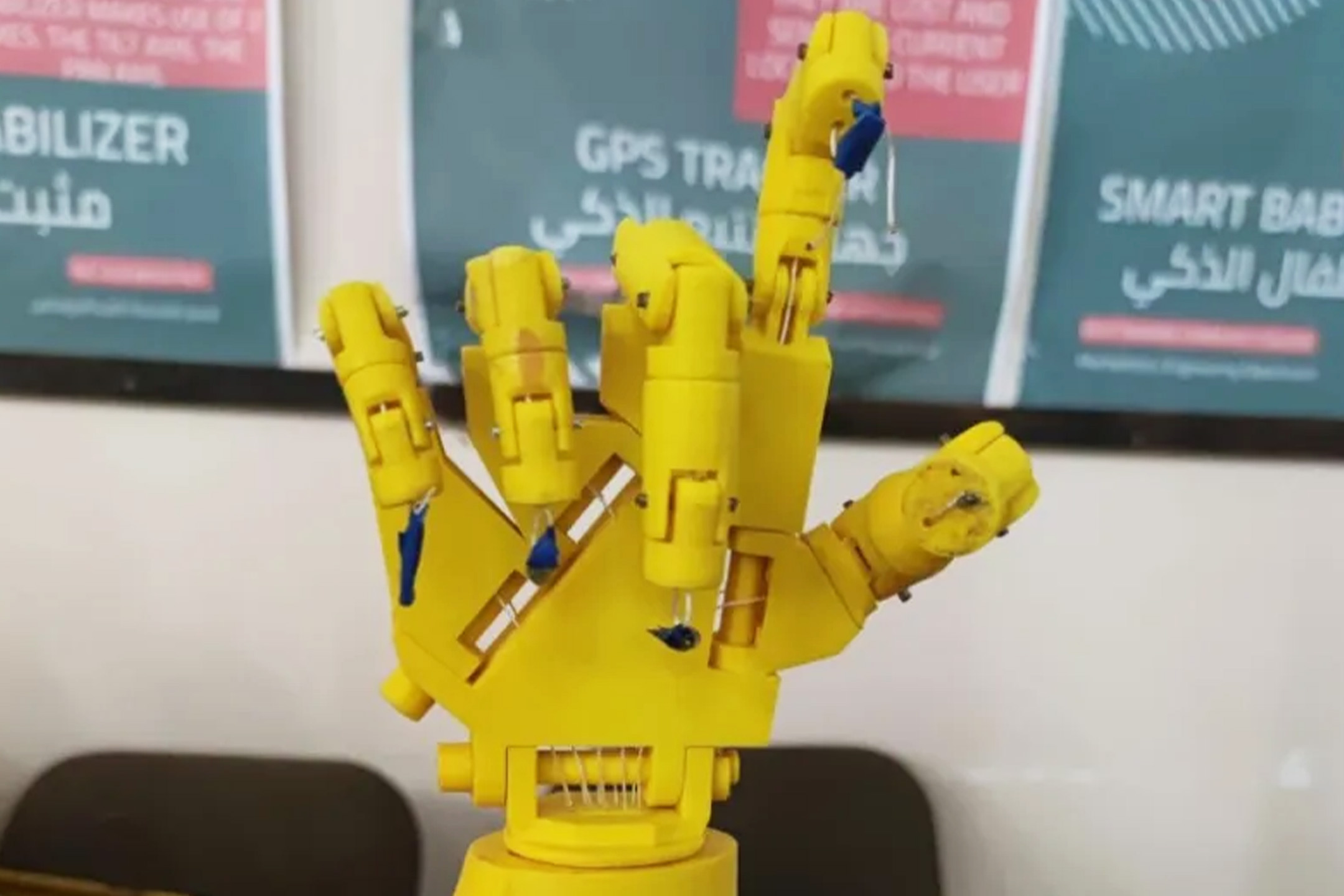
In his final year studying mechatronics engineering at the United Nations Relief and Works Agency (UNRWA) Gaza Training Centre, Alostath dedicated his graduation project to help those with amputations in Gaza, developing a prosthetic hand that could be controlled by nerve signals from the brain and muscle signals from the body. Alostath established the “Hand of Hope” project as an innovative response to help those injured in Gaza, aiming to restore mobility through locally developed prosthetic technology.
Developing this project demanded the kind of improvisation that few engineers elsewhere in the world must endure. Under Israel’s blockade of the Gaza Strip, imposed since 2007, even basic electronic components are classified as restricted materials, severely limiting access for Palestinian engineers and researchers.
“This is the core problem behind everything in Gaza: the occupation,” Alostath explained. “Everything is forbidden. For the prototype of my project […] I needed essential sensors. Yet, due to their unavailability, I had to improvise.”
The development of the project was featured by Palestine Deep Dive, highlighting Alostath’s resourceful prosthetic development and problem-solving. He designed a simple glove system, fitted with custom sensors that mimic how muscle signals are detected and translated into movement.
As 3D printers are also restricted under the Israeli blockade, Alostath constructed the prosthetic’s framework using whatever resources were available: aluminum drink cans, hot glue sticks, and juice straws. Against all odds, the prototype proved functional, responding to muscle signals and replicating natural hand movements with measurable accuracy; however, it did not achieve full functional precision due to the lack of specialized materials.
While Alostath has succeeded in developing a simple functioning prototype, the current circumstances in Gaza have made it impossible for his project to reach its full potential. “Despite overcoming immense obstacles […] I couldn’t complete the project or produce a fully functional model to test on amputees,” he explained. “There are no supportive institutions, […] no available resources, and every effort I made was met with relentless attempts to crush my ambitions and sabotage the goals I worked so hard to achieve.”
Alostath envisions that the “Hand of Hope” could serve as a viable solution for those unable to leave Gaza for medical treatment, instead offering a local and affordable prosthetic alternative. Alostath emphasized the urgency of production and innovation within Gaza. “My people are in dire need of implementing this idea,” he wrote. “We are living in an era of great technological and industrial advancement, where science increasingly serves humanity. With the right solution and a well-designed prosthetic limb, their lives could undoubtedly be transformed for the better.”
According to the World Health Organization (WHO), nearly 42,000 people in Gaza now live with life-changing injuries, including more than 10,000 children.
Alostath views this not only as a health crisis, but as an engineering challenge which demands innovation and investment. Reflecting on Gaza’s future, he wrote that “the most critical priority after the war must be establishing a mechanism to rehabilitate the innocent victims who have lost everything — their families, their limbs, and their futures through no fault of their own.”
With the borders of Gaza having limited mobility and prosthetic care being both inaccessible and unaffordable for many, Alostath’s work is one of the few viable paths toward recovery for those with amputations in Gaza.
Amid devastation and loss, Yasser Alostath’s journey reflects a truth that extends far beyond Gaza — that the pursuit of knowledge is itself a form of resistance, and that science and curiosity, even in the darkest of times, remain a path toward restoring humanity.

No comments to display.