
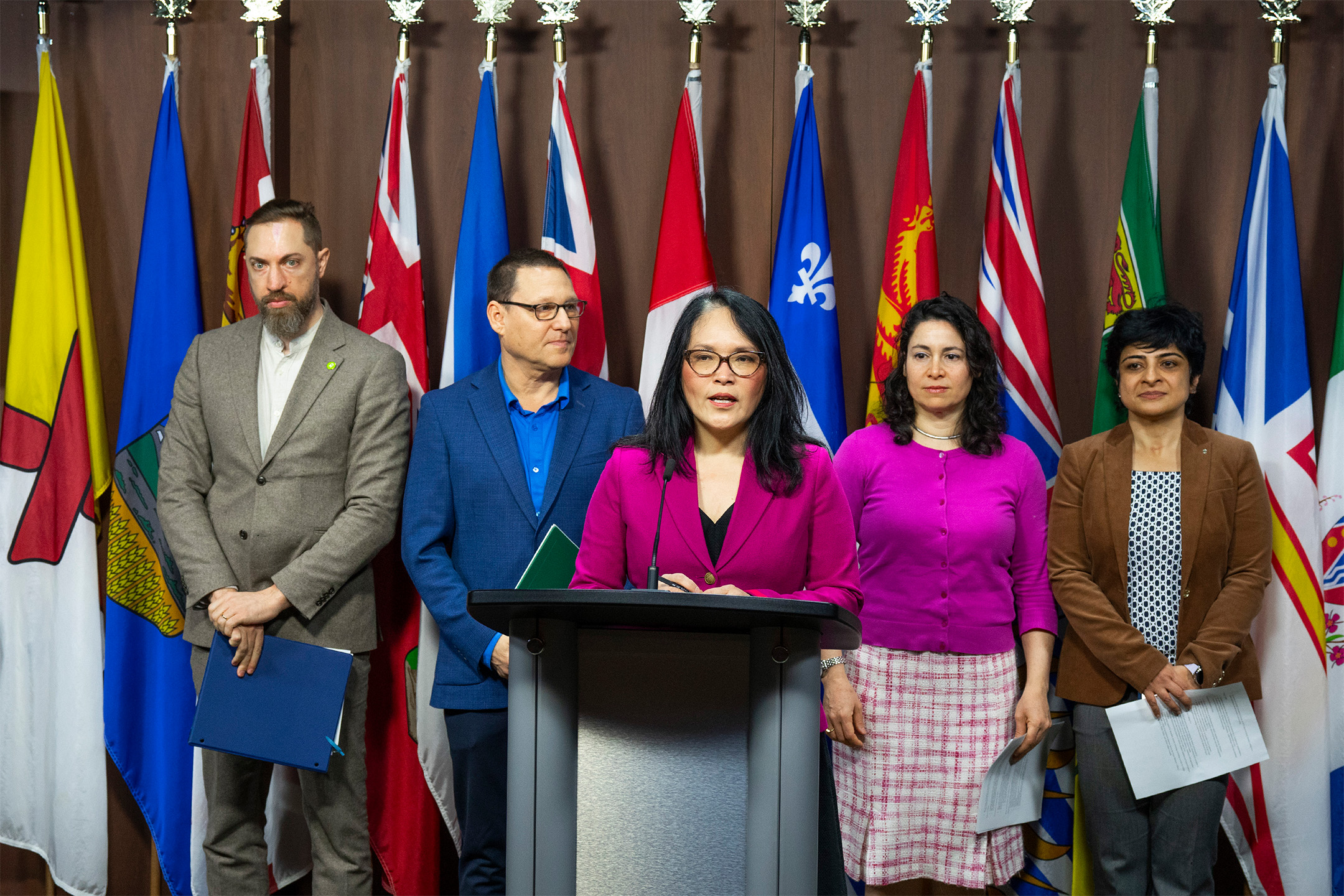
Advocates and members of the New Democratic Party (NDP) gathered on Parliament Hill on April 14 to escalate pressure on Ottawa over alleged discriminatory immigration delays. This comes more than a month after The Varsity reported on 12 Palestinian students admitted to U of T struggling to secure Canadian study permits.
At last month’s press conference, NDP leader Avi Lewis and Jenny Kwan, MP for Vancouver East and the party’s critic for immigration, refugees, and citizenship called on the federal government to implement new measures. They pushed to introduce flexible processing measures for Palestinian students from Gaza whose Canadian study permit applications have remained stalled for months or years.
The press conference featured speakers from Palestinian Students and Scholars at Risk (PSSAR), academic leaders, and Oxfam Canada, a global organization that works to address the root causes of poverty and inequality with a focus on women’s rights.
For many speakers, the issue was no longer simply about bureaucratic delay; it was about whether Canada’s immigration system is willing to adapt during a humanitarian catastrophe.
Biometrics remain a central barrier
A major focus of the conference was Canada’s continued enforcement of biometric requirements — fingerprints and photographs — which can only be collected outside of Gaza, usually in the West Bank or Egypt. However, the route previously used to complete the process in Egypt has remained closed since May 2024.
“The Liberal government knows full well that there are no functioning processing centers in Gaza,” Lewis said.
Lewis argued that Canada has previously introduced flexible immigration pathways during crises in Ukraine, Afghanistan, and Syria, including exemptions, deferred biometrics, and third-country processing.
“So the question is not whether or not solutions exist,” Lewis said, “It’s whether this government has the political will to do the right thing.”
Kwan echoed these concerns, particularly advocating for applicants who have already fled Gaza and completed biometrics in Egypt or Jordan.
“We have students whose biometrics have been completed, yet [the Canadian government] still refuses to complete the processing of those visa applications,” Kwan said. “There is no justification for it.”
Delays framed as “abuse of process”
Vasanthi Venkatesh, associate professor at the University of Windsor Faculty of Law, argued the delays represent a breakdown of the legal system.
“This processing delay is an abuse of process,” Venkatesh said. “It’s a breach of basic procedural fairness.”
According to Venkatesh, Canada’s immigration laws already permit flexibility when biometric collection is impossible or unsafe, but these provisions are not being meaningfully applied to Palestinian students.
Instead, she said, applicants are being subjected to prolonged uncertainty, repeated deferrals, and what she characterized as “administrative cruelty.”
“There is no excuse for indeterminately delaying processing,” Venkatesh said. Approximately 50 students are now at risk of losing academic offers altogether if delays continue, she added.
Venkatesh also accused the federal government of treating Palestinian applicants differently than other students fleeing crisis situations.
“It also marks systemic bias and discrimination on the part of the government, as applicants from one country, from one region, are treated significantly differently from others,” she said, referring to students from Ukraine, Afghanistan, and Syria who have received flexible immigration pathways in the past.
Student testimony highlights personal toll
Alaa, a Palestinian doctoral student who has been admitted to a PhD program at the École de technologie supérieure (ÉTS) in Montréal, joined the press conference via Zoom from Cairo.
Alaa is one of five Palestinian doctoral students who have filed mandamus applications with the Federal Court to persuade Immigration, Refugees and Citizenship Canada to process their visa application.
He says he has been waiting nearly 23 months for a decision on his study permit application.
Alaa said he previously came to Canada in 2019 for research and left after his visa expired. He said his biometrics were already on file from his previous visit.
“I felt welcomed in Canada, respected, and inspired,” Alaa said. “It made me believe that Canada is a place where people are judged by their knowledge, their work, and their potential.”
Alaa said he has been admitted to a doctoral program in electrical engineering at ÉTS Montréal and hopes to research next-generation communication and artificial intelligence technologies.
“I want to continue my life. I want to continue my studies as a doctoral student. I want to contribute through my knowledge, but I cannot move forward without a decision,” he said.
He said taking legal action was not his choice, but that after nearly two years of silence, he felt he had no other option.
“I am not asking for special treatment,” Alaa said. “I am asking for consistency. I am asking for a decision today.”
Reputational and academic damage
Nadia Abu-Zahra, an associate professor at the School of International Development and Global Studies at the University of Ottawa, said legal action is increasingly becoming the only option for students.
“These students did not want to go to court,” Abu-Zahra said. “Legal action is a last resort.”
Abu-Zahra emphasized that Canada could implement practical solutions immediately, such as the permit flexibility measures implemented in the past.
“This situation is solvable,” she said, “What is missing is the decision to act.”
Daniel Komesch, manager of policy and advocacy at Oxfam Canada, warned that delays are undermining Canada’s global credibility while depriving universities of highly skilled researchers.
“Anyone who is admitted to a Canadian university and applies for a study permit should be considered based on merit, not where they come from,” Komesch said.
Komesch highlighted the case of his Oxfam colleague Meera, an engineer admitted to the University of Regina. She has been living in Gaza and has waited two years for her study permit, despite federal scholarship funding.
In a testimony read by Komesch, Meera wrote that, by getting her education, “I hope to equip myself with advanced skills so that I can return to the Gaza Strip with better knowledge to contribute to the efforts aimed at rebuilding our devastated infrastructure and fragile economy.”
Meera has been unable to complete biometric requirements for her permit due to the lack of functioning visa centres in Gaza.
Growing calls for federal action
Advocates are urging the federal government to allow biometrics to be completed in Canada, grant temporary exemptions or deferred collection, create remote or third-country processing pathways, increase transparency around security screening, and prioritize already-complete applications.
For Kwan, the issue should not be reduced to partisan politics. “It should not be an issue about whether or not the NDP wants to see this done. This should be done because it is good for Canada, because it is fair, it is just,” Kwan said. “It is about a fight for knowledge and for our future.”

No comments to display.