
Content warning: This article mentions sexual assault.
Outside the Royal Alexandra Theatre on the opening night of Mile End Kicks, the crowd parted, and a Megabus emerged. I wondered briefly if the bus had gotten lost, and had accidentally driven into the middle of an international film festival. The bus, I learned later, contained the cast of the film, and was transporting them to the theatre.
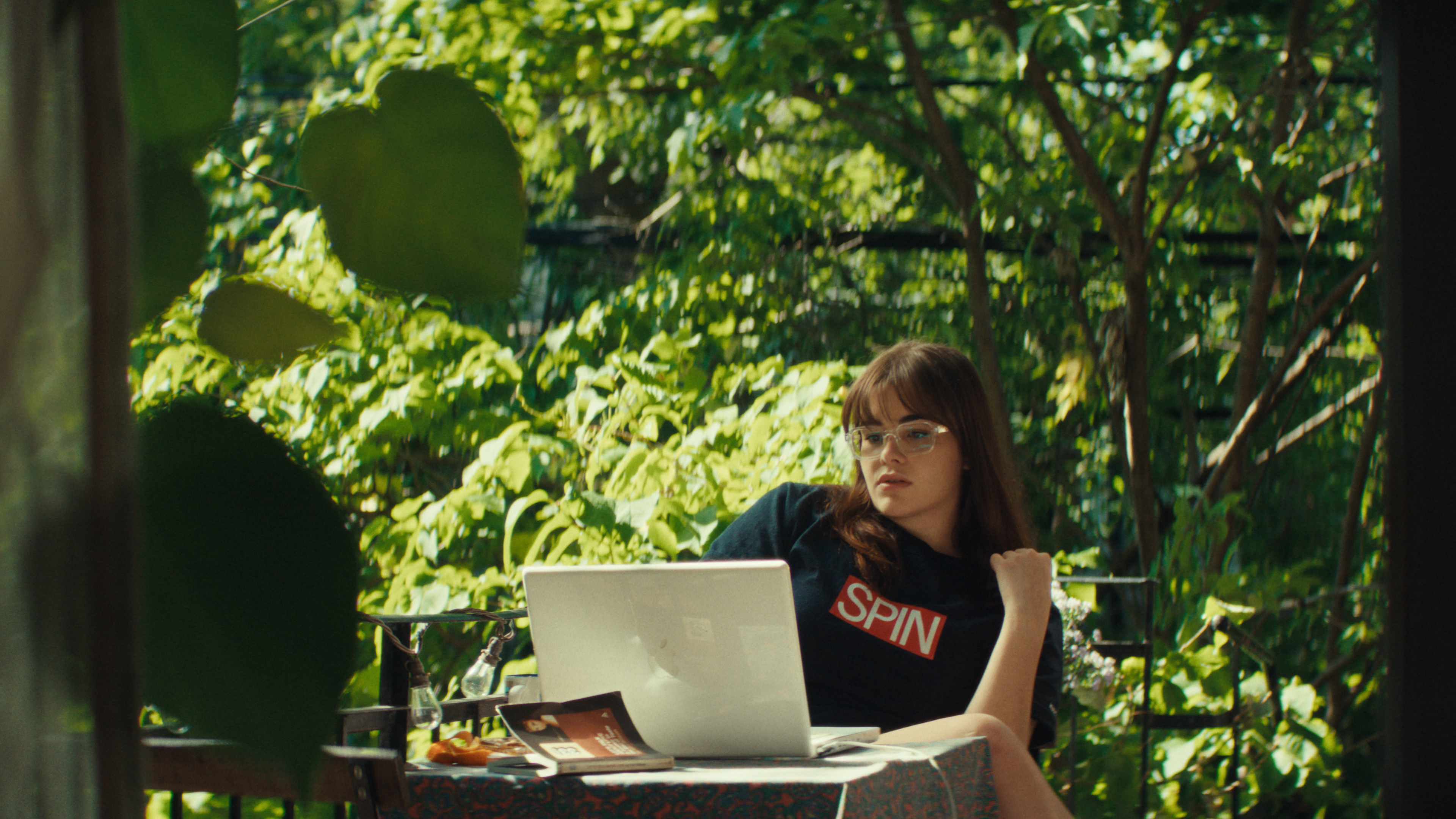
It’s Chandler Levack’s second feature film, but she wrote it before her first TIFF feature — the success of I Like Movies (TIFF 2022) secured the budget to make Mile End Kicks. The movie follows Grace (Barbie Ferreira) — a young anglophone music critic at a Canadian indie magazine in 2011, where she is surrounded by men in plaid. Grace is moving to Montréal for the summer, where she’s subletting a room in Madeleine’s (Juliette Gariépy) apartment on Rue Saint-Urbain, and she’s writing a 33 ⅓ — a book centred around a seminal album — on Alanis Morissette’s album Jagged Little Pill, and is thrilled with her $500 CAD advance.
Grace leaves behind the Almost Famous poster in her childhood bedroom, a pool prone to turning green without explanation, divorcing parents, a little white dog, and a ‘Keep Calm and Burlington On’ poster in the living room. When she flipped off the CN Tower from her Megabus window, the crowd at my showing cheered. It’s a gesture I felt a special kinship with.
I spent the summer in Montréal for the first time in four years — I was the least cool kind of person there: a McGill student from Ontario — subletting an apartment in the Mile End not far from Madeleine’s in the film. As Grace traipsed up spiral staircases, sitting on shaded balconies, savouring early morning bagels, loft parties, park afternoons, poetry readings, I failed to forgive myself for moving to Toronto.
Before long, Bone Patrol — this is indeed the name of the band — arrives to disrupt Grace’s writing. She sees them play at a loft party, and, moments after proclaiming that she avoids drugs, smoking, et cetera, accepts weed from one of the band members and asks another for a cigarette.
She ends up romantically entangled with the two: Archie (Devon Bostick), the soft-spoken guitarist with secrets — he is fond of the answer, “personal reasons” — and Chevy (Stanley Simons), the frontman armed with floppy hair and a filthy apartment, spewing aloud his thoughts about art and ‘the abyss,’ easily distracted during sex, making Grace swoon with lines like: “I have, like, one beer back at my place.”
Mile End Kicks is a romantic comedy haunted by the story preceding it. Grace had been having sex with her editor-in-chief, Jeff (Jay Baruchel), whom he insisted she liked and wanted. In the summer, she stands on a rooftop watching Chevy play guitar, and asks him, bathed in hazy orange light with the sun setting on the horizon, if they could have sex there, where they could get caught. It’s a line that Jeff said to Grace when she was bent over his desk. She uses the language of traumatic sex because it’s one she knows.
The film’s structure is largely chronological — but the scenes between Grace and Jeff unfurl out of order. Near the start, Grace rips the plastic off Joanna Newsom’s Have One on Me with her teeth; it’s the album on which Newsom suffered vocal damage and didn’t speak for months. Grace, in turn, spends very little of the film actually writing.
The tension that runs through the film is one of inexpressibility: of wanting to be young and angry, unapologetic, sharp, incisive, but instead apologizing and smiling over and over again, of wanting terrible men, folding, giving in; of wanting to be a different kind of person, a different kind of woman, but not knowing how to get there.
Levack asks the audience — both as herself in a speech before the screening and through Grace, talking to Madeleine on her balcony — why women want guys in bands, and whether what they really want is to be a guy in a band.
This question is an idea from Levack’s first film, I Like Movies, a semi-autobiographical bildungsroman wherein the protagonist’s gender is switched, telling the story of Lawrence, a seventeen-year-old cinephile. My boyfriend confessed after the screening to staring at the men in suits giving speeches onstage, wondering “which one was Chandler.”
Near the end of I Like Movies, Lawrence’s manager Alana throws her hands up, asking, “Do you know what I would give to be a seventeen-year-old boy just quietly sitting in the corner watching my DVDs, knowing I’m going to inherit the whole fucking earth?”
Lawrence laments the tragedy that “I have to go through the rest of my life as, like, me,” while Grace continuously falls into being someone she doesn’t want to be as she becomes intoxicated with the idea of men in bands. The desire to know what it’s like to create something as someone else hangs over both films, and it might be why Grace can’t seem to write her book.
Mile End Kicks is a film full of great terrible slam poetry, great terrible men, great terrible sex, and thank god Levack didn’t give in to budgetary pressure to shoot the film in Hamilton and pretend it was Montréal — Québec, I imagine, would not have forgiven this easily.
Editor’s note: The director of Mile End Kicks was The Varsity’s Editor-in-Chief for Volumes 128 and 129. Thank you Chandler Levack for championing our Arts & Culture section <3

No comments to display.