
In 1964, aspiring filmmaker David Secter pitched his concept for a film about the unlikely ‘friendship’ between two U of T students. His prospective cast and crew thought nothing more of the relationship between the main characters. Indeed, several of the actors would later articulate their disbelief upon learning of the film’s expressly intended queer narrative.
Last year, Winter Kept Us Warm — described in retrospect by writer Chris Dupuis as “Canada’s first queer film” — celebrated its 60-year anniversary. Secter, the film’s writer and director, was a U of T undergrad during the film’s production — and, it turns out, a Varsity contributor!
Though he had much experience writing film reviews for The Varsity, Winter was to be Secter’s ambitious leap into the world of feature-length filmmaking. With barely a script and $8,000 amassed to fund the entire project, Winter became the first Canadian English-language feature to screen at the prestigious Cannes Film Festival in 1965.
And they were roommates… sort of
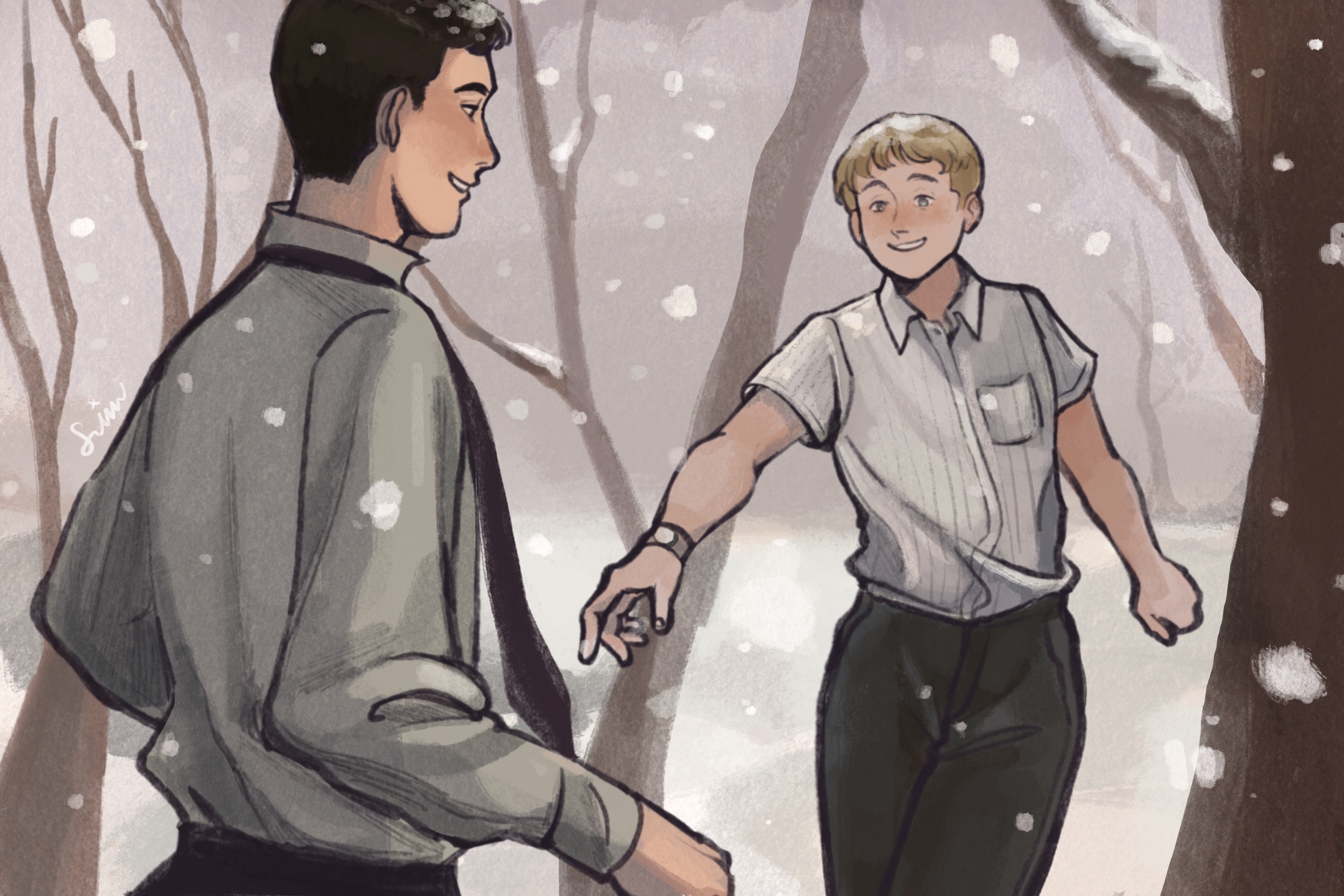
Winter centres on the relationship between Peter, a shy, mild-mannered first-year student; and Doug, an impish, jaunty frat boy. The film uses various motifs to emphasize the stark contrast between the two men. For instance, each has his own musical theme — Peter’s is sweet and mellow; Doug’s is fast-tempoed and jazzy. Peter walks with hunched shoulders, trying to take up as little space as possible; Doug moves with an exaggerated confidence and swagger.
After an awkward first meeting in the UC dining hall, the two have their first proper encounter at the Hart House library, where they briefly discuss the book Peter has plucked from the shelves — T.S. Eliot’s The Waste Land, the poem from which the film takes its title.
Doug develops an immediate and intense interest in Peter, which is only heightened by Peter’s initially cautious disengagement. As the pair spend more and more time together, Peter begins warming up to Doug’s playful antics. Meanwhile, Doug bares more of his soul to Peter, revealing the insecurities underlying his self-ascribed “big man on campus” persona.
As his yearning for Peter intensifies — made evident through numerous shots of Doug staring intently at Peter — Doug becomes more detached from his girlfriend, Bev. Tensions escalate in Peter’s budding relationship with Sandra, an upperclassman, and culminate in Doug’s bitter, jealous confrontation with Peter in the film’s penultimate scene — one which easily reads as a scorned lover suspecting their partner of infidelity.
The power of subtext
The film’s queer themes are subtle enough that Secter could maintain a degree of plausible deniability with his intentions when the film premiered. To many viewers in the 1960s, including the film’s own cast, the plot of Winter simply registered as that of a burgeoning friendship between two different students from different worlds as they navigated the uncertainties of university life.
Yet even at the time, there were suggestions — or rather, accusations — of something more to the relationship between Doug and Peter. When the subject was broached in a 1966 interview with the CBC, Secter’s response was decidedly noncommittal. He maintained that while some may consider that the dynamic between Peter and Doug “borders on latent homosexuality,” he was nonetheless “just dealing with… a friendship.”
Winter is not entirely a fictional story. In the decades since its release, Secter has been open about how Doug’s feelings for Peter drew heavily on his own experience with a close friend for whom he’d developed feelings — a friendship that ultimately dissolved when that friend began dating a girl.
This context, I think, is part of what makes Winter so compelling to revisit today. Mainstream audiences at the time may not have identified — or were perhaps unwilling to identify — the film’s underlying queer themes. Yet, one can’t help but wonder if there was a queer audience, however small, who may have seen something of themselves in the relationship between Doug and Peter.
Before Canada had even decriminalized homosexuality, Secter managed to craft a narrative that, while inconspicuous, stands as an early, sympathetic portrayal of queer experience in film. Drawing from his own experiences as a closeted university student, Secter’s clever use of subtext successfully tells the story of a man’s tragically unrequited love for another, through quiet yet powerful undercurrents of yearning and desire.
The amateur nature of Winter is precisely what makes it so profound. Though lacking the polish of a professional production, the film’s sincerity is an unmistakable reflection of Secter’s love for the medium and his goal of articulating a story that at the time struggled to be heard.
Today, Winter Kept Us Warm may register as little more than a footnote in the broader timeline of queer cinema — yet it is more than worth seeking out. I believe it is this kind of earnest, deeply personal storytelling, made in a time where such stories could only exist in the mainstream through tender, whispered expressions of affection, that has laid the groundwork for more open, creative expressions of queer identity today.
Winter Kept Us Warm is available for viewing on Blu-ray through the University of Toronto’s Film Library Audiovisual Collection.

No comments to display.