
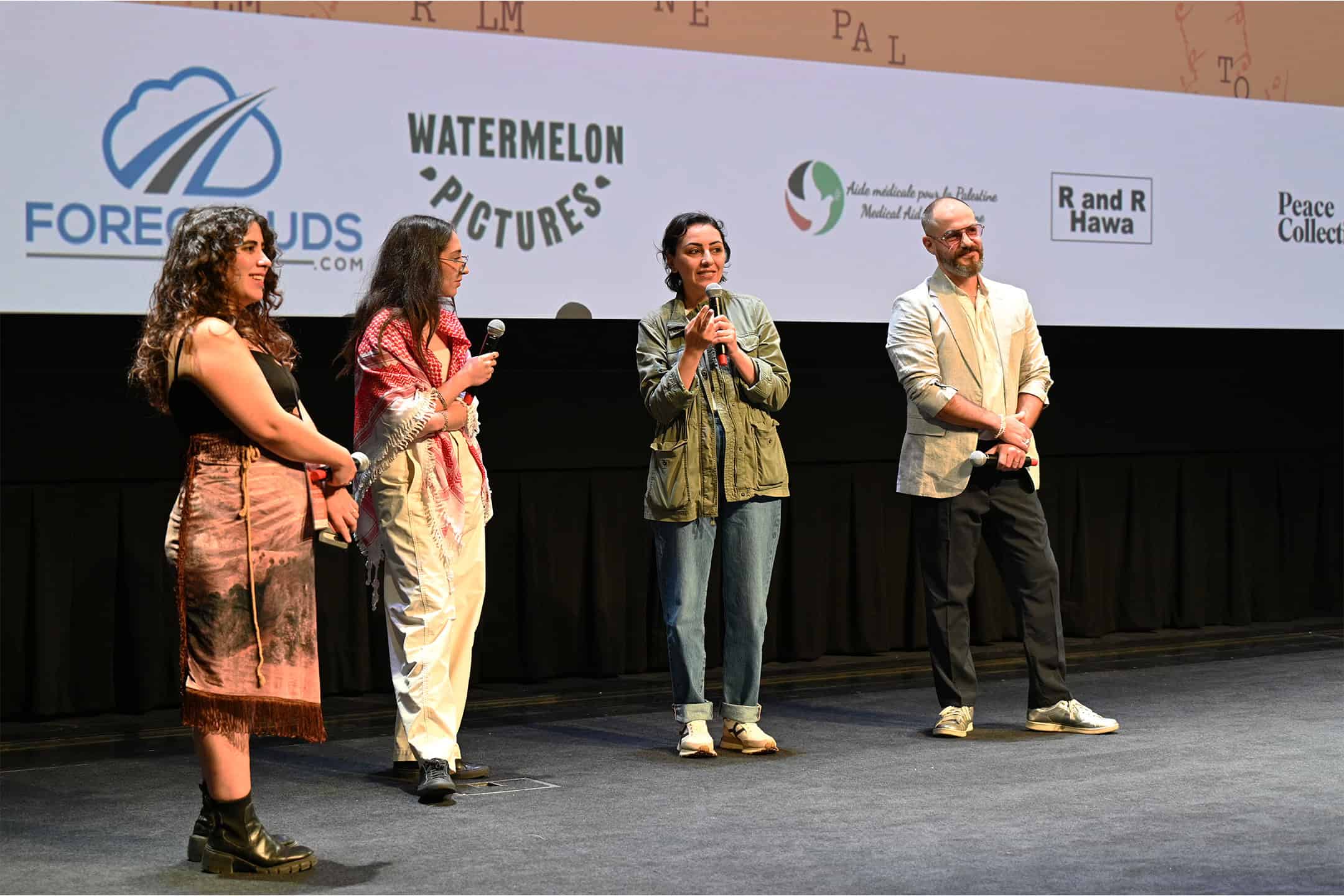
On Sunday, September 28, I had the pleasure of attending UNSILENCED: Anti-Palestinian Racism Shorts, which featured four short films at the TIFF Lightbox as part of the 18th iteration of the Toronto Palestinian Film Festival (TPFF). The series included Sara Balkis’ Between The Silence & The Noise, Paula Sahyoun’s The Silence They Taught Us, Rimah Jabr’s You’ve Seen it on TV, and Rodrigue Hammal’s Exception.
The films centre on anti-Palestinian and anti-Arab racism, as well as the censorship of Palestinian identity in mainstream media. While each short is a different genre, they all comment on the lived realities of Palestinians. These wonderfully crafted films left me to reflect on the impacts of media censorship, and take action to amplify Palestinian voices and media.
The screening began with Between the Silence & the Noise. It centres on Julia (Tracy Hawchar), a Lebanese-Canadian journalism student who cares for her grandfather, Antoine. Initially, Julia dismisses the shock on Antoine’s face as he watches bombings in Lebanon on the news. However, after her class on the Lebanese Civil War, she becomes more interested in uncovering her family’s history.
The film has a warm aesthetic with film grain, and comments on the treatment of journalists who fought to defend the rights of Lebanese and Palestinian civilians during the Lebanese Civil War. On April 1 2024, Israel passed a law banning foreign media in Palestine, forcing Palestinian journalists to cover the genocide themselves. The film speaks to the importance of having access to one’s history.
The second short screened was Paula Sahyoun’s autobiographical documentary, The Silence They Taught Us. The film began with a mix of live-action and animation, which spotlighted Sahyoun’s internal battle over whether to share with her friends that she is Palestinian. Rather than following a linear plot, this short takes us on Sahyoun’s journey of embracing her Palestinian identity.
The film contains interviews and animations to convey the challenges she faced in expressing her identity to others. As Sahyoun recounts, her father hid his identity, which she internalized as something to be feared. The film ends with a call to action, stating that reclaiming her voice is a powerful step towards collective liberation and that being Palestinian is the greatest gift of her life.
The third film was You’ve Seen it on TV, directed by Rimah Jabr. This short shifts between dark comedy, drama, and thriller to exemplify the broader issue of surveillance in suppressing digital actions and communications. The story centres on Zain, a graduate student, and his stalker and their two assistants who follow and interrogate him. In the short film the stalking never truly ends.
The film subtly references the ongoing censorship of Palestinian content on Meta-run platforms. On some of the largest social platforms, such as Instagram and Facebook, Meta issued thousands of content takedowns, nearly all being peaceful expressions of support for Palestine.
In an article for The Breach, a former producer at CBC noted that despite the ongoing genocide of Palestinians, senior executives did not want to make hosts uncomfortable, and later warned her during a staff meeting for bringing up the topic. As a whole, there are strict guidelines surrounding digital advocacy for Palestine. It is clear that, like Zain, many face repercussions for even small attempts at speaking out.
What I admired about this film was its unconventional plot structure. Starting as a typical dramedy, it morphs into a dystopian thriller, with distorted images and surrealism. The film ends on an ambiguous note, leading viewers to wonder whether this monitoring now reflects Zain’s new reality.
The final film of the series was Exception by Rodrigue Hammal, which, at 32 minutes, was the longest short in the series. This film is a hard-hitting drama about the devastating consequences of the loss of free speech. This film discusses the rise of professors losing their jobs as a result of speaking in support of Palestine. The team behind Exception skillfully captures the struggle Karim (Waleed Zuaiter) faces while making a life-changing decision.
When pressured to either sign a pledge to revoke comments he made advocating for Palestine, or lose his position as a professor, Karim must consider the two sides involved in this decision — his family and the administration challenging him. I was inspired by how Karim confronted authority, culminating in a plea to protect the university’s right to free speech and expression.
Walking away from the TIFF Lightbox, I learned four stories. Four new perspectives. Four lessons to carry with me, and above all, a responsibility to use my voice for social good. As a student who is heavily involved in the arts and media, on and off campus, it is my responsibility not only to create but also to amplify projects that combat these issues, such as the suppression of Palestinian voices. In a time when individuals are actively censored from speaking up for Palestine, artists cannot be silent. Not now, not ever.

No comments to display.