
If you’ve walked past Sidney Smith, Queen’s Park, or along Bloor Street to Ontario Institute for Studies in Education (OISE), you may be familiar with the large poster boards with graphic images and bold text that reads “ABORTION” or “LIFE.” Captions at the bottom write “first trimester” or “baby at 10 weeks.”
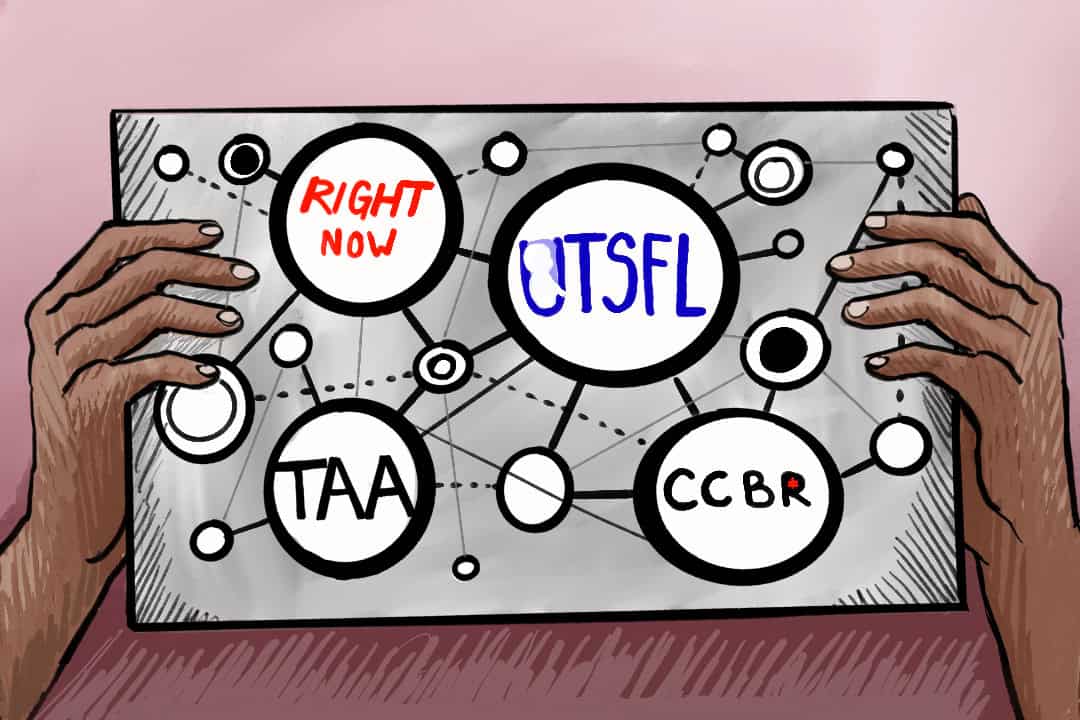
Despite years of coverage on anti-abortion protests at U of T, the groups behind these protests remain hard to pin down. My investigation seeks to uncover the network behind these protests: how, when, and why they appear across U of T, and how they adhere to U of T protest policies.
Cross-campus protests
In a message to The Varsity, Melani Veveçka, president of the University of Toronto Student Union (UTSU), wrote that at UTSG, anti-abortion demonstrations “appear on campus fairly regularly throughout the year.” She found that “they are more likely to be on campus at the start of the academic year, particularly around orientation, when campus activity is at its peak and there are more new, impressionable students.”
The start of every new school year brings with it a new cluster of young students excited to learn everything there is to know about life at U of T, absorbing all the new sights, sounds, and information on campus. That impressionability may make new students susceptible to the manipulative tactics, like upsetting imagery, that anti-abortion protestors on campus often use.
Anti-abortion protests are not limited to a specific message. Some are rooted in theology, featuring posters with text such as “life is holy” and “life is sacred.” Others adopt a more direct political language, with slogans such as “abortion kills children,” “human rights for ALL humans.”
Liz Rajesh, Co-Director of Branch Coordination for The Prevention, Empowerment, Advocacy, Response, for Survivors (PEARS) Project, wrote in a message to The Varsity that the timing of protests at UTSC is also consistent throughout the year, with an uptick during September.
However, the UTSC demonstrations do not seem to follow the same style of imagery as those prominent at UTSG. Rajesh has only “occasionally seen the more graphic posters […], but that’s quite rare.” Most of the protests she observes use text-based posters: “messaging is generally theological in nature, though sometimes it included broader anti-abortion sentiments.”
Which organizations are behind anti-abortion protests?
Many anti-abortion protests at UTSG are organized by Toronto Against Abortion (TAA), an anti-abortion advocacy group founded by Blaise Alleyne, a U of T alumnus who obtained his Master of Theological Studies in 2019. He is also the Eastern Strategic Initiatives Director of the Canadian Centre for Bioethical Reform (CCBR), another anti-abortion advocacy group that has staff who volunteer with TAA. The CCBR has an overarching vision of “an abortion-free Canada.”
The website whyhumanrights.ca is frequently linked at the bottom of these posters. Bernadette Zasowski, president of University of Toronto Students for Life (UTSFL) — a recognized student group that opposes “abortion, euthanasia, IVF, [and] embryonic stem cell research” — explained in an email to The Varsity, that whyhumanrights.ca is not an individual organization but rather an online resource. This website, which features similarly graphic videos, is also a project from the CCBR.
The graphic imagery, the bold text stating “abortion,” and the link to whyhumanrights.ca, are all common anti-abortion poster markers — especially by a CCBR project called “‘Choice’ Chain.”
In a message to The Varsity, Alleyne stated that “the signs, the pamphlets, the approach to conversations, and initial training in carrying out the project is standard and provided by CCBR.” Alleyne also wrote that before using CCBR materials, setting up anti-abortion events used to take the full day, but “once ‘Choice’ Chain became available as a project, it was a lot easier. It was a lot more portable.”
“ ‘Choice’ Chain is a project from CCBR that other anti-abortion groups can run — the signs, the pamphlets, the approach to conversations, and initial training in carrying out the project is standard and provided by CCBR,” Alleyne wrote.
While TAA is an independent organization, they have strong connections to anti-abortion student groups on campus. In fact, “Choice” Chain was started by Alleyne during his time with UTSFL.
“In 2014, I restarted the UTSFL activism team and we began running ‘Choice’ Chain monthly at U of T,” wrote Alleyne. “By 2015, we were running ‘Choice’ Chains weekly on campus. In 2016-2017, the activism team grew beyond UTSFL and became Toronto Against Abortion.”
To this day, TAA and UTSFL have maintained a collaborative relationship. Alleyne explained that TAA runs frequent outreach during the year at U of T, often aided by members of UTSFL, who volunteer with TAA.
Zasowaski also confirmed that “UTSFL partners with organizations like Toronto Against Abortion, which offers volunteer opportunities to advocate for human life.”
TAA’s activism is not limited to U of T. The group has run across several different university campuses in Toronto, including York University, Toronto Metropolitan University (TMU), and George Brown College. In April, TMU’s student newspaper, The Eyeopener, reported an increased presence of TAA on their campus in April.
While TAA seems to have the most active presence at U of T, it is not the only anti-abortion group that has made an appearance on campus. Veveçka wrote that It Starts Right Now Canada, an organization that seeks to elect anti-abortion candidates into public office, has also been “active in setting up displays and engaging with students on campus.”
Abortion politics
Abortion politics are divisive, which evidently manifests on campus.
Pro-choice advocates maintain that abortions are a human right and a necessary part of reproductive healthcare. Amnesty International — an international non-governmental organization that advocates for human rights — echoes this sentiment, emphasizing on their website that abortion is “a medical procedure that ends a pregnancy” and a “basic healthcare needed by millions of women, girls and people who can get pregnant.”
Nithya Gopalakrishnan is a co-executive of the Sexual Education Centre, a U of T student group that provides informational services about sex, sexuality, and gender identity. In an email to The Varsity, she wrote that “anti-choice protestors are advocating for a violation of bodily autonomy for [people with uteruses] by presenting people on campus with graphic images and intimidating rhetoric–neither of which should have any place on a university campus.”
A lack of access to safe abortions harms women and queer people. The United Nations Committee on the Elimination of Discrimination against Women (CEDAW) is a treaty body that seeks to monitor and implement tools to reduce inequality against women.
Their convention represents the committee’s work, which “has been instrumental in bringing to light all the areas in which women are denied equality with men.” They mention the importance of reproductive choice, such as access to health care around family planning and the right “to decide freely and responsibly on the number and spacing of their children.”
In 2022, CEDAW urged the United States to legalize abortion at minimum for cases of rape, as well as incest, threat to life, and fetal impairment, demonstrating the importance of abortion access for people with uteruses. Contrastingly, the CCBR heavily implies that the life of the fetus takes priority over the resolution of trauma in circumstances involving sexual assault, as is common among these groups.
These contesting views evidently manifest on campus, where organizations like PEARS are for abortion access and reproductive autonomy, while organizations like UTSFL are starkly against it. But student opinions at large on the right to protest about their positions — pro- or anti-abortion — can be mixed.
In 2017, Zach Rosen — The Varsity’s Current Affairs columnist at the time — wrote in an article that although he believes that the “ideology” behind the anti-abortion protests is “wrong,” he also believes that “the right to protest needs to apply equally to all points of view.”
“The student body at U of T is incredibly diverse,” wrote Veveçka, “with over 40,000 undergraduate students just on the St. George campus alone. With a community of that size, it’s natural that opinions will vary widely, including on an issue as complex and personal as abortion.”
Are debates and grey areas a recipe for weak abortion protest policies?
To Veveçka, the university needs to find a way to balance its duty to care for the well-being of its students — which can be harmed by the imagery and messages on anti-abortion posters — and the constitutional right to protest. “That means ensuring that advocacy on campus does not cross into targeted harm or create an environment that undermines a person’s sense of belonging or safety.”
Rajesh believes many UTSC students find the protests uncomfortable. “U of T is often seen as a progressive and inclusive space,” she wrote, “so witnessing protests of this nature on campus can be jarring and, for some, triggering, especially for those who have had related personal experiences.”
Part of coming to university is being met with opposing viewpoints to our own. However, I believe there is a line between platforming a different perspective and platforming intentional hate and misinformation.
These platforms are like pipelines, only exponentializing negative stigma around basic bodily autonomy. It’s hard for me to believe that these organizations are simply starting a conversation without creating a hostile environment for many students. But the constant ambiguity surrounding the ethics of anti-abortion protests might be what makes regulating them through policy so difficult.
U of T generally supports the right to protest and to express opinions on its campuses. However, it does impose limits on place, timing, and manner of protests in its user guide for protest policies. For example, protesters have to book specific spaces to protest, no demonstrations are allowed between 11:00 pm and 7:00 am, and there is zero tolerance for violence or excessive noise.
There may be a grey area around U of T’s protest policies that implicates discrimination. The policy prohibits the use of discrimination using “language… that demeans others based on their… gender identity or expression, sex or other categories in the Ontario Human Rights Code.”
However, there are no outlined restrictions on the use of graphic or disturbing imagery as a medium for demeaning or discriminating at protests. Anti-abortion protests commonly use disturbing images to garner shock value and attention, even to rile students up. So the lack of specification on how imagery, beyond words, can be equally as discriminatory is problematic.
In the case of anti-abortion imagery, it essentially subjects anyone who can have an abortion to discrimination. U of T specifically outlines that sex-and gender-based language discrimination, is prohibited, but visual-based discrimination seems to have slipped under the rug.
Veveçka similarly expressed her opinions on this grey area. “These pro-life groups often maintain that their intent is to express their belief rather than to target a specific gender, which provides them with a degree of plausible deniability. Whether that claim holds true is difficult to determine, and unfortunately, that ambiguity often allows such displays to persist without clear institutional intervention.”
Protest policies from other Ontario universities are similar to U of T’s. TMU’s guidelines acknowledge the importance of free speech and debate so long as they do not breach the realm of “harassment, disruption or acts of violence.”
York University’s protest policies are a bit more detailed. In their Guide to Freedom of Expression, they provide a list of unprotected expressions such as “suggesting its members are engaged in illegal or unlawful activities” and “degrades, denigrates or vilifies persons or groups.”
While these examples demonstrate a specificity that U of T lacks in its own policy, they still have enough ambiguity to absolve anti-abortion protestors of formal repercussions for spreading their message using disturbing imagery.
Education not persecution
Even if U of T did have stricter protesting policies, there would still be limitations on intervention. Protests often occur on public roads, which are not owned by the university, so, from a legal standpoint, the university can’t do much to intervene. Constant caveats seem to be what keep anti-abortion protests going, despite how much backlash they receive.
Even if there is no violation of U of T protest policy, even if students retain the rights to protest and freedom of speech, and even if anti-abortion organizations argue that they operate out of care and concern, it’s no less frustrating to see them politicize and eschew abortions.
Abortions can be lifesaving medical procedures in instances where a person’s health is compromised. They can help reduce unwanted pregnancies, ultimately reducing the number of children in already over-extended foster care and adoption systems. They enable women the bodily autonomy to prevent pregnancies that will interrupt their plans and goals for their own lives, even if they plan to have children later on.
Abortions should continue to be a right.
Like Rajesh says at the Sexual Education Centre, many on- and off-campus organizations offer the resources for sexual and reproductive health and wellbeing that can help you navigate any issues you face. Action Canada for Sexual Health & Rights offers statistical reports, factsheets, and a hotline for sexual health information. Birth Control Sexual Health Centre has information on pap smear results, a sexual health information line, and a distress line. Right here at U of T, the Health & Wellness Centre provides resources for birth control, emergency contraception, sexual assault support, and abortion care.
Where to obtain an abortion in and around U of T:
Closest to UTSG: Bay Centre (Women’s College Hospital)
- 76 Grenville St, third floor
- 416-351-3700
- womenscollegehospital.ca
- Manual Procedural: up to eight weeks gestational age (GA)
- Medication: up to 10 weeks GA
- Procedural in hospital: up to 24 weeks and six days GA
- No admin fees
Closest to UTM: Mississauga Women’s Clinic
- 101 Queensway W Unit 401
- 905-629-4516
- mwclinic.com
- Medication: up to 10 weeks and six days GA
- Procedural: up to 18 weeks GA
- Admin fees: $70
Closest to UTSC: East End Women’s Clinic
- 301–520 Ellesmere Rd
- 416-901-3278
- eastendwomensclinic.com
- Medication: up to 10 weeks GA
- Admin fee: $60
