
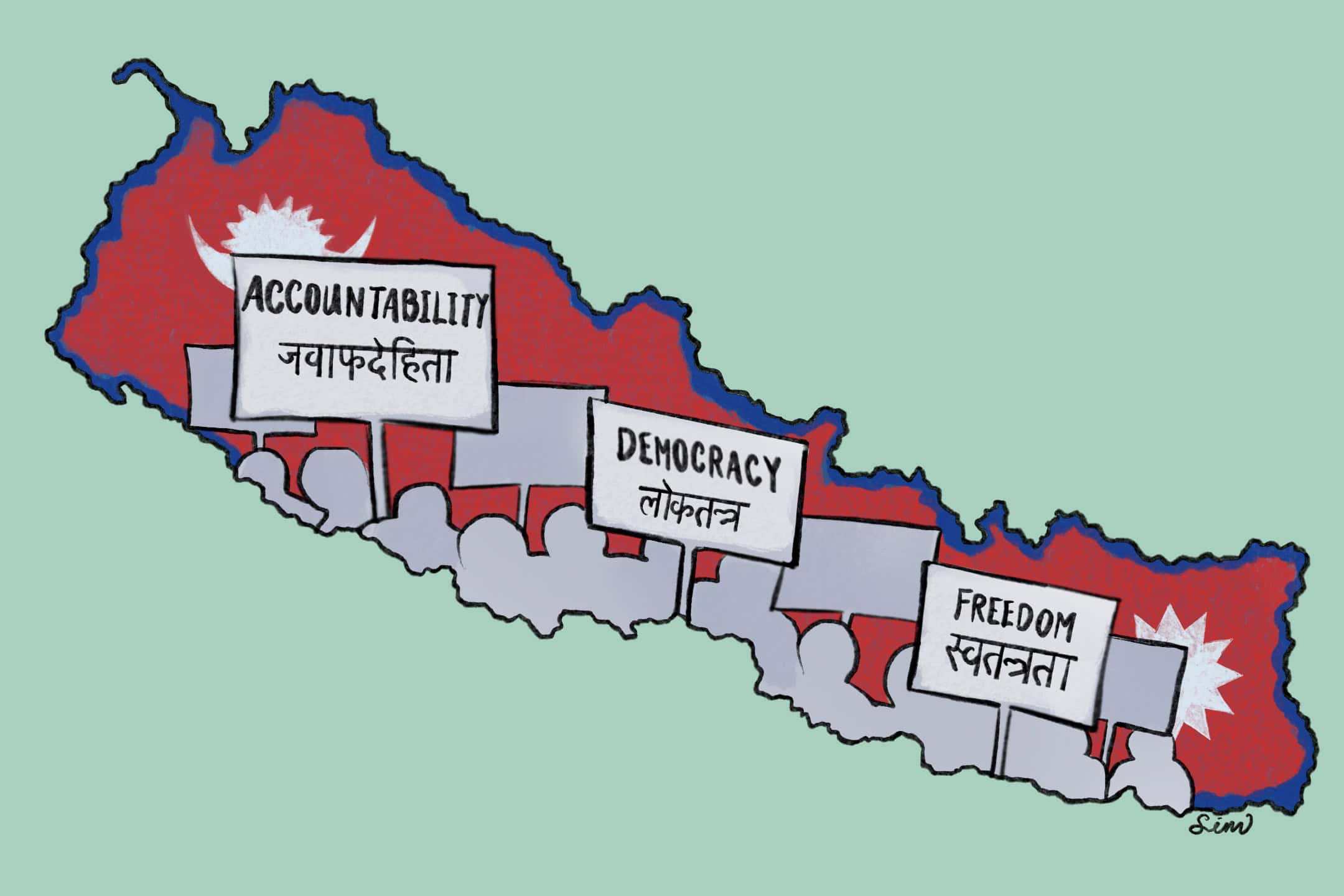
I have seen how older generations often perceive Gen Z as a generation that complains too much, being relentlessly outspoken about everything from politics to workplace culture to global justice issues. But I believe that it is this ‘complaining’ that became the force that overthrew an oppressive and unresponsive government in Nepal.
In an era when demonstrations and protests are often dismissed as ineffective and inconvenient, Nepali youth are showing that collective action can shake the foundations of corrupt power.
A political system that failed its youth
This September, a wave of protests filled Nepal’s streets, with citizens demanding accountability and change. The Nepali youth were protesting for change from the corrupt political ruling class and the socioeconomic issues they refused to address. Protestors demanded accountability from their government, as they failed to effectively address rising youth unemployment, inflation, housing insecurity, and shrinking economic opportunities.
What people might refer to as complaining was, in fact, a disapproval of systems that had let them down. Gen Z in Nepal questioned and organized against injustice instead of accepting or adjusting to it. This collective desire for change forces institutions to address issues that have been neglected for a long time.
Police crackdown and social media restrictions
Tensions escalated when police intervened for crowd control and safety. Violence erupted as protesters and police confronted each other in the streets of Kathmandu, marking a turning point in the protests. 19 protesters were killed, and hundreds were injured after police used guns, rubber bullets, and tear gas. Instead of deterring the demonstrators, the violence intensified the protesters’ resolve.
The government-imposed restrictions on major social media platforms, including Facebook, X, and YouTube, were justified by officials as a measure to prevent misinformation. For a generation that relies on digital platforms to share information, the restriction of social media felt like a direct attempt to silence dissent.
International media outlets have framed the protests as backlash against restrictions on social media platforms. But those on the ground reject this narrative, stating that the real cause is widespread corruption and abuse of power. For young people facing high unemployment and a political system seemingly ignoring the everyday struggles of citizens, the ban felt, to me, like an affront to both freedom of voice and expression.
On September 9, 2025, after protests swept Nepal, Interior Minister Ramesh Lekhak resigned, and within 24 hours, Prime Minister KP Sharma Oli also stepped down. Subsequently, the social media platform restrictions that sparked the protests were lifted by the government.
Gen Z protests
Dubbed the “Gen-Z protests” by mainstream commentators, the movement reveals the growing political influence of young people. When young people demand accountability, governments reduce the protests to chaos and complaining. Nepali youth are not protesting because they are young; they are protesting because the political system has consistently failed them, and they wish for a better present and future for themselves.
When governments stagnate, institutions fail, and censorship rises, the streets become the only genuine democratic platform. I believe youth protest culture is powerful because it shows that the people are no longer passive. It represents a generation that rejects apathy and recognizes the power of collective action. Protests remain one of the few ways through which citizens can force their voices into political systems that resist change.
I think that many people overlook the goal of protests of disrupting the everyday practices that allow injustice to go unchecked. Protests serve as a reminder that some people’s comfort often relies on the discomfort of others.
Nepal’s turning point
The youth-led protests show how pressure can question authority and demand accountability. It has caused an interim government, led by former Chief Justice Sushila Karki, Nepal’s first woman to hold the post, to take the helm.
From Sri Lanka’s economic protests to Iran’s youth-led resistance and student movements across South Asia, Nepal joins a growing list of countries where youth-led movements have disrupted entrenched political orders. Gen Z’s willingness to challenge authority is a break from narratives of political disengagement often imposed on young people.
Nepal has reshaped the political landscape of the entire country. As of late October 2025, the Supreme Court of Nepal had not issued an interim order against the dissolution of parliament and the establishment of an interim government. Some challenged the interim government’s legitimacy in court, arguing that the dissolution of parliament violated constitutional norms, but the legal challenge has not halted the transition.
Following Karki’s lead, President Paudel accepted her advice to dissolve the lower house and set a new election date for March 5.
If the reforms follow suit, governments will be forced to address the corruption that has persistently undermined the trust of citizens and act in the best interests of the people they are supposed to represent. If these changes take hold, the Gen Z protests in Nepal will be remembered not merely as a revolt but as the start of a more responsible and accountable political era.
More than a moment
In multiple countries, youth-led movements are targeting structural failures, such as economic inequality and censorship, and expressing frustration with decades of political stagnation. The protests in Nepal are part of a broader global direction, where younger generations, especially after years of systemic failure by governments, are uniting not just for single issues but for systemic change.
Gen Z may be accused of ‘complaining too much,’ but youth in Nepal showed that public pressure can still foster political change, even against strong and resistant institutions. It is not a rare instance; it is proof that coordinated and passionate voices can dictate the direction of politics in the future.
Ishmul Malik is a second-year student at the University of Toronto Scarborough studying journalism and political science. She is an International Affairs columnist for The Varsity’s Opinion section.

No comments to display.