
“Did you see this video?”
Usually, the question is asked by a friend, laughing and leaning over to show you something funny on their phone. But lately, what we’ve been seeing online is a lot less funny and a lot more shocking.
My feed is now filled with videos of protests, clips of police arresting demonstrators, and protestors shouting through megaphones. During a time rife with political unrest — wars in Gaza and Iran, budget cuts for public services, and the affordability crisis — it’s no wonder that a social uproar has taken over many of our explore pages.
For many of us, what keeps our eyes glued to the screen isn’t just the protests themselves. It’s the state actors involved, specifically, the police. In video after video, police officers appear armed with tactical gear and handcuffs to quell the political unrest. They push. They punch. At a demonstration protesting the Ontario Student Assistance Program (OSAP) cuts three weeks ago, they even took a skateboard straight to a person’s face.
All this violence begs the question: have demonstrations gotten so dangerous that the police feel they must attack people? That they must improvise weapons against people exercising their Charter Right to freedom of assembly? When I interviewed several U of T students who attended a recent protest against OSAP funding allocation changes, they expressed a resounding “No.”
The March 4 OSAP protest
“It was so absurd, their reaction and the resources they were putting into something that hadn’t shown any signs of being violent up to this point,” said neuroscience and education studies student Sukeerat Sidhu, about the Toronto Police Service’s (TPS) response to a protest that took place on March 4 in front of the Ontario Legislative Building at Queen’s Park.
According to Sidhu and fellow UTM students Gurleen Hans and Alesha Fernandes, the demonstration was well-organized and peaceful. Tensions escalated only after police arrested 22-year-old Rohtansh Saini for allegedly spray painting the monument of George Brown.
“There were five officers on one person [during the arrest],” said biology student Fernandes. “That’s when things [started] getting violent.”
Sidhu, Hans, and Fernandes all recount that the crowd was agitated, but emphasized that the protestors were non-violent, and were just “loud and chanting.”
The students assert that the police instigated the violence and were “shoving people around.” Sidhu called it a “disproportionate response” to what was simply an impassioned crowd. Referencing the video of an officer hitting a protester with a skateboard, Fernandes added, “There’s no way that’s in their training.”
A police officer using a makeshift weapon against an unarmed individual is frightening and unusual. It is a lot easier to think that instances like this are the fault of a few ‘bad apple’ officers — Premier Doug Ford even used this sentiment to reassure the public that the police are still trustworthy, following the arrests of seven Toronto police officers over allegations of corruption. But this line of thought does not reflect the troubling reality of policing, where a closer look into their training reveals that vague policy leaves room for violent behaviour.
TPS did not respond to The Varsity’s request for comment in time for publication.
Toronto Police procedures
I looked into two of the TPS’s service procedures regarding crowd control, which guide officers in addressing situations like the Queen’s Park protest: Procedure 11-04: Protests and Demonstrations, and Procedure 15-01: Incident Response (Use of Force/De-escalation).
The purpose of procedure 11-04 is to “assist officers in carrying out their function at protests and demonstrations while maintaining a role of complete neutrality.” The document makes it clear that police officers should only become involved at protests when there is “a breach of the peace or a violation of provincial and/or federal law, or when there is strong suspicion that such a breach or violation may occur.”
This helps explain the growing police presence that protestors reported following Saini’s arrest for the alleged vandalism, which is a crime under Ontario and federal law.
When considering the use of force against the protestors at Queen’s Park, the grounds for police intervention are more vague. The Supreme Court of Canada defines breach of the peace as meaning “there is a risk of violence and that someone will get hurt.” While the freedom of speech and freedom of assembly allow for such actions, the legislation finds it reasonable to limit these rights to protect public order.
Technically, the police are allowed to intervene in non-violent protests, even in violent ways, if they deem such intervention necessary. But how the police use their discretion to determine this is often biased.
Procedure 15-01 states that the decision to use force should be in line with the police officer’s training, the law, and the Ontario Use of Force Model — a framework that is not outlined in the procedure. While these clauses sound like they hold the police accountable to concrete regulations, a closer reading of these provisions reveals a lot of regulatory ambiguity.
Firstly, the procedure outlines that force can only be used by officers in accordance with their training, “unless no reasonable alternatives exist.” This principle applies to the use of non-approved weapons, referred to as “Weapons of Opportunity.” Thinking back to the use of force with a skateboard on a protester by a TPS officer, it seems unlikely that “no reasonable alternative” to violence existed.
Among the use of force options advised under Procedure 15-01 are “officer safety, and communication and physical control.” So why jump straight to a weapon against an unarmed person, rather than using one of these other techniques?
The justifications for such techniques are complicated. Procedure 15-01 requires officers to consider the proportionality of force used, based upon their “subjective belief” of what danger was presented by the situation. There is no standardized protocol within the Procedure for police to determine what a threat is and how to react.
A framework for the use of force
The Ontario Use of Force Model, as referenced by Procedure 15-01, was published by the Hamilton Police Service and is used province-wide as a reference for officers to assess whether to use de-escalation tactics. Such tactics include verbal communication, physical control, the use of weapons, and, in the most extreme alternative, applying lethal force.
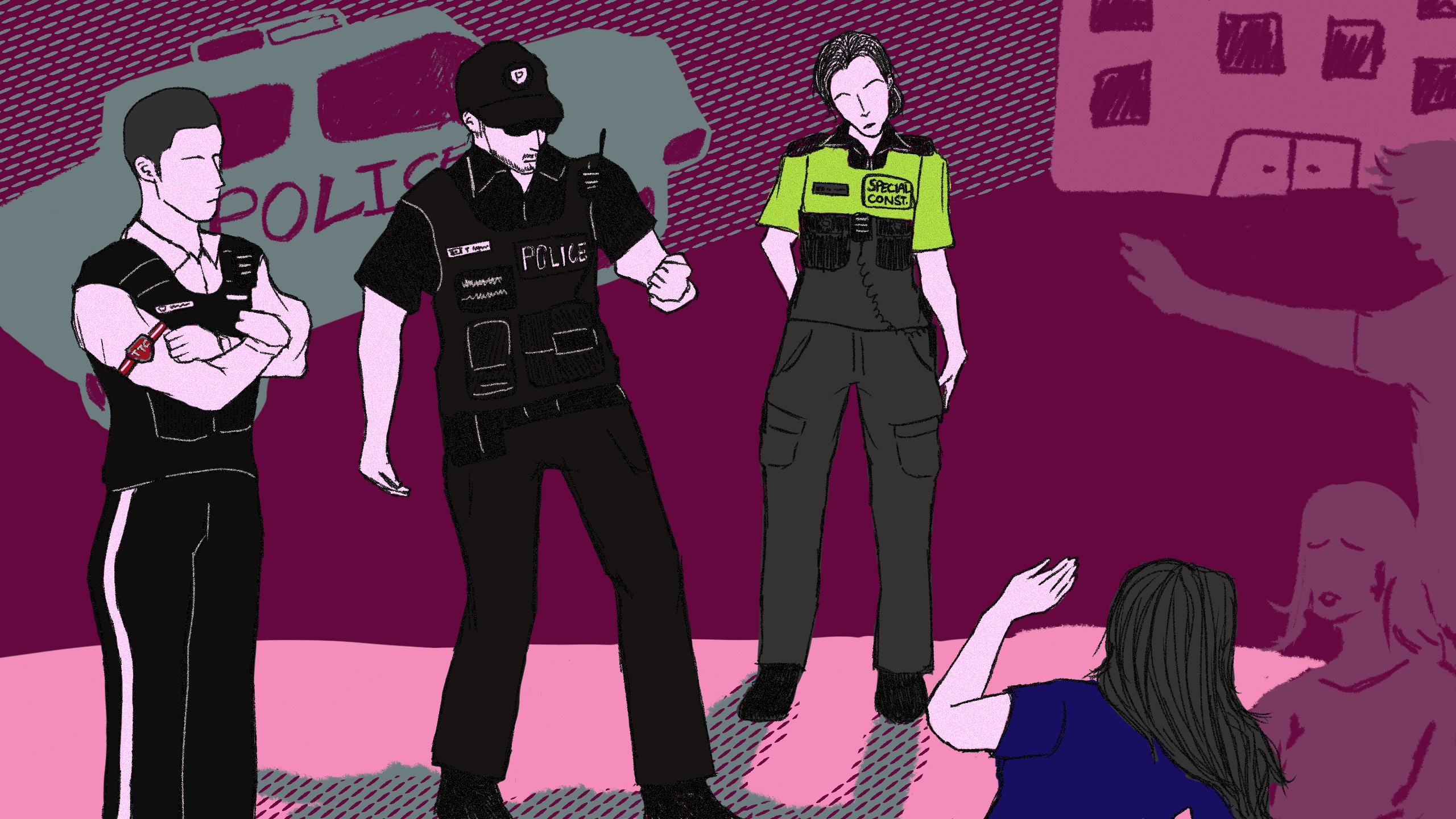
To determine what action to take, officers are expected to assess situational factors, such as risk of bodily harm or death, whether a suspect is cooperative or resistant, and how many other officers are present at the scene. The model is not only used by police in Ontario, but also by Special Constables and Fare Enforcement Officers, as outlined in Procedure 15-01 and the TTC’s own Use of Force Policy.
However, this model is not entirely clear on whether it encourages de-escalation, given that only one non-violent response, verbal communication, is outlined, compared to three violent responses: physical control, use of a non-lethal weapon, or use of a lethal weapon.
This makes de-escalation seem secondary to using force, even though Procedure 15-01 instructs that officers “shall, in all situations involving the use of force, consider de-escalation tactics, including disengagement predicated on the philosophy that protection of human life is a core duty of the police.” Even in a situation where force would be allowed and may be ongoing, officers are told to consider disengaging, rather than escalating violence.
Discrepancies and contradictions are so prevalent in these procedures that I can hardly wrap my head around them. It is too unclear how police officers are trained to employ de-escalation tactics when their policies emphasize violence.
De-escalation as a “hard” skill
To understand how officers interpret these guidelines regarding the use of force, I spoke with Maykal Bailey, an assistant professor in UTM’s Department of Sociology, who observed police training firsthand for his research into Canadian policing practices.
“Hard skills training is depicted more through hand manipulations, takedowns, and how to get somebody into a position where you can arrest them or put the cuffs on them more easily,” he explained. “Then there’s soft skills training, which is supposed to be reflective of ideas around de-escalation,” he explained. Soft skills include building rapport, exercising empathy, and actively listening to the people officers are engaged with.
From his experience talking with and researching police officers, however, Bailey found that the way officers were trained in de-escalation encouraged officers to apply “hard” skills more often than “soft” skills. He observed that subduing and detaining someone to prevent violence was explained as a de-escalation technique.
“Whatever violence they’re being confronted with, they can escalate it ‘one step up’ in order to gain control of the situation. The idea is that if you’re able to subdue somebody, then you’ve kind of de-escalated the situation,” Bailey explained.
This understanding of de-escalation as involving force is at odds with the non-physical tactics people might expect. Yet it does align with the Use of Force model’s recommendations for de-escalation, three out of four of which recommend force.
Institutional pressures may also shape how officers approach these situations. Police work is “reactive,” according to Bailey. Police effectiveness is often measured through their response times, meaning they face pressure to move from call-to-call as quickly as possible.
De-escalation clashes with this expectation, as it is a timely process. From what Bailey observed during ride-alongs, police have long call lists that carry over from previous shifts. This can deter police from taking their time when responding to incidents. “It might seem more efficient to resort to just an arrest or a warning to consider the event dealt with so that then you can move on to the next call,” Bailey said.
This mentality could be applied to perceptions of breaches of the peace, which are common at large gatherings like protests. Perhaps police find it more effective to use force against protestors in the effort to frighten others into compliance.
After witnessing the use of force from the police responding to the Queen’s Park OSAP protest, Hans, a psychology and biology student, said that the next time she sees police, her first thought will be, “Let me make sure I don’t look violent.”
An increasing risk for students
Tension between the police and the public is nothing new — the TPS themselves reported in February that public trust in the police has been “strained,” with concerns surrounding misconduct and bias in policing standards growing, especially among youth.
Violent encounters with police will only worsen this perception. Even those who have not had a negative encounter with law enforcement themselves will have seen a viral video of one online, or have witnessed the victimization of someone else. It is frightening to think that we are living in a city full of authorities with few guardrails on their use of force.
“I would never have expected something like this to happen in Toronto,” Fernandes said, noting that the force she witnessed was “jarring” and lowered her opinion of the police.
A climate of fear is all the more dangerous when considering how subjective police interpretations of breaches of peace and danger are. The OSAP protest was not the first, and most certainly won’t be the last demonstration where students come into contact with law enforcement. Just last September, a pro-Palestine protestor was arrested by TPS after allegedly asking police to identify themselves.
How can students know which of their behaviours might be interpreted as dangerous by police, and how can they be expected to take rational precautions while fearing for their well-being? Students should not have to be fearful of the very individuals sworn to protect them, but this seems to be becoming a new, dangerous norm in an era of excessive police violence and an unwillingness to practice effective de-escalation.
The training of police and adjacent authorities is in desperate need of an overhaul and stronger oversight in order to keep students and other Torontonians safe. Students deserve safety on their campuses, their commutes, and wherever else their lives in the city may take them. It is law enforcement’s duty to provide that.

No comments to display.