
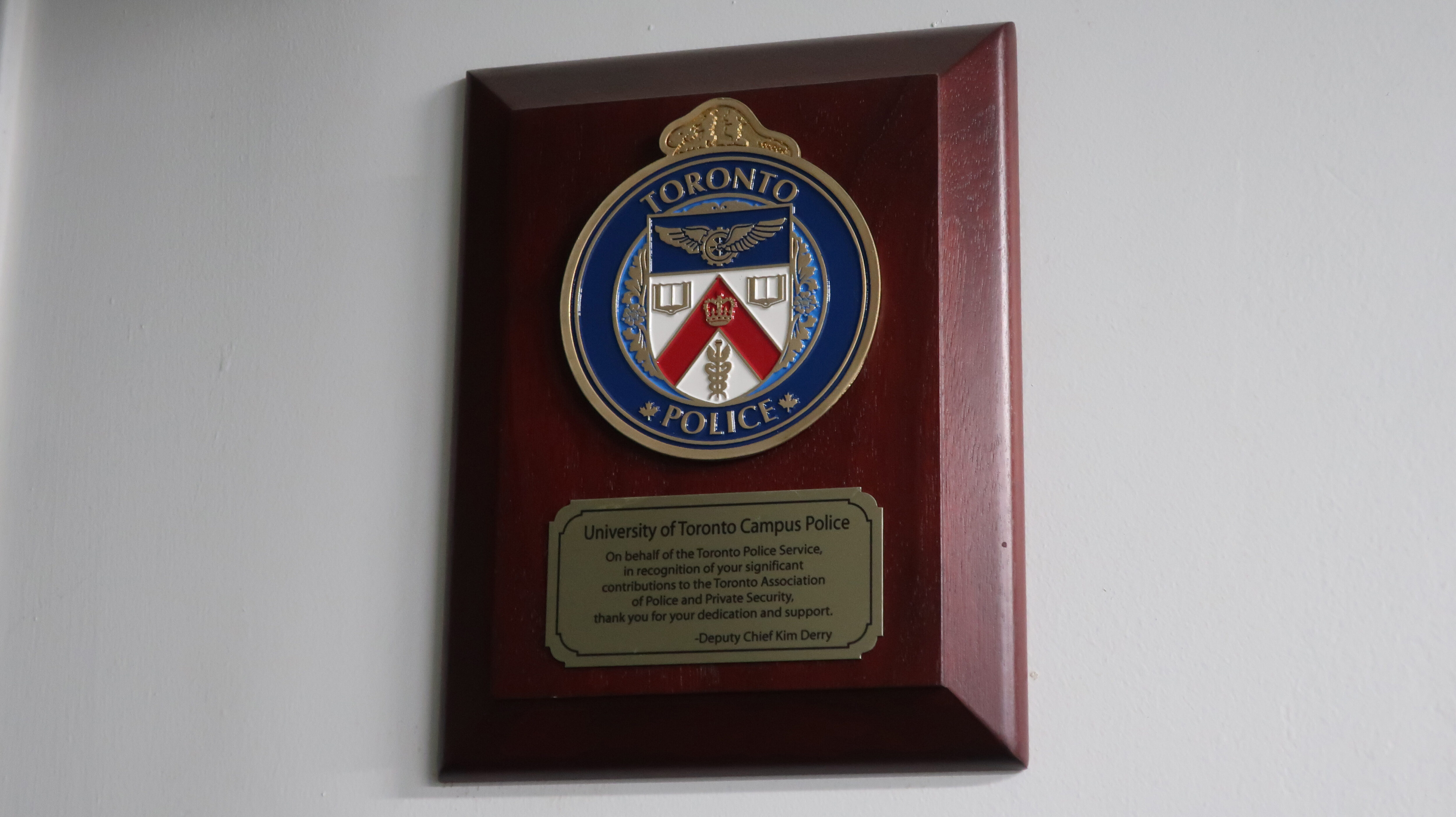
In response to student protests starting in 2019 and the Black Lives Matter protests in 2020, U of T has rebranded Campus Safety from Campus Police and implemented non-police alternatives, such as community crisis response coordinators.
The rebrand involved the pivot to a more “approachable, accessible and distinguishable” visual identity across campus safety’s vehicles, uniforms, and online presence. The rebrand didn’t change the role or authorities of campus safety. Although they’re no longer called campus police, special constables are still managed by the Toronto Police Services Board, and are authorized to arrest and release, act on criminal and provincial offences, and transport prisoners within the city of Toronto.
Movement to defund and abolish Campus Safety
In 2019, UTM student Natalia Espinosa was handcuffed by campus safety after visiting the Health & Counselling Centre (HCC) for suicidal ideation. Although she did not present an active risk of harm, Espinosa was handcuffed while being transported to the hospital.
The incident prompted the release of two open letters, the first of which received over 130 signatures from students, faculty, and staff. Drafted by Beverly Bain, a Women & Gender Studies Institute professor at UTM, and Vannina Sztainbok, a former assistant professor in the Department of Social Justice Education, the letters suggested that the university exclude campus safety from mental health situations and invest in additional health and wellness services.
The second open letter, “Open letter: President Gertler, defund and abolish Campus Police,” was drafted in response to the university’s 2019 Report of the Presidential & Provostial Task Force on Student Mental Health. The letter demanded that the university immediately defund and abolish campus police, especially following Toronto Metropolitan University’s (TMU) decision to cancel its proposed special constable program.
The letter was published in the months after George Floyd was murdered by a white police officer in May 2020, prompting a global movement to remove special constables from campuses.
In 2021, U of T released its Final Report on the Role of Campus Safety (Special Constable Services) in Responding to Students in Mental Health Crises, which outlined the university’s commitment to enhanced mental health training for special constables. In addition, it described the development of non-policing supports for students experiencing mental health crises.
The report also confirmed that the university would introduce cross-unit training between campus safety and Health & Wellness services. Although the report emphasizes “recognizing when policing presence may not be the most appropriate solution,” there has since been a 97 per cent increase in campus safety’s response to students experiencing mental health crises.
The report recommended that restraints should only be used in circumstances where violence is present, and the university’s Update on Institutional Commitments notes that there are ongoing discussions about implementing a “least restraint” approach to student transfers to hospital emergency care.
The Community Crisis Response Program — created from the recommendations outlined in the 2021 report — was implemented in the year following campus police’s rebranding as campus safety. The rebrand ensured that the university was aligned with the Comprehensive Ontario Police Services Act, 2019, which held that special constables can’t have the word “police” in their title.
Expanding campus safety staffing and increasing officer wages
In 2022, UTSC hired its first community crisis response coordinator, a role intended to “de-escalate and reduce police presence when students experience a mental health crisis.”
While community crisis response is presented as an alternative to police, the coordinators work collaboratively with special constables to respond to mental health-related calls. UTSG’s community crisis response coordinator, Lauren Weidmark, was a campus special constable from 2015–2023.
As part of its Administrative Response to the report, the university also highlighted a need for tricampus consistency in institutional responses to student mental health crises.
When asked whether the university’s spending on campus safety training and mental health supports had increased, decreased, or remained stable since 2021, a spokesperson for the university said that these budgets are not available collectively for comparison.
The university’s 2025–2026 budget lists additional campus safety staffing as a funding priority for the upcoming year. Campus safety staff’s wage rates have also steadily increased in the past decade, with corporals’ pay scales increasing by 31 per cent since 2017.
Despite a decrease in the total number of campus safety events since 2021, campus safety has also seen an 89 per cent increase in the number of arrests made, charges laid, and cases turned over to the Toronto Police Service (TPS).
Campus safety during and after the People’s Circle for Palestine
In an interview with The Varsity, Beverly Bain, who is also a member of the No Pride in Policing Coalition, expressed distrust towards campus security’s authority to exercise restraint.
“The only time students have become violent is when campus police appear on the scene and try to take them, detain them. [Students] panic, they get upset, and that is when things escalate. The explanation given for handcuffs is that students may become violent and they can hurt themselves or hurt the officers, […] but that was never the case. In cases where [students] were told they were going to be handcuffed and they were handcuffed, that’s when they became agitated.”
Bain also notes that Black, Indigenous, and queer students are more at risk of being perceived as aggressive by campus safety, particularly in the aftermath of October 7.
“Those who are racialized […] are treated much more aggressively in situations where they oppose the institution at different levels. […] Why would these students want to interface with campus police, or why would they want them on campus? That is what we’re faced with at this very moment, and what we’ve asked for is for more community responses.”
During the People’s Circle for Palestine encampment, the university released A User Guide to U of T Policies on Protest and Use of Campus Spaces, which prohibited student protesters from “occupying or entering U of T premises without authorization.”
In cases where protests violated these policies, the university held that campus safety was authorized to manage protests and that “any resistance (physical or verbal) may result in Campus Safety action or requesting the assistance of municipal police.”
Bain feels that campus security’s response to the encampment has further shifted racialized students’ perceptions of security officers.
“These are the same officers that abused and harassed students and faculty throughout the year that this encampment took place. […] The majority of black, brown and Indigenous students don’t see campus police as that which you want to entrust with your safety because they didn’t feel campus police protected them during these moments. In fact, they felt abused by campus police.”
Recent calls for increased Campus Safety
Some students have expressed concern about safety on campus, particularly in light of the fatal shooting of Shivank Avasthi at UTSC. The “Improve campus security at University of Toronto Scarborough” petition amassed 7,695 signatures, calling on the university to increase the number of security personnel on campus and install modern surveillance systems.
Although the shooting occurred in broad daylight, the petition also notes that areas at UTSC lack sufficient lighting, “leaving significant blind spots where incidents can occur unnoticed.”
Earlier this month, Yuriy Khraplyvyy was arrested in connection with a series of small fires set at Victoria and St. Michael’s colleges.
Referencing the UTSC shooting and the UTSG fires, one Reddit post reads: “the fact that such incidents can occur (multiple times as well) is frankly ridiculous. I mean, if concrete measures aren’t taken to strengthen campus safety, what’s to stop similar tragedies from happening again?”
Some feel that adding T-card entrances to buildings will reduce the likelihood of safety incidents.
A Reddit post about the shooting states: “Where is the investment in our safety? We have the mandatory police presence provided by the government, but where are the school-funded measures? Where is the basic security? We still don’t have T-card restricted access to buildings to ensure only students and faculty are inside.”
Another post reads: “UofT allows unrestricted access to libraries and campus buildings. Anyone can walk in. Students are expected to just accept that, even after repeated thefts, assaults, and now a shooting. We pay tens of thousands of dollars in tuition. Basic safety is not a ‘nice to have.’ ”

No comments to display.