
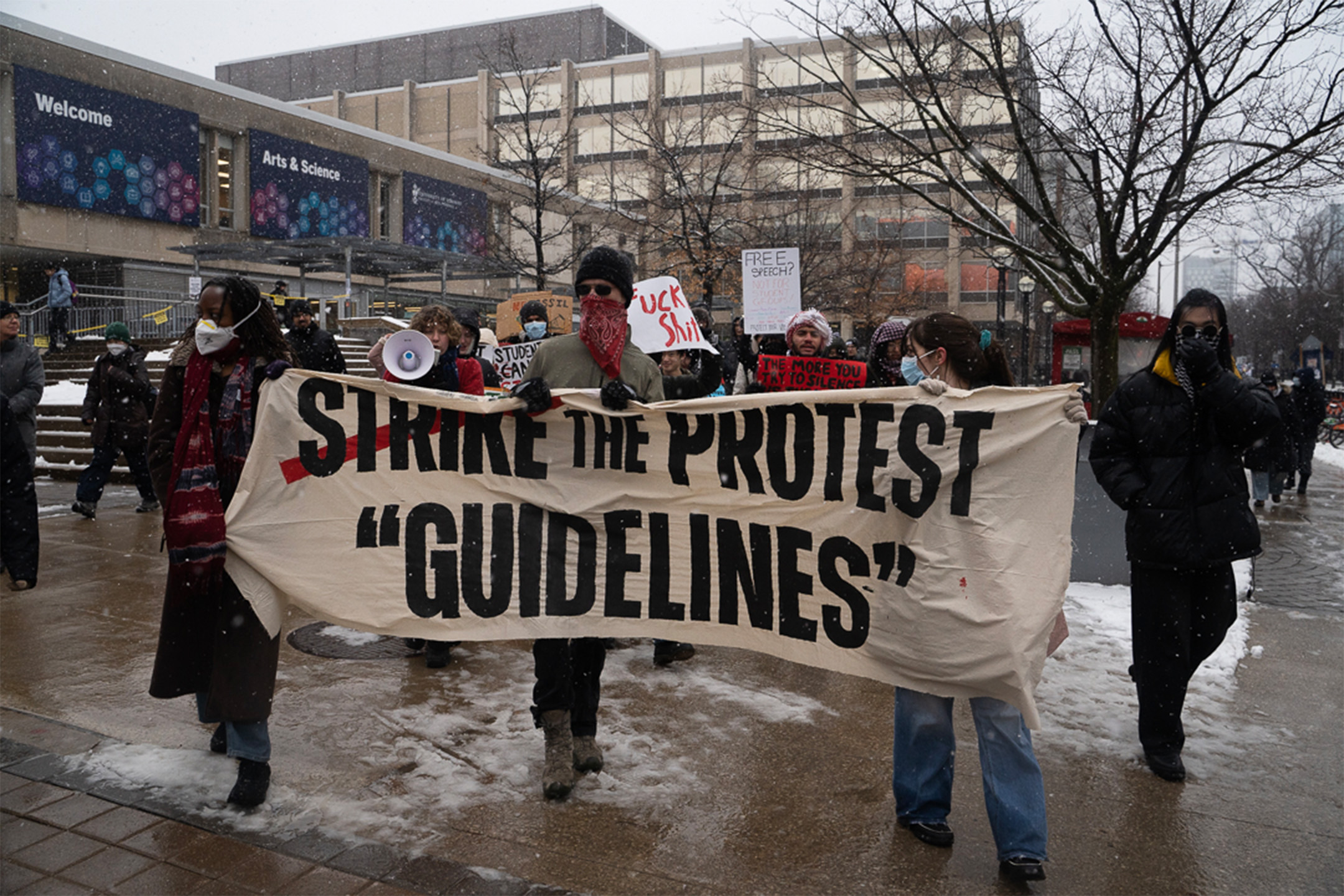
Climate Justice UofT (CJUofT), a student-led environmental group, led a rally on March 13 against the university’s User Guide on protest laws and policies released in August 2024.
In an interview with The Varsity, a representative of CJUofT said that “after the encampment — the People’s Circle for Palestine in summer 2024 — the university released a set of protest guidelines following the injunction that severely limits students’ right to protest on campus. We see this as a major issue for democracy, especially in the times of rising fascism… We are asking them to rescind the protest guidelines, to reaffirm our rights to protest on campus.”
Supporters gathered in front of Sidney Smith Hall at 4:00 pm holding a banner reading, “STRIKE THE PROTEST ‘GUIDELINES.’ ” Several students held signs reading, “STUDENT VOICES CAN’T BE SILENCED,” “WE PROTESTED FINE WITHOUT YOUR GUIDELINES,” and “FREE SPEECH? NOT FOR STUDENT GROUPS!”
Protesters chanted while marching, “The more you try to silence us, the louder we will be,” and “the students united, will never be defeated!” During the march, the crowd was followed by a Campus Safety car.
In response to backlash when the guidelines were originally released, a university spokesperson wrote to The Varsity explaining that the guide was “an educative resource primarily for students,” and that it “does not establish new policy. Any corrective action will be taken in accordance with the underlying policies and/or law.”
User Guide on U of T Policies on Protest
The Provost’s Office and the Vice-Provost, Students Office, developed the User Guide “in collaboration with several U of T offices, including the legal team as well as campus safety,” according to a Senior Assessor’s Report to the University Affairs Board in October 2024.
The guide stated, “U of T supports peaceful protests: Peaceful protests are a form of free expression and have been a force for progressive change at the University of Toronto (U of T) and elsewhere for generations […] But there are limits.”
It then clarifies that U of T policies and the court order following the encampment “place limitations on protest,” including restrictions on the time, place, and method of protest. Protestors cannot occupy or enter campus spaces without authorization, protest from 11:00 pm to 7:00 am, or build any structures. Protests also cannot interrupt university activities, including through excessive noise from amplifiers or megaphones or by blocking access to buildings or roads.
The guidelines also stated that signs and posters outside designated areas are considered vandalism, which includes “chalk, marker, paint, and projections.”
The guidelines concluded, “Engaging in these prohibited activities can result in consequences under law and U of T policies, including arrest, suspension, trespass from property, and expulsion. […] Any resistance (physical or verbal) may result in Campus Safety action or requesting the assistance of municipal police.”
In December 2024, a letter calling on university administration to rescind the User Guide was signed by several campus organizations, including all four full-time student unions, the Association of Part-time Undergraduate Students (APUS), the Canadian Union of Public Employees (CUPE) Local 1230, 2484, 3902, and 3261, and the University of Toronto Faculty Association (UTFA) Executive Committee.
CJUofT’s statement
CJUofT created an Instagram post endorsed by three other student organizations: U of T’s New Democrats, Tkarón:to Students in Solidarity with Palestine, and New Pride U of T. The groups wrote, “On Oct. 2024, after the encampment for Palestine on King College Circle, UofT released a series of ridiculous protest guidelines. This is an infringement on our right to protest.”
A representative of CJUofT read a statement to the crowd at Sidney Smith before the protest started.
“In their own words, U of T allows peaceful protest that does not interrupt university activities. What is a protest if not disruptive to the status quo? These guidelines ensure that our dissent never disrupts, making advocacy contingent on the university’s permission and white settler comfort.”
“If you’re feeling angry right now, know that you can do something about it. The only way to protest these guidelines is to protest. Get creative. Make your voice heard. You don’t have to wait around for a group to organize a protest. Grab your friends and tag a building, make art and put it in public spaces without a permit. Walk up to a member of the administration and say, fuck you.”
“Every act of protest is a refusal. Every moment of refusal is liberation. Let yourself be guided by your humanity, by your love for others, by your longing for liberation. You do not have to be set free by anybody,” they concluded.
Voices at the protest
“We think students’ right to protest is more important than ever, and that the university is demonstrating cowardice and trying to repress student voices on really important political issues like climate justice, Palestinian Liberation, and so many others,” said a representative of CJUofT.
“Students’ right to protest has been vital for Land Back. In various places, it has been part of the climate and the environmental movement, the suffrage movement, the civil rights movement, the anti apartheid movement. Students’ right to protest has been the vehicle of social change. When the University of Toronto says things like defying gravity and calls themselves leaders, it’s because they have students who keep them accountable and who push them to be better,” the representative added.
A first-year master’s student said to The Varsity, “We have to keep our voices up for the Palestinian people; we need to continue our support. And this is another way of us expressing our voices towards the restrictions that we saw when the encampments were around. […] It’s twofold, both to support the Palestinian cause and to preserve our protests and rights on campus.”

No comments to display.