
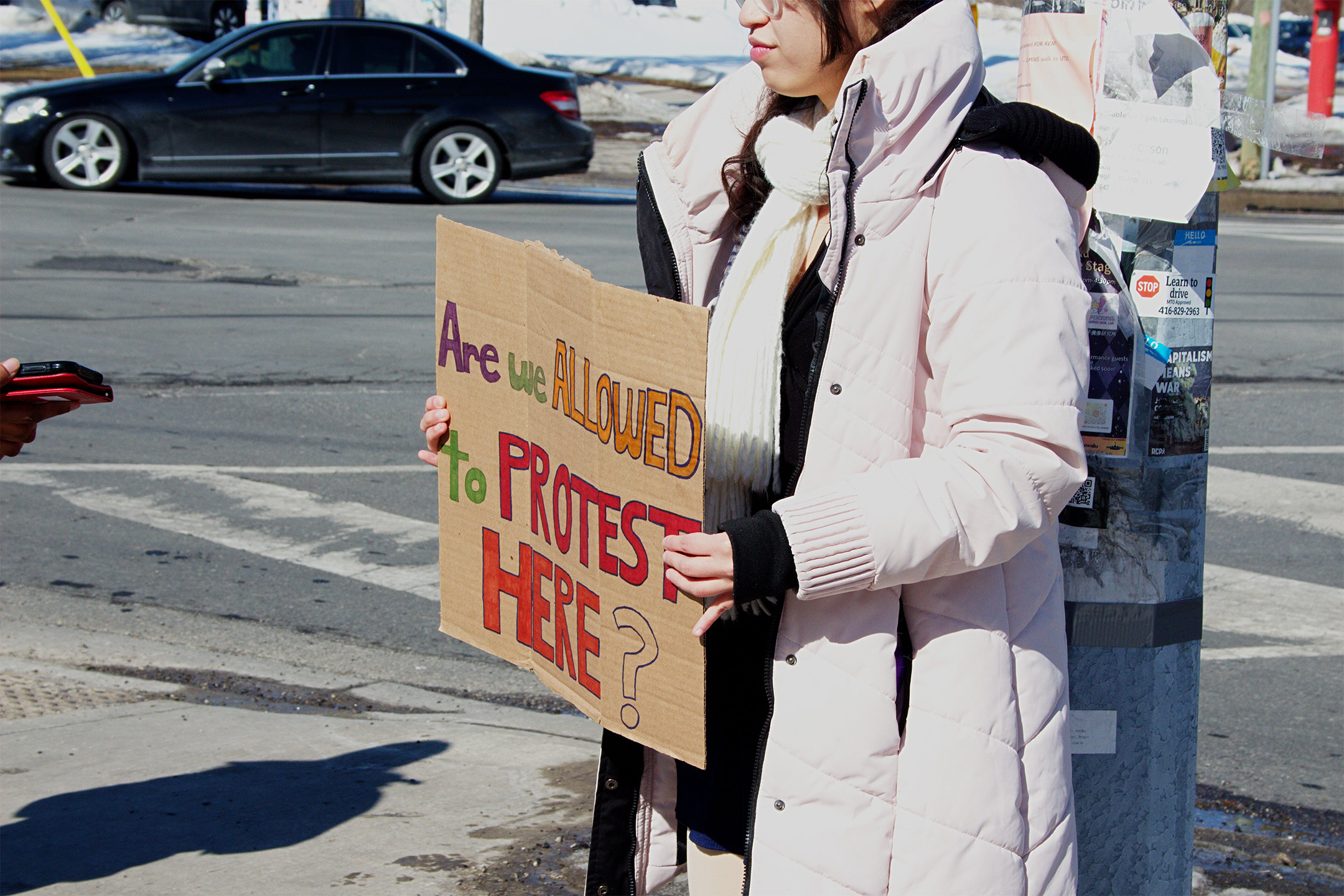
Historically, the university has always been a site of political contestation. One where students, whether they are mobilizing for issues domestic or international, big or small, have made their voices heard. When effectively organized, students have been able to bend the powers that be to address their demands.
At U of T, there has been a long history of student organizing, from the anti-Apartheid movement of the ’80s, to opening the Robarts Stacks to undergraduates after a student protest in 1972 (to think there was a time when students had to occupy Simcoe Hall just to be let into Robarts is crazy).
Student movements are an essential part of a vibrant and democratic society. They fundamentally protect and enrich us all by providing a counterbalancing reaction to abuses of authority, envisioning new political possibilities, and expanding our horizons for what can be possible. The right to organize and protest should be held up and protected as one of the most fundamental of these rights.
That said, it is highly concerning that freedom of expression at U of T and beyond is under attack. Since 2023, in the wake of what international human rights scholars and UN special rapporteur on Palestine and the Occupied Territories, Francesca Albanese, have called a genocide in Gaza, there has been a mass shift in opinion on Palestine, especially amongst youth.
After Columbia University’s 2024 encampment, similar student protests swept across North American universities and beyond, reflecting a broad and increasing discontent with institutional actors’ complicity in crimes against humanity. Calls for disclosure, divestment, and the cutting of institutional ties with Israel and companies complicit in its human rights abuses grew rapidly.
At U of T, the People’s Circle for Palestine, the pro-Palestine student encampment, lasted for over 60 days, only ending after a lengthy legal battle. U of T filed an injunction against encampment organizers, with the court ruling in favour of U of T. The court argued that, despite U of T being a public institution, it functioned as a private entity and hence could restrict activities that may fall under charter rights.
In response to their judicial win, in October 2024, the U of T administration introduced new protest guidelines based on what the court deemed permissible in the ruling.
U of T states that these guidelines merely act as a user guide for existing policy. However, I believe that these guidelines present a more expansive range for prosecution of expression and assembly than U of T’s already in place code of conduct.
For instance, new restrictions on the specific allowable time and manner of protest. Gatherings between 11:00 pm to 7:00 am, and tents or the erecting of any sort of structure are not permitted, prohibiting any further overnight occupation tactics on university grounds.
The “certain poster and sign section” adds the use of chalk and video projections as forms of vandalism.
Although these specific guidelines do not exist in the official code of conduct, they serve as a deterrent to any protest action that may include any of these tactics. However, historically, it is these types of tactics used by organized student movements that have resulted in real change.
Most notably, the 18-day 2023 Victoria College occupation to force the divestment of federated college investments from fossil fuels was successful in obtaining its demands. Under these guidelines, such actions taken by students could put them at far higher risk of repercussions from the university administration, due to these more expansive and vague categories.
These kinds of restrictions on organizing and expression in light of the growing pro-Palestine movement are not restricted to U of T. “Bubble Zone Bylaws” have been cropping up in many Canadian municipalities, which restrict legal protest to a certain distance away from “protected sites.” These sites can include anything from schools to government offices. Toronto passed a version of such a bill despite public opposition and criticism from human rights groups last year.
In an era of OSAP cuts and Palestine crackdowns students organizing is ever more essential for a functioning and just society. The student body cannot allow for an erosion of fundamental rights. Student groups are organizing on campus to counter these guidelines, including Climate Justice U of T, which has called for a protest on March 13 at 4:00 pm in front of Sidney Smith.
It is time for U of T to strike the guidelines and create a truly democratic university.
Enzo Fouquet is a third-year undergraduate student studying geography with a focus in planning and political science at U of T. He organizes and works with Climate Justice U of T, Geography Student Union, U of T NDP, and Campus Co-op.

No comments to display.