
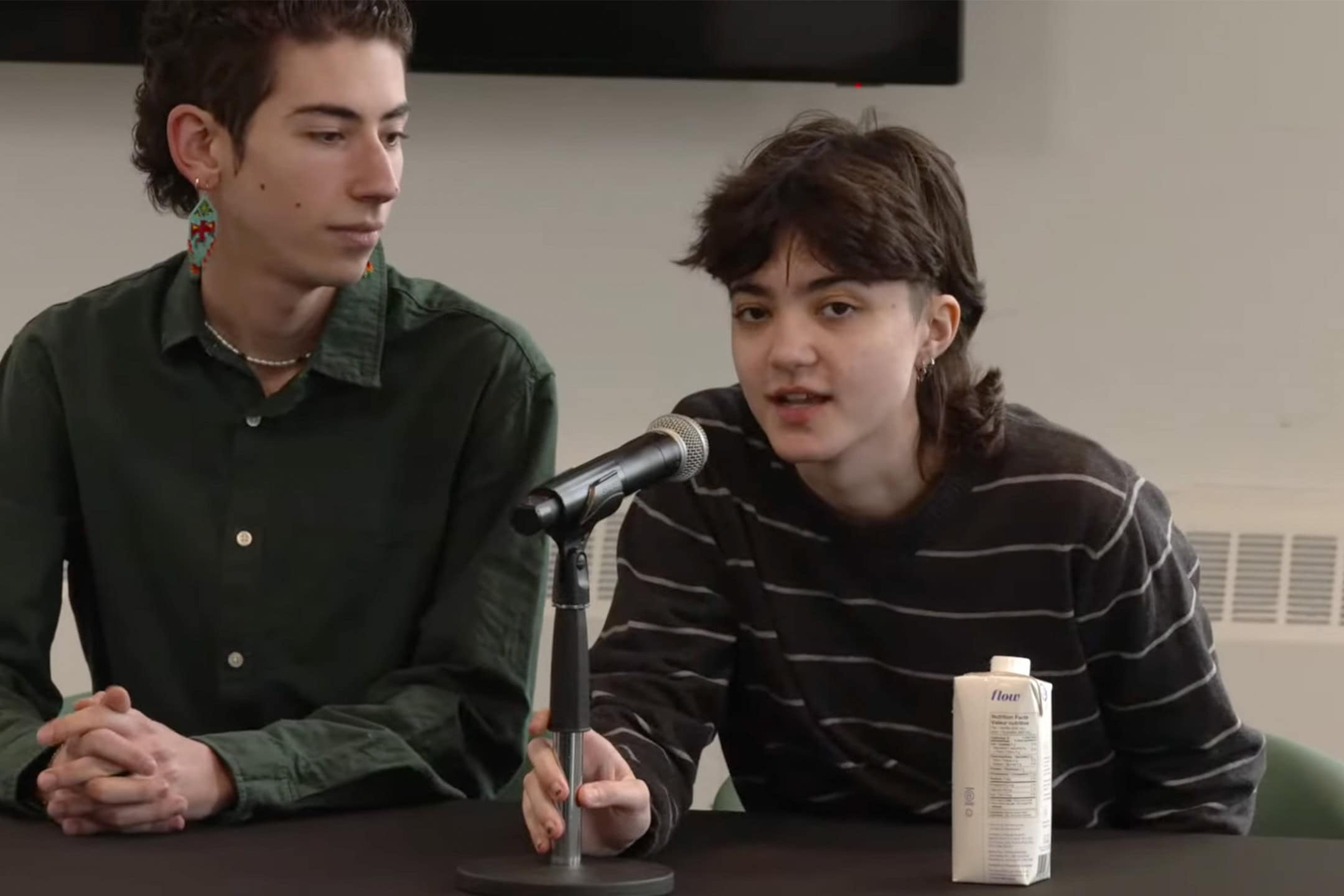
At yesterday’s debate, Landon Sanderson and Meagan Mellor were the only two candidates, of the five running for VP Equity, to attend. The full debate, moderated by Deputy News Editor Junia Alsinawi, can be watched on The Varsity’s YouTube channel.
The Varsity: How would you consistently make the time and space to communicate with different equity-seeking groups on campus and be aware of the unique issues they face?
Landon Sanderson: I want every student’s voice to be in every room that I occupy. My story, my perspective, and my experiences can never holistically encapsulate every single equity-seeking person’s experience at this school.
I built quite a few connections over my last year here at U of T, specifically with queer groups and Indigenous communities across campus. I think having those preexisting connections is going to play a really big role in being approachable and adaptable to the different groups that may have perspectives that they want to share with someone in the equity portfolio. I think having approachability and having conversations be at the forefront of the equity platform is super important, so always making sure that we’re making time to have these one-on-one conversations.
Something that I’ve discussed before is having monthly or bi-weekly meetings with the larger affinity groups across campus to discuss things like financial stability, positionality, and resources. Also, implementing something like office hours or one-on-one meetings with the equity portfolio, whether that be myself as VP Equity or any of the assistants in the equity sphere, allows them to have these one-on-one conversations to voice concerns.
Also, what I would like to do is actually follow through to make sure these statements are actionable, allowing student groups or students themselves who have issues to raise to either attend meetings of the executives, or meetings of the board. To allow them to use their own voice and not just allow me to be their mouthpiece — although that still is very important — or allow written statements from students and student groups to verbatim voice concerns that may arise from issues on the campus.
Meagan Mellor: When it comes to access to equity on campus, it’s really important to understand how interdisciplinary these resources are on campus. I’ll give an example using one of my platforms, which is centralizing sexual assault resources. So if a student were to go and make a disclosure, they could go and contact our student group, Prevention, Empowerment, Advocacy, Response, for Survivors (PEARS). PEARS is divided into different college segments and into more of a general PEARS organization, so already you have an interdisciplinary approach.
From there, you then have to approach the Sexual Violence and Prevention Center (SVPC) on campus, and also communicate with Community Safety and the Office of Safety and High Risk. Then there’s a bunch of other different organizations that are all interlinked within that block. From there, if you want to have accessibility because you’ve been sexually assaulted or you’re a respondent of sexual assault, then you have to talk to your accessibility advisor, so you have to talk to your registrar, and then you have to talk to your finance office.
So there’s a bunch of different interdisciplinary student groups, resource groups, and networks that don’t work hand in hand — and they don’t work together.
The problem with that is when you have all these people, you have to reshare your story or reexplain yourself to everyone all the time, constantly. Students don’t necessarily have the time to bear that mental burden.
So, with my platform, I would like to institute a centralized resource so students don’t have to always retell their stories, which would build off of the newly implemented REES network. So, always, students can understand where they need to go to access the resources that they need, and they don’t have to run around on campus to talk to all these people. Finding a space to centralize the information so students don’t have to run around with people who don’t necessarily know where to access it is very important to me.
TV: If elected, do you intend to promote the boycott, divestment, and sanctions movement (BDS)?
LS: I know this question is definitely a little controversial, and I definitely love that they’re asking this question. Yes, actually, I do intend to support this movement.
Part of my platform is institutional accountability, and if U of T continues to invest and fund the genocide of folks in Gaza and of the Palestinian people. That is something that the UTSU, specifically the Vice President of Equity, should have as a forefront platform to advocate against. We are responsible as students and as advocates to play a role in global society.
Our issues are not just extensive in Toronto. They’re not just extensive in Ontario or Canada as a whole. We have a role to play in the international sphere. So I think supporting this movement, and actively naming that this is a genocide and not a conflict, is super important, and it’s definitely something that I intend on doing. I think collaborating with folks who have experience and are on the ground organizing in the community is something that I intend to prioritize.
MM: As a representative of the VP Equity, I do think that it is important to support the movement. Although I wasn’t a student at U of T at the time when the encampment was there, I did visit the U of T encampment. I also visited the McGill encampment and the encampment at the University of Ottawa.
I think that it’s very important for students to have a right to voice their concerns and also to stand up against an institution which is actively funding organizations and actively funding individuals who support a genocide, because while genocide impacts students, but it also impacts the community as a whole. If we’re not allowing our students to speak, then we’re actively complicit with the genocide as well.
We need to be able to give students a voice to express their concerns, and having these students allows them to have a platform, allowing them to have a say. Allowing them to have a right to protest is essential on public property, on a university property that is meant to support the people who pay to go there, and who pay to run the institution.
I think that’s also especially important to get departments involved, because there are members of departments who are big faces in equity and big faces in justice who would not sign movements to support the encampments despite appearing to do so because they feared losing their jobs. This becomes especially controversial when U of T gives out honorary degrees to people who fund the genocide. So I think that it’s especially important to support movements that advocate for student beliefs, and if the BDS is one of those movements, then we need to support that.
TV: Sometimes, individual equity-seeking groups across campus see their interests as in conflict with one another. How do you plan to manage these conflicts?
LS: I think that when we’re looking at equity-seeking groups’ issues and the concerns that they raise, we often have a very superficial understanding of where those issues are coming from. When we dig a little deeper into the root causes of why these groups experience the adversity that they experience, often, a lot of these times, these issues are cut from the same fabric as one another.
Communal solidarity is something that’s super important, and once we actively work to achieve that, I do believe that a lot of these issues will be able to be dissolved, and there will be a lot of interconnectedness among equity-seeking groups. So obviously, understanding that not all of these issues are the same and they’re not all coming from the same position, but that there is a connection at some point between everything — a lot of issues are rooted in things like racism, settler colonialism, capitalism, that are so embedded within our institutions that we are taught and trained as a society to be divisive and actively working to deconstruct and uproot those systems is something that is so imperative to equity work, and it’s really hard to do so.
But in the same breath, I say that each group does have unique struggles that need to be addressed accordingly, and it’s important that everyone in equity, everyone at the UTSU, and everyone who claims to be advocates at our university opens up a listening ear to those groups.
MM: I think that the second you silence a group from speaking their opinion on campus, there’s no longer equity. I think that everyone has the right to voice their opinions and the right to access support, networks and resources, so long as they ensure that they’re respecting the other students to have a different opinion.
This is why one of my platforms about centralizing resources, about sexual assault, wants to also target the perspective from survivors, but also the perspective from respondents, because it’s important that we remain equitable and not necessarily impartial. There should also be an equal voice, and an equal voice for students from both sides of conflicts. All these students deserve a space within an institution and a space to exist and assert their opinions and to be accepted in the community, so long as they respect the people around them and those who disagree with them.
The candidates were given time to pose questions to each other.
MM: I’m from Quebec. I also live right beside an Indigenous reserve called Kahnawake, and my cousins are also Mohawk. So, from my student experience, I lived in a community and a culture perhaps very similar to yours.
There’s this really big focus on Indigenous inclusion, Truth and Reconciliation, and decolonizing our education system and the way that we teach about Indigenous practice and culture. How will you then ensure that there’s a vested interest within the student body to have a greater recognition for Truth and Reconciliation if they did not grow up in an environment which promoted that cultural knowledge?
LS: Coming from a student in Manitoba, which has one of the highest Indigenous populations of all the 10 provinces in Canada, a system that really heavily embeds Indigenous education, I’ve definitely witnessed a discernible difference in the Ontario education system and how high schools and people coming to university perceive Truth and Reconciliation.
One of my major goals under my Indigenous leadership platform is establishing some kind of advisory body or committee on Truth and Reconciliation that allows community members, staff, faculty, and students to come together to recognize Truth and Reconciliation across campus. U of T currently doesn’t have a major advisory body for Indigenous students; the Indigenous Students Association is kind of the only entity that is doing that work actively right now.
I’d like to use their kind of systems and allow them to play an advisory role in shaping this campus-wide group that brings together community members, staff, and students all together to create spaces that allow for measurable and actionable reconciliation to shift the passive allyship of U of T when it comes to Truth and Reconciliation to more of an active player in our national society.
LS: So you’ve mentioned a lot about having a platform for communal sexual assault resources. How do you intend on executing this in a way that is meaningful and ensuring that platforms like this don’t get lost or muddled up in all of the other overwhelming resources on campus?
MM: I’d like to create a centralized document or information system, which would then be in collaboration with, for example, the SVPC.
What I’d like to do in conjunction with them and PEARS and in the establishment of REES and with the Community Safety Office and Campus Safety, is to create a document that could then be shared between those facilities. So, when students go to one group to make a disclosure or to ask a question, there’s this central resource for you. In sharing that resource with all of the different groups and all the intersectional groups, eventually, once that becomes more established, sharing it with departments to share with their students, it becomes an online centralized resource which all students have access to.
It would just be shared with a lot of people, and we would work with all of the communities that it impacts to ensure that everyone’s voice and opinion is heard. For example, we would say First Nations House and go speak to them to see if they have any resources or community resources specific to Indigenous students facing assault, since marginalized bodies are more likely to obviously be a victim to sexual assault.
Online audience question: How will you balance representing all the unique perspectives and backgrounds of students throughout the year against the backdrop of global conflicts? Or basically, if another encampment happens, what’s the plan?
LS: My voice is only one voice, only one story. This is a pretty cliche surface-level answer to say that I want to listen to people, and I think that’s a pretty given response to a question like that. But I think what makes a difference in listening is what you do with that information. If you’re listening to an equity-seeking group, and you’re listening to all this global conflict, and you kind of just don’t really do anything with that, then your listening isn’t really impactful. I intend and promise to listen and follow through with action.
These groups that are voicing concerns, most of the time often have calls to action that are attached. The recent encampment in May, all that they were asking for was to have a meeting with the institution and the administration of the university, which was already a struggle. This shouldn’t have been a struggle, because having a meeting is not that hard.
I think a role to play in the UTSU and as Vice President Equity is to help facilitate those meetings and those calls to action, because an encampment, fun fact, is a last resort. And these groups are not completely radical or irrational. This was a response to a lack of resources and a lack of support for an ongoing global conflict that the institutions are actively supporting behind everybody’s backs. As a UTSU representative representing students and as a union, making sure that those conversations can and will happen early is super important.
MM: I don’t think necessarily that the university was funding a genocide behind our backs — I think that they were funding it to our face. What’s really important is supporting another encampment if it’s needed by students. If the administrative body won’t listen, it’s up to the UTSU representative to go and to stand up for equity within the campus and the community, knock on those doors and break down those doors and say: we need to have a meeting, we’re having a meeting now, this meeting is happening.
It’s important that we support all student interests, all student bodies, and all student voices by having those meetings, so that we don’t have to face a last resort. Would I support the encampment? Definitely, because it is the last resort option. I would not support an encampment if it were the first call to action, but it never is.
I would do the best I could do within my power to make sure that we wouldn’t reach that point, because it is our job to really come together and speak to those people, because we are funding things that don’t necessarily align with student values or interests, to our faces. It is our responsibility to go and say, this is not necessarily what the students are interested in, this is not what the student body stands for, and then see how the administration responds before making extreme decisions.
Online audience question: We’ve talked about institutional responsibility. How would you specifically plan to hold the university accountable while in office?
LS: Actually inviting student advocates to the spaces, not my voice acting vicariously through another or vice versa, but rather actually letting these advocates have a seat at the table. And there’s a lot of impact that can come out of doing one-on-one meetings and doing group meetings with equity-seeking communities, but there is even more impact with actually advocating and fighting for them to have their voice shared at a higher-level decision-making table.
Relating it to something like the encampment and those advocates, it was a contest between the students and the Governing Council of the university. Allowing student union advocates, as well as advocates from the general student body, to actually have a seat at the table is super important. These voices need to be prominent and not in the background.
MM: I think that when you look at the way administrative bodies at the university work, these students at the end of the day don’t have the same power that an administrative body does. There comes a point where I can’t make a promise that I can hold the university accountable, because the entire student body can’t hold the university accountable.
That’s because the system is built to suppress students and to suppress the people who are paying for this university to operate. Which is why I will support extreme measures like encampments to make student voices heard. I will support protests, methods of activism, methods of publication, and circulation of public materials, especially through student publications, that go against the university and the university administration, because we have the right to exercise our voice and exercise our presence. I will stand up to make sure that that information is widely circulated across campus, so the administration knows.
I will do what is in my power and within sort of my own rights and my own place as a representative of the UTSU to make sure that that gets done. Promising that students can have an equal seat at the table when they’re not in the same room is not the right plan, because that just creates a sort of loop of false promises. Just being a representative and saying that the students have a right and this is equitable, is the best call to action to put pressure on the university.
This debate has been edited for length and clarity.

No comments to display.