
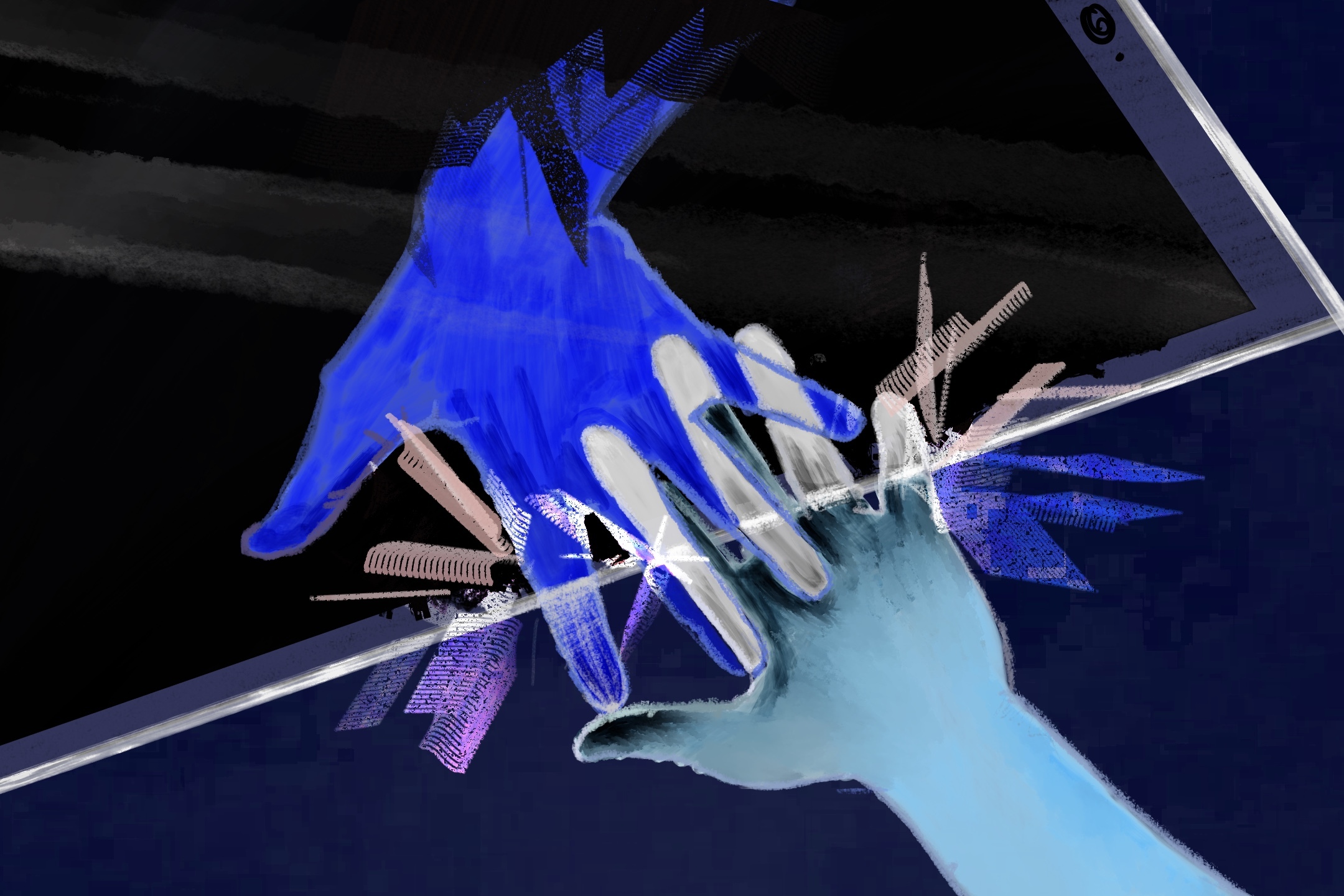
On November 4, 2025, Zohran Mamdani was elected mayor of NYC. Mamdani has garnered a lot of attention throughout his campaign and amid his win — not only for his politics, but for his physical attractiveness, and being the first Muslim American mayor.
TikToks, X posts, and other social media posts romanticizing Mamdani went viral during the weeks leading up to the election. One X user posted: “I support Mamdani for his ideas, but I also think it’s so important to have a hot mayor.” Another user mentioned Mamdani’s wife, Rama Duwaji, in their post: “Congrats to New York on your hot mayor and hot mayor wife.”
A video of Mamdani reciting and spelling his name out for another mayoral candidate who repeatedly mispronounced it went viral, prompting some social media users to create remixes with upbeat music and flashy transitions, all with the overarching theme of praising Mamdani.
While these posts may seem lighthearted and harmless, they associate Mamdani’s abilities as a politician with qualities — such as being “hot” — that are irrelevant to his platform and even beyond his control.
Moreover, the combination of Mamdani’s attractive traits and attractive policies — such as making city buses free and freezing rent — seems to have made many people develop a parasocial attachment toward him on social media, viewing Mamdani as a peer with whom they share political views.
But just like any famous figure — politicians, celebrities, or influencers alike — we don’t truly know who Mamdani is, and there is a danger in idolizing him and his politics under the assumption that we do.
Defining parasocial relationships
Parasocial relationships are “one-sided relationships, where one person extends emotional energy, interest, and time,” to another person, who “is completely unaware of the other’s existence.” Thanks to the ever-panoptical social media age, digital celebrities are now a prime object for these attachments.
According to Harvard professor and author Arthur C. Brooks, people form parasocial relationships because of their inherent need to connect with others. “Humans have evolved to thrive in groups,” and thus become “attracted to and care about people if we have a regular enough exposure to them.”
Through social media, people are frequently exposed to others who seem to share or represent their interests or values, making it easy to feel connected to them without ever having interacted with them in real life.
The COVID-19 pandemic seems to have exacerbated parasocial relationships, too. While trapped at home, limited in our ability to develop or sustain in-person social connections, the figures on our screens supplemented this desire for closeness when we could no longer socialize with friends and family.
This has lingered to the present day, with people — especially youth — reporting higher levels than ever of poor social skills and lack of connection and community.
Parasocial relationships with politicians and celebrities
Social media plays a key role in creating and maintaining connections between politicians and the public; politicians use their digital presence to gain public support.
With Mamdani, many people see a young, attractive, brown, and Muslim man wanting to change NYC with his progressive views. Voters who were previously dissatisfied with NYC politics connected to Mamdani because they felt represented by him.
Many of the social media edits of Mamdani stemmed from people who idolized him as an attractive person and an attractive politician. Some bridged Mamdani’s personal characteristics with his politics, and began posting romantic edits about him ‘saving the city.’
When people form a parasocial relationship with a politician, it is often rooted in affinity bias, which is defined as “the tendency to favor people who share similar interests, backgrounds and experiences with us,” in a 2024 Forbes article.
This tendency manifests in politics, where we are more likely to feel as though a politician ‘knows’ our needs or ‘sees’ us as individuals, when we feel like the policies they propose or their personal characteristics align with our own. This relationship is only intensified when the politician shares personal characteristics with them.
When it comes to parasocial relationships with celebrities, some fans similarly cross lines and boundaries. For example, Evanna Lynch, the actress who played Luna Lovegood in the Harry Potter movies, recounted, in an interview with The Guardian, how she will “never forget” an experience with a fan who would send her “novel-legnth letters on Facebook” and was sometimes “really friendly and sweet,” but get “furious” when she would not reply to his messages.
“I’m much more guarded now,” Lynch said. “I usually don’t reply to those messages, because there’s a fragility there that can be quite dangerous to entertain when you’re somebody who they revere so much.”
Since social media often invites people to share more about their lives than they normally would with strangers, the nature of these online spaces readily enables the formation of parasocial relationships. Moreover, algorithms repeatedly show them content related to the celebrity, and this repeated one-sided ‘interaction’ leads them to form a connection.
Social media allows fans to view, share, and comment on posts, not only giving them easier access to updates on celebrities, but also allowing them to develop a sense of proximity to them. This blurs the lines between expectations of closeness with the celebrity, and the reality that we never truly ‘know’ them.
Positive and negative effects of parasocial relationships
While both positive and negative effects of parasocial relationships involve a lot of energy, time, and interest from fans, they differ in the extent to which behaviours toe the line between fandom and delusion.
A 2024 Global News article by Sarah Do Couto discusses Christine Noels, a visual artist from Ontario in her fifties. She became a fan of the K-pop group BTS after discovering them during a difficult period in her life, where she was working an unfulfilling job during the COVID-19 pandemic. After she was laid off, Noels’ love for BTS gave her the inspiration and motivation she needed to start drawing once more.
According to the article, Noels felt emotionally invested in BTS, and that the relationship she or other fans have with the band is reciprocal. “There’s this increased loyalty on our side because we feel that. They have encouraged me to be my best self.”
BTS frequently interacts with their fans, through livestreams and fan events, which creates a sense of intimacy, often giving fans like Noels a sense of closeness and acknowledgment as an individual fan. This can lead some fans to think they are justified in boundary-crossing behaviour, like having a say in celebrities’ personal autonomy, or invading their privacy.
The hosts of the Shameless podcast, one of Australia’s most popular pop culture podcasts, Zara McDonald and Michelle Andrews, exemplify this. Fans of the podcast are obsessed with finding out the offscreen ‘truth’ about the hosts’ friendship, jumping to conclusions and assuming that they aren’t ‘real’ friends, despite there being no evidence to suggest this.
“We still on occasion receive DMs that imply we’re not actually friends, or that we’re trying to deceive people and don’t actually like each other,” Andrews said in an interview with The Guardian. This is another interesting side effect of parasocial relationships, wherein fans can feel like celebrities are lying to them or keeping information that they ‘deserve’ to know from them.
McDonald and Andrews similarly recounted tales of changes in fans’ behaviours when their attempts to form friendships with them in real life were rejected. “We’ve been invited out to social events with listeners, who sometimes get a little confused when we don’t respond,” said Andrews. This illustrates the “consequences of not indulging what fans perceive to be a reciprocal relationship.”
Having a perceived personal stake in what a celebrity does is another negative impact. Some K-pop fans behave inappropriately and are hostile if a band member begins dating someone. For example, fans of boy group EXO felt “betrayed” when a member, Chen, announced his engagement to his girlfriend and hinted at her pregnancy in 2020.
A protest erupted outside SM Town Coex Artium, a building owned by SM Entertainment which manages Chen’s group, in Gangnam. There, some fans expressed anger at Chen for promoting “controversial” behaviours like premarital pregnancy; another argued that “he’s pursuing his happiness at the expense of other people’s dreams, youth and passion.”
The term “para-loveshock” has even been coined by authors Scott Jones, James Cronin, and Maria G. Piacentini in their article for the Journal of Business Research. The term describes the phenomenon wherein fans “break up” with a beloved celebrity after they commit what fans perceive as some form of wrongdoing.
Sentiments like these are baseless and reflect the false sense of ownership some fans feel they have over their idols. Ironically, the term “idol” itself anticipates the parasocial nature of relationships between fans and K-pop groups, which might explain why these issues frequently occur in the K-pop sphere.
In parasocial relationships, fans might believe they have a claim over the celebrity based on a fantasy in which they believe they could be in any kind of reciprocal relationship with a celebrity.
This has harmful real-world implications, since most celebrities do not know who most of their fans are on an individual level. Fans who are inappropriately invested in the personal lives of celebrities might not be able to accept that they won’t love them back, which could negatively impact their mental health. Studies have even linked parasocial relationships to maladaptive daydreaming, anxiety, depression, and obsessive-compulsive behaviour.
Fans can also forget the fact that the celebrities they follow and engage with are still people at the end of the day. Couto’s article highlights Meghan Nolan, a Taylor Swift fan in her twenties. Nolan acknowledges her admiration of the singer, but claims it is not a parasocial one, and that the difference is that she sees Swift as not just a celebrity, but as an individual.
Nolan believes some fans treat Swift as someone who exists solely for their entertainment, which justifies prying into her personal life and violating her boundaries and privacy. These types of behaviours are what distinguish harmless admiration from obsession.
The unique dangers of parasocial relationships with young women
Social media also plays a major role in facilitating parasocial behaviours. In a 2024 National Geographic article, Mel Stanfill, a digital humanities professor at the University of Central Florida, explains that “when you interact with everything through your phone, the fact that there’s a human being on the other end can often get lost.”
A prime example of how women experience the dehumanizing effects of parasocial relationships is stories recounted by the Kalogeras Sisters, who are popular creators on YouTube. The Kalogeras Sisters are a trio of young sisters from Edmonton, Alberta, who regularly post entertainment content, like travel vlogs and storytimes.
In one of their most recent videos, the group recounted interactions with fans who projected parasocial relationships on them. They discuss stories of fans groping, catcalling, assaulting, and verbally harassing them.
In one case, they claim that a group of boys repeatedly harassed them from outside their room aboard a cruise by banging on their door in the middle of the night. In another instance, one sister explains how a woman physically grabbed her face and repeatedly tried to kiss her, exclaiming to her sons, “This is how you do it, boys!”
The trio’s stories speak to a larger issue of how parasocial relationships uniquely affect female media personalities, especially young women. The fans — and evidently non-fans — in these stories were likely viewers of the group’s YouTube content, and thus felt like they deserved social and physical ‘access’ to the sisters.
Many of the group’s videos are filmed with them speaking not only to each other, but directly to the camera, which viewers might experience as intimate, leading to misguided feelings of friendship and familiarity with the sisters.
Content where viewers ‘feel like they’re on FaceTime’ with the creator is increasingly desirable to fans, and some influencers even try to curate their videos to exude this feeling.
But when fans warp this fun video style into a perceived friendship or bond with the creator, they develop that parasocial relationship that rationalizes invasive and inappropriate behaviour toward the creator — someone they ultimately don’t know.
What can we do?
Ultimately, parasocial relationships are a testament to our modern social media age. Perceived ownership over celebrities is nothing new. Magazine tabloids plagued the celebrity realm of the last few decades, where celebrities, especially women, have long been trashed on the front pages.
In the current age, social media is the new tabloid, only bigger, bolder, and more wide-reaching. You don’t have to go to the store and pick up a magazine to find out the latest gossip on celebrities or politicians — you just have to open any of the dozens of social media apps that are available.
Our devices make connecting with each other easier and faster than ever. On the flipside, they can distort our perception of what interpersonal connections really look like and entail, especially since social media content consumption is one of the main reasons we use our devices. When the content we consume is about the personal affairs of famous people, it can blur the lines between the lives of others, and our own.
So while ‘interaction’ with popular figures seems inevitable in this day and age, it’s up to us to practice actively distancing from the false comfort of reciprocity or connection with the pixels on our screens.

No comments to display.