
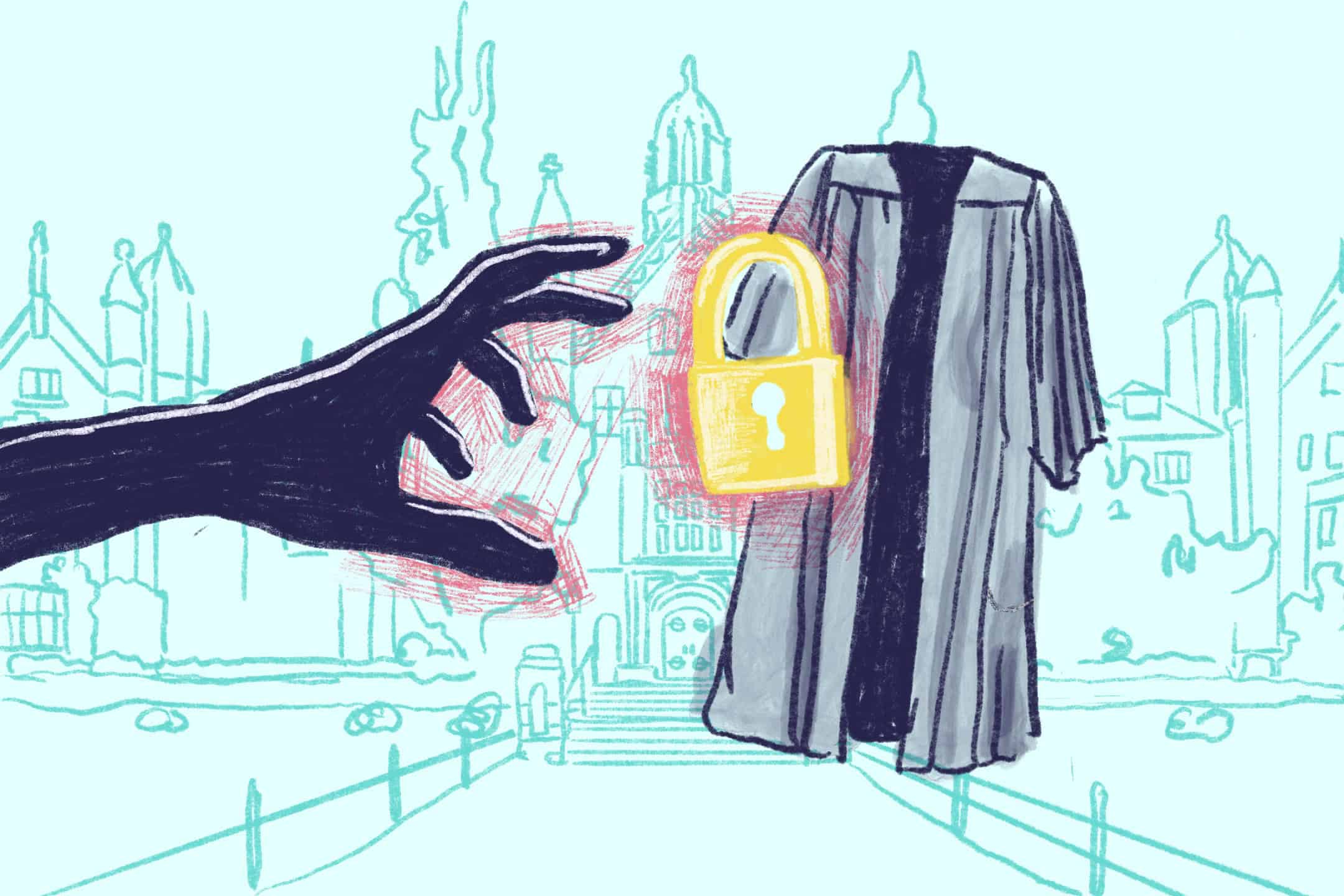
After years of student pressure, academic gowns have been reintroduced to some Trinity College events. The first gowned event took place in April.
Gowns, like those worn during convocation, were once worn regularly at certain Trinity events until the COVID-19 pandemic paused all in-person gatherings. The Trinity administration decided not to revive gowned events after the lockdowns ended.
In 2023, students began to push for gowns to be reinstated, saying they served as a distinctive symbol of the college and built a sense of community.
The administration initially resisted the efforts to restore gowns, pointing to a past association between gowns and tradition-related scandals. One administrator claimed to students that the college had thrown out its old collection of gowns, but students from the Trinity College Meeting (TCM) found 300 gowns in excellent condition in the basement of Trinity.
This year, new appointees in Trinity’s administration engaged with students through public meetings, and in March, it was announced at a TCM meeting that gowned events would be returning to Trinity College.
Trinity College has not officially announced outside of the TCM that gowns have returned, but the discontinuation of gowns was also never officially announced.
Trinity’s traditions tumble
Trinity once harboured a highly distinct student culture, with gowns as a defining feature. Students took part in a dense matrix of events, customs, and traditions, some of them sanctioned by the college, others maintained independently.
Most of those traditions are no longer kept up today. Some fell out of practice naturally, especially over the pandemic, while others were purposefully dismantled –– such as Episkopon, a student secret society founded at Trinity in 1858.
The secret society was an officially funded and recognized Trinity club until the college dissociated from it in 1992, after which point it operated independently. In June 2020, Episkopon announced its own dissolution amid intense public criticism. Students linked it to what they characterized as a broader culture of harassment, discrimination, and anti-Black racism at Trinity.
The backlash against Episkopon and the college prompted Trinity to form a task force on anti-Black racism and inclusion, which aimed to modernize the college practices and culture.
Isengard, turkey drop, and other Trinditions
One former tradition at Trinity is Isengard — named after the tower from The Lord of the Rings — was a recurring race to stack a tower of beer cans from out a common room window all the way up to the roof.
Another tradition was the “turkey drop,” where crowds would gather to watch a stuffed turkey drop out the window of Henderson Tower in celebration of Thanksgiving.
Trinity also used to hold weekly High Table dinners –– or just ‘High Tables’ –– in Strachan Hall with students and faculty, gowns required. These were the most iconic gowned events at Trinity, though gowns were also worn at assemblies of the TCM and at meetings of the Trinity College Literary Institute, a self-described “satirical debating society.”
A 2018 Varsity Op-Ed accused the dinners of perpetuating an “eerily feudal” hierarchy, because student tables were divided by academic year, and faculty sat on the slightly raised platform at the end of Strachan Hall.
One of the modernizing proposals made by Trinity’s anti-discrimination task force was to “realign High Table dinners to be welcoming and non-hierarchical community events.”
After pausing during the lockdowns, though, High Tables were never brought back.
Malcolm Standing, a Trinity student who first arrived at the college before the pandemic and has been highly involved in student life, explained in an email to The Varsity, “Gowns are most inextricably linked with the high tables, and since weekly high tables never returned I think it slowly became apparent that gowns themselves wouldn’t be coming back either… Perhaps the lower years couldn’t quite sense it, but the loss of [the] high table was something a lot of people in my year interpreted as a death knell for gowns returning in any capacity.”
The letter
In December 2023, the students of the Trinity College Board of Stewards (TCBS) wrote an open letter calling on the college to reintroduce gowned events. The letter argued that Trinity’s gowns –– similar to the hard hats worn by engineering students –– served as a distinctive visual symbol of the college.
The letter argued that making gowns optional, subsidized, and available to borrow at the welcome desk would address any equity concerns. The letter also noted that members of Episkopon had used academic gowns –– specifically, gowns stained with candle wax –– at their events, but dismissed the association.
“The first year students asking for academic gowns are far more interested in Harry Potter cosplay than cult membership,” the students wrote.
“Maintenance issues”
In December 2023, TCBS student leaders met with an administrator to discuss the college’s policy on gowns.
The Varsity interviewed four students who were present at that meeting. According to Alexander Lawson, one of those administrators present, Cameron McBurney framed the reintroduction of gowns as a costly endeavour that would come at the expense of more substantive programming, like mental health support.
Lawson, Tristan Cullum, and Anna McIntosh told The Varsity that, at that meeting, McBurney claimed that Trinity’s old collection of gowns had been thrown out due to “maintenance issues.”
Lawson told The Varsity that McBurney made the same claim again at other meetings that year.
Cullum told The Varsity in an email that he and other student leaders later investigated and found that the college had roughly 300 gowns in excellent condition stored in a basement room of the Larkin building.
This description of events is corroborated by a TCM meeting minutes document from that year: “Has admin clarified whether or not they have the robes? Cam said no, Noor [Pannu, student Head of College] saw them in the basement.”
McBurney did not respond to The Varsity’s request for comment.
Steely town hall at Seeley Hall
In the 2025 student government elections at Trinity, the winning candidate for TCM Chair, both winning candidates for Head of College, and the winning candidate for Head of First Year all campaigned on reintroducing gowns.
Trinity College began the 2024–2025 school year with two new officials in the top ranks of its administration –– Nicholas Terpstra as Provost and Kevin O’Neill as Dean of Arts & Vice-Provost. In response to the calls for gowns to be reintroduced, they agreed to gather student feedback by holding a public meeting.
A town hall about the gowns was held in November, and moderated by Dean O’Neill. The Varsity sent a reporter to the meeting, which was held in Trinity’s Seeley Hall.
Every student who spoke was in favour of restoring gowns. One upper-year student who attended the town hall said it drew the largest crowd he had ever seen at a TCM meeting.
Students frequently shouted out interjections and jokes at the expense of the administration, drawing cheers from the crowd.
Dean O’Neill warned the students against adopting an “us versus them” mentality toward the administration. He tried to steer the discussion towards practical questions concerning the implementation of gowns.
One student said, “I’m not paying extra fees just to live in a building that has no events or anything else going on for it.” Another said that, “at this point, Trinity is just a residence.”
One student reported a widespread sense that the traditions like gowns were delayed “due to red tape that I feel a lot of people of the college think, rightly or wrongly, originates from administration.”
A different student said that “the administration has erased a lot of important traditions at Trinity… for example, the fact that Trin couldn’t go to chant off at the start of this [past] year, I thought that was utterly ridiculous.”
Trinity students were allowed to take part in the cheer-off this year after the college’s old chants –– some of which had been used for nearly a century and featured distinctive lines like “no new ideas shall ever come near to us!” –– were to be replaced by a slate of new chants with lines like, “who’s got the best moves? Trinions! Trinions!”
Many students used the old chants anyway.
The Trinity College Historical Society released a statement last August condemning the chant change, calling it a “needless blow to the unique character of the Trinity community,” and saying the decision had been made by “unelected appointees of the college administration, without due consultation with relevant stakeholders.”
Dean O’Neill described gowns as “an empty signifier,” meaning that they could be taken to represent Trinity’s “history of poor behaviour,” but also that “you have the ability to write whatever you want onto it, and this idea that if you would put on a gown and then become a scholar of Trinity College, that’s inspiring.”
The town hall concluded with the decision that student leaders would put together a new proposal for the reintroduction of gowns, which would be presented to college leadership for consideration.
“Seize the welcome desk.”
The criticisms of the administration voiced at the town hall closely mirrored views that other Trinity students have expressed elsewhere.
Many similar grievances were expressed in the latest issue of Salterrae, Trinity’s student magazine. Salterrae went dormant after the pandemic and was revived only this year.
The “Reject Modernity, Embrace Trindition,” issue featured one article that accused the “ruthless” administration of having “seized upon every opportunity to make residence inhospitable to student life,” to reduce the liabilities incurred by a scandal-prone student culture.
A Trinity alum wrote in another Salterrae article, “I was genuinely disheartened to hear a large number of alumni and current students sharing with their friends and siblings who were thinking of attending Trinity to reconsider since “nothing happens at Trinity” anymore.”
Another Salterrae article claimed that in recent years, “as the Dean of Students’ Office ballooned in size and budget, so too did administrative hurdles for throwing events, starting a club, or doing anything that could be construed as ‘social.’”
Similar views also surfaced in the latest spring elections, when Trinity student Matt Pindera won an election for a mid-level position in the TCM off a tongue-in-cheek platform that lambasted the administration for “treating us as children,” and a pledge to “seize the welcome desk.”
Gowned gatherings get going
At a public meeting in January, TCM Chair Kaelem Moniz announced that Provost Terpstra had committed to the college covering the cost of reintroducing gowns. Finally, at a TCM meeting in March, it was announced gowned events would be returning to Trinity.
The first gowned event was the second annual Last Lecture, held in April.
At that TCM meeting in March, Terpstra said, “Myself and the dean of arts have been talking about how we can bring back a lot of the traditions of the college that have gone for many reasons. This is a minimum number of things, but there is no maximum.”
When asked about the future implementation of gowns, a Trinity College spokesperson wrote to The Varsity earlier this month that, “To ensure equity and access for all students, several factors, including vendors and costs, are currently under review for the procurement of academic gowns for use at academic events at the college. Trinity will be discussing options with student leaders over the coming months.”
