
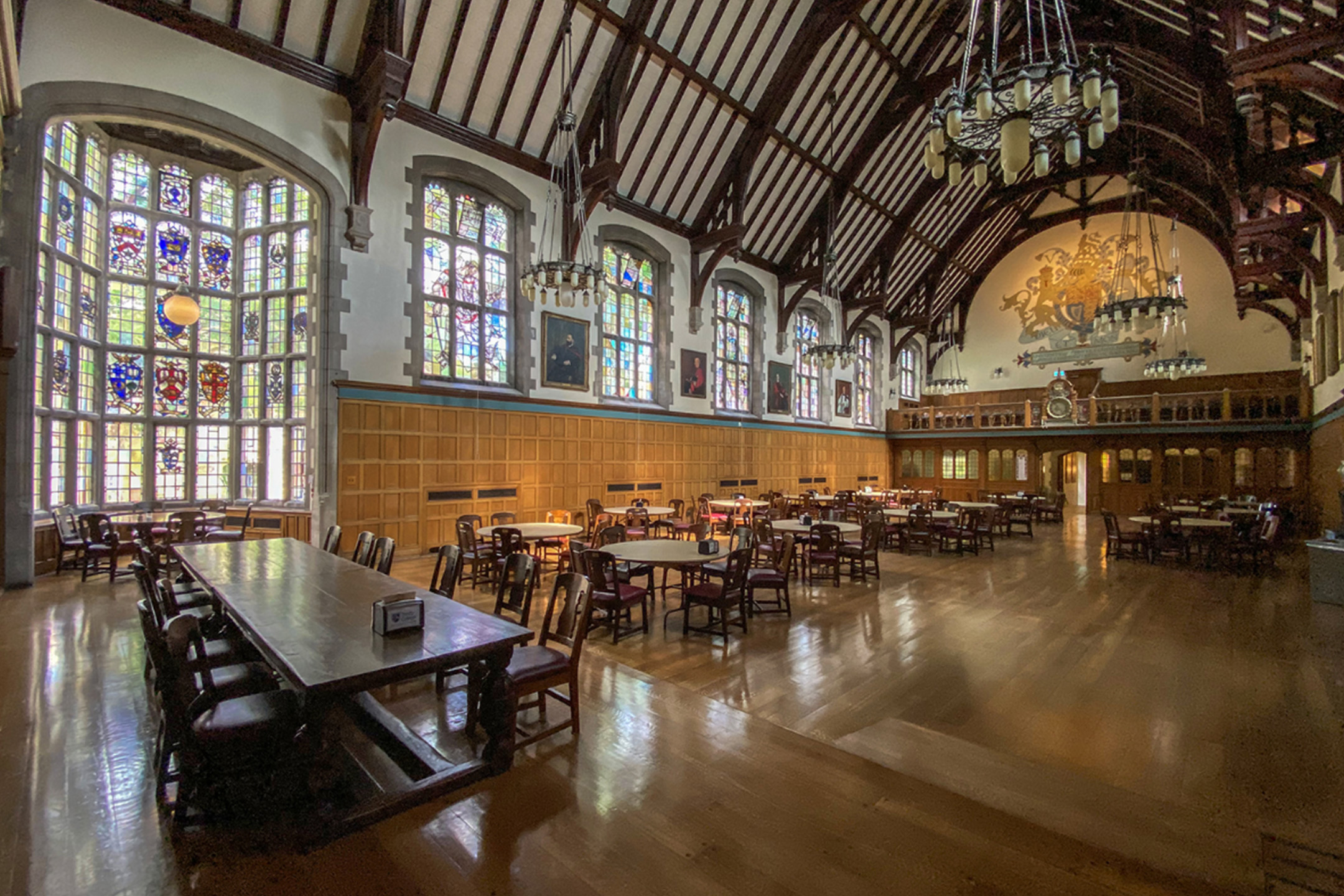
On Thursday afternoon, in a fluorescent-lit room tucked away behind Strachan Hall, private consultants from the firm Kaizen Foodservice conferred with a handful of students, staff, and faculty on potential changes to the dining policies of Trinity College.
As Trinity struggles to contend with the $105 million load of debt picked up from a turbulent construction project, the college is considering switching to a pay-to-enter meal plan. A switch to that same model at New College last year led to increased overall costs for students.
At a public assembly on January 16, Trinity students broadly expressed disapproval of the proposed change, under which non-residents would be forced to pay in order to enter the dining hall.
“I’ll be working on this in order to try to keep Strachan a public space,” said Anneke Lee, chair of Trinity’s student government, the Trinity College Meeting (TCM).
The college may also be contemplating a move away from its current food services provider, Chartwells, who have been criticized by Trinity students for low-quality food offerings, and alleged links to exploitation of child poverty, and prisoner abuse.
A Trinity College spokesperson wrote to The Varsity, “With the opening of the Lawson Centre for Sustainability later this year, we held consultation sessions, including a town hall and focus groups with students, staff and faculty on January 22, to help shape the future of dining at Trinity and support overall student wellbeing. At this point no decisions have been made.”
At the table
At that dining consultation, the booths of two reusable-container companies competing for a contract with Trinity, Friendlier and Reusables.com, sat at either end of the hall, decked out with large banners and branded T-shirts.
Chartwell’s, the contractor that operates Trinity’s kitchens, gave away free samples, and informed students about the benefits of the proposed pay-to-enter meal plan model, marketed as “All-You-Care-To-Eat.”
Currently, Trinity uses a declining balance meal plan where students pay for a set amount of dining dollars, used to purchase food on an item-by-item basis. Unused meal plan funds at the end of the year are not refundable, and only a small amount can be carried over to the next year, an arrangement that has drawn student criticism.
Under the pay-to-enter model, students could pay for either an unlimited or finite number of “swipes” each week, which they could use to access a buffet-style dining hall.
Consultants from Kaizenfoodservice held two focus group sessions to solicit student, staff, and faculty input on dining options. The Varsity acquired a transcript of one of these sessions.
While explaining the pay-to-enter model, the consultants highlighted that it is currently used at New College.
They did not note that the switch at New College from declining balance to pay-to-enter last year increased the overall cost of meal plans. Neither did they mention that at New College, swipes not used by the end of the week expire, meaning students lose money for every meal they miss.
Only one student expressed a preference for the pay-to-enter model, with several others objecting particularly to the prospect of their dining hall becoming a restricted space.
“The impression that I got was that while they emphasized that they had not decided which meal plan option they wanted, the consultants running the meeting seemed to promote all you care to eat model in how they phrased their questions,” wrote third-year Trinity student Jeremy Diavolitsis, who attended one of the focus groups, in an email to The Varsity.
The consultant-led focus groups at Trinity’s “Dining Town Hall” contrast with the two public consultations held by college leadership last year, where top administrators came in-person to discuss pressing issues with disgruntled students directly.
Buttery blues
The Lawson Centre for Sustainability, projected to open by summer 2026, will be equipped with its own dining hall, prompting the college to consider scaling back or shutting down the food services at current dining locations.
Trinity has already moved to shrink and consolidate its expensive food services. In January 2024, operating hours at The Buttery were drastically reduced from 76 to 56 per week. At the same time, hours at Strachan Hall saw an increase, but by only four per week.
Students have complained about the early closing times of Trinity’s dining locations. Strachan and The Buttery both stop serving food by 8:00 pm, though U of T schedules classes until as late as 9:00 pm, and students often stay out working until well past midnight.
The consultants repeatedly highlighted a possible reconfiguration where the Lawson Centre facility would become Trinity’s main dining hall. Strachan and the Buttery would retain some retail food options at a significantly reduced scale. One location would offer a narrow selection of hot meals like the kind currently served at The Buttery, and the other would only sell grab-and-go snacks.
They emphasized that this was just one potential option.
At the focus group, the Kaizen consultants stressed cost as a key factor behind the potential rearrangement.
In 2024–2025, Trinity spent almost $5 million on food services and catering. That translates to roughly $10,555 a year per resident, which is almost double the $5,957 per resident spent by University College. This comparison may be confounded by the inclusion of catering expenses, which are not rendered on a per-resident basis.
From the repeatedly delayed, over-budget construction of the Lawson Centre, Trinity has accrued $105 million in debt.
The college secured some reprieve through a March renegotiation of the repayment timeline on a $5.2 million loan taken on from the University of Toronto during the COVID-19 pandemic, per its latest financial statement. The first installment, originally $1.3 million due next year, is now set at just $250,000 due two years from now.
Concerns with Chartwells
According to the minutes from a recent session of the TCM, the college is also considering moving away from its current food service provider, Chartwells.
Trinity students have made recurring complaints about the food offerings under Chartwells, saying that portions are too small, lacking in variety and nutrition — especially for students with dietary restrictions. Chartwells used to provide food services at UTM, until students launched a campaign complaining of steep prices, low quality, and a lack of vegetarian options.
According to the Trinity Times, students have circulated allegations of undercooked meat and food poisoning from Chartwell’s dining services.
In 2021, the TCM endorsed an open letter accusing Chartwells of exploiting child poverty, and demanding that Trinity College cut ties with the company. The TCM also highlighted that a subsidiary of Chartwells’ parent company, the Compass Group, was accused of serving rotten meat to Canadian prisoners and exposing them to listeria in 2008.
“Chartwells prioritizes its own profits at the expense of student welfare. Trinity residents and students have been writing to you for years demanding that you acknowledge our experiences with a lack of nutrition despite the increasing prices of Strachan food,” the letter stated.
Chartwells did not respond to request for comment before publication.
Correction: This article was updated to reflect that Trinity College’s debt accrued by the Lawson Centre construction is $105 million and to clarify that the listed per-student cost of food services included catering.

No comments to display.