
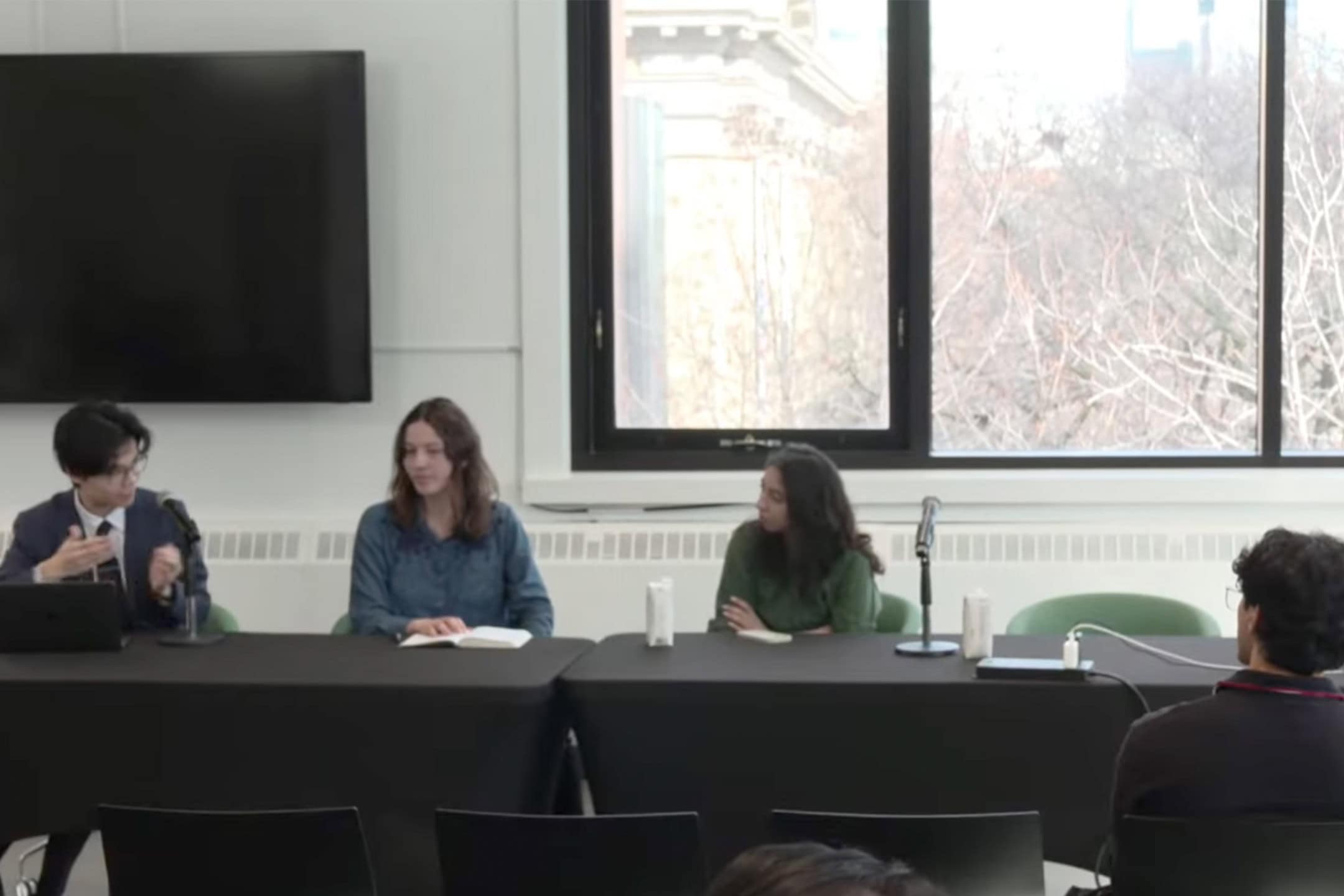
All three 2026 UTSU presidential hopefuls — Marie Kinderman, Adrian J. Lam, and Safia Zaman — contended at yesterday’s election debate organized by The Varsity, which can be watched in full on YouTube. The discussion was moderated by Deputy News Editor Junia Alsinawi, and included questions from the audience.
The Varsity: What is the biggest problem with UTSU? How will you fix that under your office?
Adrian J. Lam: The UTSU and U of T are very fragmented. Structurally, there’s not much we can change about it, because we have the college system, and everyone belongs to a college and a faculty.
UTSU in itself is very invisible and inaccessible. All my pillars, all five platforms, cater towards this one central theme, including orientation, including partnering with college registers and unions, bringing UTSU everywhere.
I think this is the biggest issue at the UTSU right now. It’s very fixable. We just need more outreach, more visibility, more accessibility, and we need to do it through different, smaller, actionable items.
Marie Kinderman: The UTSU does not feel like a home. It’s run more like a company. Students should feel like they can reach out and ask for help.
The UTSU is not communicating the problems of our time. If we’re talking about problems around the world, it’s not making statements about those. It’s not actually communicating to the students about the problems of OSAP, not communicating to students how to access those services.
The social media strategy is just really out of touch, and I have a really positive record with outreach with student groups on campus, and I’ve collaborated with them.
Safia Zaman: We are collecting lots of student fees, hundreds of thousands of dollars in student fees. And not all that money is going back to the students. A lot of that money is staying as surplus, and then it gets put into a savings account, never to be used, just for a random rainy day that happens in the future.
I don’t think that’s how student unions should run. All the fees that you collect in that year should go back to students, and it should go back to them in greater return. If we’re collecting $12 from you, you should get it back in more than $12, right? We should be using all of our money there.
The UTSU, for the past few years, has had surplus revenues savings of over a million dollars annually. That money should be going back to students in the form of events, in the form of financial aid, awards, scholarships, and then, of course, in the form of things that help affordability.
TV: How much do you plan to enter into conflict with the university? Will you work within or outside the university structure?
SZ: I have experience arguing with Dean Melanie Woodin and her team. The whole purpose of a union is that you are representing the student body, not the administration. A lot of UTSU executives have been creating relationships with admin for self-interest, and that’s all. The admin, they’re not my friends. I don’t agree with a lot of things they’ve done.
I don’t agree with any statements that they put out regarding racism, Islamophobia, Palestine, and I don’t agree with the way that they treated the university like a business. I mean, Dean Melanie once said to me, “The students are our clients,” so when it comes to how much money we spend on the students, we still need to be making a profit, right?
The UTSU is a nonprofit that represents the students, so I’m not for that, and everything that I do will be in the interest of the student body. I will be using the mechanisms of the UTSU as an organizing body and as an organization that receives millions of dollars from students.
AL: We are a student organization, and we do need to strike a very healthy balance between working within the university structure and also from the outside when needed.
I think we have to hold senior administration accountable and keep students engaged and keep listening to what they have to say and what they’re telling us, and from there, I think we usually need to have very strong internal discussions about how we can represent the people and view the concerns better, right?
And I think we also need to show up for our students who need support the most. And that means acting very quickly and delivering changes that are real, effective, and spread by students across the campus.
MK: I was a grassroots organizer, and have been for multiple years, and I’ve worked on political campaigns, and I’ve worked alongside people who work in politics, MPPs, and so I understand that the UTSU has a lot of tools. We can lobby, we can fundraise, we can mobilize, you know, we can hold protests. All of those are tools.
If this is about getting into conflict with administrators, it is about how we are using all of our tools effectively to talk to the administration? Are we using all of them? Are we lobbying the university? Are we actually talking about the issues transparently? Are we talking about food insecurity transparently? How many students are suffering from this issue? How many students do not have access to affordable housing?
We need to communicate these issues effectively to the university because U of T is a research-based institution, and many of the issues are not being dealt with through research-backed information.
TV: For Marie, which unpaid campus jobs would you campaign for to be paid, and where would you draw the line?
MK: Any volunteering jobs that are over 10 hours a week. I’m willing to negotiate with campus actors to ensure these jobs are paid.
There’s a lot of money. U of T fundraises a lot of money. It has the capacity to fundraise a lot of money, so any volunteer or honorarium position that does over 10 hours a week, I would love to get that paid because students deserve to be paid for their work, and they deserve to have a roof over their head.
TV: For Safia, you plan to install rooftop gardens, height-adjustable chairs, residences, and workplaces. How do you plan to coordinate with the numerous colleges and departments to fund and implement them?
SZ: UTSU has budget surpluses in various areas. So if you look at their financial statement, for example, you might see a wheelchair accessibility project which has $500,000 of unused funds.
One of the ways that I plan on making campus more accessible is actually using that money. Wheelchair accessibility projects, I’m sure, include accessible entrances, accessible washrooms, and sanitary products in the washroom. $500,000 is more than enough money for that.
The Student Commons budget had over a million dollars in venue funds, and so I’ve asked the board of directors for approval to move that money into a different budget. That’s something that we can discuss in the summer. That money can be used for providing tall adjustable chairs in residences and workplaces. My neck is killing me, my chair in my dorm is terrible — it’s way too short.
Installing the garden roof as well, I think that’s one of my better ideas, because not only does that impact the amount of damage that occurs to buildings on campus — so no problem, U of T, for saving you some costs — but gives short vegetables to students. Students are at risk of getting scurvy. We’re not eating enough fruits and veggies, we’re not eating enough in general.
TV: Adrian, how do you balance pushing for a more decentralized UTSU while also justifying the high cost of the Student Commons and facilities?
AL: 100 per cent, like I said, U of T is a very fragmented campus. We have a $1 million surplus every year, and a lot of underperforming budget lines. I think the importance is moreso, how exactly do we use, or how to find these underperforming budget lines, and reallocate them towards a more decentralized UTSU.
I also want to emphasize, I’m not trying to replace the already existing structures and also traditions that each college has; I just want to bring UTSU into different college spaces, into different parts of this campus, to make it feel more visible.
Some of the things we don’t really need to use money to do. I can personally sit at Sydney Smith. I can personally sit at Trinity College.
I think the biggest part is, how do we present ourselves? And the only way to do it is actually physically being present everywhere.
The candidates were given time to pose questions to each other.
MK: Adrian, what do you have to say to the students who do not attend social events, and who aren’t convinced by professional attire and titles, that you care about reducing inequality and making education accessible?
AL: I would say as president, student life is 100 per cent, a very important part of my portfolio. But I think I stand out because I’ve been working with so many student unions, with so many committees outside of UTSU, and I can see exactly what the issues are from the third perspective, right? Because when you’re in a system, you really can’t see what’s going wrong and how we can help them better.
I am able to provide that because I’ve been working from a different perspective, second perspective, third perspective of these committees. Regardless of advocacy, I think I have been in a very unique position, because I have been with multiple communities, whether it be religious, whether it be the LGBTQ community, I’ve been a part of it.
And every single part of the community, I will say it satisfies one part of me, but U of T in itself satisfies every role of my personality. I think it is a very good place for me to actually make everyone feel comfortable. Make everyone feel at home, right?
AL: Marie, what exactly is the execution plan for the food co-op? How would the budget work? Who will operate it, who will run it day to day?
MK: I’ve already proposed this to several actors on campus. I’m already in conversations with the Office of the Vice Provost, who I’ve worked with before. I’m already in conversation with both major student unions, with retail dining. We’re exploring all possible spaces on campus.
We have a fully fledged proposal. We’re going to employ students on campus, because we know that students want jobs. Students want to be paid. We have several partners in mind. We have Farmer Co Op, which is a local co-op for Regenesis, which already works with leadership.
We already have all these actors in place, and we’re actively working on pitching these actors on campus and negotiating for space. We’re having a lot of success so far, because this is a really popular project and students are really excited about this.
Audience question: Safia, do you believe that it’s reckless to spend reserve funding right as the biggest threat to standard funding faced in UTSU history just appeared?
SZ: That’s something that I would definitely discuss with the team. This is something that the VP Finance will also help a lot with: should we take money from that reserve, and how much money should we take? Obviously, I don’t want to deplete it entirely. That would be insane, right?
When it comes to whether or not we provide chairs to students, that’s kind of lower on the accessibility list. Having accessible washrooms in all the buildings, that’s extremely important. People need washrooms. The chair idea is one idea of how we tackle accessibility on campus that affects a lot of students. So, it’s not set in stone.
I agree, to throw money into an issue before kind of gauging what the year is going to look like would be a little crazy, so I don’t have to do that.
This debate was edited for length and clarity.
