
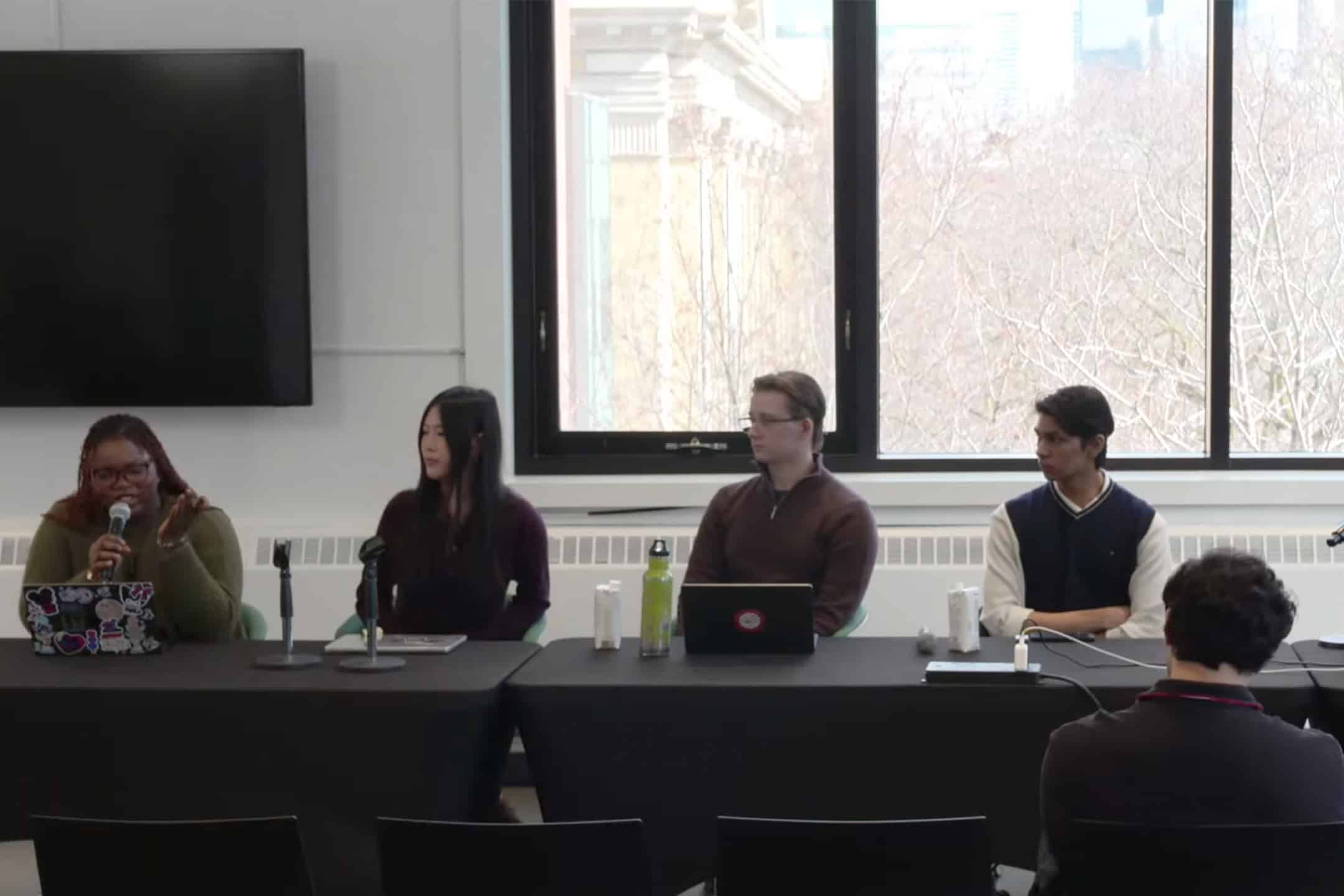
Earlier yesterday, four of the seven VP Public & University Affairs candidates gathered in the Student Commons to debate the issues facing students. Here are a few of the questions Damola Dina, Adwik Kusumakar, Eli Miller-Buza, and Yumi Yip answered, moderated by Deputy News Editor Junia Alsinawi. The full debate can be watched on The Varsity’s YouTube channel.
The Varsity: With Doug Ford targeting many aspects of post-secondary education in Ontario, how will you specifically campaign for students regarding tuition, OSAP, and Bill 33?
Yumi Yip: Protesting. As rational choice theorists mention, the collective action problem is rooted in the idea that people can free ride, and that people will eventually solve it on their own as a public good. It would eventually benefit them, somewhat similar to the climate crisis.
Unifying the students and being able to build that platform where students understand that they have the opportunity to lobby together. We already have precedent from the 2019 case when Ford’s government initially instituted the tuition freeze.
While the tuition freeze is really great because it prevents the two per cent increments each year, at the time, he was underfunding schools. That effect has been prolonged over these past seven years, causing schools to be in a deficit.
Damola Dina: In making any sort of progress, there has to be a combination of things: long-term projects and short-term ones. Long-term ones include lobbying the government. This looks like rallying students; collective action is where any progress can be made.
This isn’t something that affects just U of T students; this is something that’s affecting all students. So, collaborating with other universities and other student unions in pushing for any sort of progress for the long term.
And then having those short-term things to protect or cover students until any sort of progress can be made, such as increasing the funding towards the student aid programs, pushing the universities to increase funding to their grants and to their aid programs.
Eli Miller-Buza: Bill 33 is going to limit levies in order to make things better for students and make them more affordable for students. The recent OSAP cuts are going to make things less affordable for students.
Back in 2019, they made tuition more affordable, but then didn’t try to help universities. Students generally don’t vote for the Ford government, and the ridings that students are in don’t have seats in those.
Our current political system doesn’t represent us very well. And no matter how many times we tell the Ford government that their platform is inconsistent and that what they’re doing is illogical, they’re not going to listen to that.
The real way we have to tackle the Ford government is to shift public sentiment in the places where they have seats. We need to actually threaten their electoral mandate in order to get what we need.
Now, back in 2019, the Ford government cut a bunch of things from public education. We protested, we got minor concessions, and we went away — the mistake there was to go away so early. Going away so early meant that we didn’t keep the importance of education in the electoral cycle for long enough.
At the UTSU, we need to create a permanent role — not a permanent person working on it — but a role that is always dedicated to fighting the tuition increases, that is always dedicated to fighting these OSAP cuts, because this is a long-term game.
Kusumakar arrived late to the debate and missed this question.
TV: What issues will you prioritize lobbying for if elected? Who would you work with as part of your lobbying efforts?
DD: All through my platform, I’ve said affordability as a general term, because it isn’t just one thing that’s affecting us. It’s tuition, there’s food, there’s housing, there’s transit. This is a universal problem that costs, and affordability has been plaguing students, and it’s also not a recent thing. It’s been our issue time and time again. I think tackling that as a whole issue is what will give us the most success.
That’s an issue that I have been focusing on for the past year, and I will continue to if I am elected again, and continue to support whoever is elected for the future positions.
YY: First and foremost, the most important priority is making sure that students are actually in the loop. Making sure that we have access to communicate with them and their concerns, and what we have noticed, to educate them as a society. Creating a portal and communicating via this portal to be able to monitor it more regularly would be really important.
Some of the things that I’m focusing on right now are Bill C-18, which essentially limits access to journalism and credible journalism. Especially in a digital age where people are so susceptible to their algorithms, they don’t have access to this quick, accessible journalism, which the C-18 Bill was meant to protect in the market. However, it has not had that effect.
Same with Bill 33. The impact that it has on determining ancillary fees for students and having oversight over audits and being able to mandate internal audits within our university is something that really impacts the transparency of students within the academic aspect of university and public policy at that intersection.
Adwik Kusumakar: So I believe the first step to advocating for affordability is to first listen to all the needs and concerns of the students in detail. I want to create a platform to mobilize these concerns, and I want to create semesterly reports that highlight all the recurring and key issues, which will range from rent stability, transit costs, and all the detailed particular costs that students need to tackle in order to make U of T more affordable.
I do have previous experiences in diplomacy and advocacy, being a United Nations representative for U of T as well as my country. I would try to leverage my past experiences in order to effectively advocate these very particular concerns and do everything to the best of my effort and commitment to make U of T more affordable.
EM: I think we largely all agree on a lot of the priorities here. Affordability matters. But we should be focused on advocacy priorities where other groups are not advocating for students or where other groups’ advocacy is not covering students.
The media industry, journalists, and YouTubers have been lobbying against Bill C18 for years, and they have gotten nowhere — students adding their voice to that conversation will not necessarily do anything. We have this conversation about priorities every single year, and then we deliver on almost none of those. We keep shifting our priorities throughout our years, and we don’t get anything done because we’re not focused.
My platform is about creating focused internal positions to handle the priorities that matter, not the priorities that are relevant for three months and then go away, but the evergreen priorities that keep mattering, that we keep forgetting for short-term goals that we never achieve.
TV: How would you organize lobbying around international crises such as the violence in Gaza and Israel, and climate change? Would you prioritize lobbying around these issues or over more local concerns?
YY: Looking at these global issues affects people because, as students, we are the next generation of people who are going to be leading society and establishing that precedent that we do care about what’s going on internationally, especially at Canada’s top university.
Being able to speak on these matters really allows for students to be heard, and that’s why I think having that opportunity on our portals for students to be able to lobby against this sets a precedent that we care about these issues that are going on that are impacting people whose families are abroad in these international crises.
There is action in these small actions, even if it seems short-term. Loosely framing long-term goals without actual, clear direction doesn’t consider the accumulation of these small, short-term lobbying effects.
AK: In order to address issues, for example, what’s happening in Gaza, what’s happening in Congo, what’s happening in Myanmar, I would start with creating further awareness around campus and utilizing campus bodies like the UTSU itself.
U of T is an educational institution. I don’t see any reason why we can’t have further awareness revolving around these topics, especially using all the resources these bodies hold. There are several student bodies on campus which have advocated for these very issues, but I haven’t really seen much on this from major student bodies over here.
Starting with U of T at a grassroots level, I would try to ensure effective collaboration on creating further awareness around these very issues. Furthermore, for climate change, there are a number of student bodies around campus, but the audience usually remains the same — a few hundred people.
I would try to expand this awareness among the rest of the student cohort. We have 40,000 students, but we only see a fraction at these conversations, at these town hall events.
EM: We at the UTSU have a duty to our students first and foremost, and so when it comes to international events, that means our duty is to enable students to organize and do the incredible advocacy work they have already been doing.
The university’s response to the encampment was fast and aggressive, and that was not okay. That was against the rights of students.
The UTSU can issue all sorts of statements, but the important part is protecting the people who are already doing this work. These international events often distract us.
When the encampment happened, the UTSU very validly pivoted and focused on that, but forgot about all of the other advocacy for most of a year. That is not okay.
The solution to this is not telling somebody with a moral conscience to stop focusing on the thing they think is most important to them. It’s to have people whose job it is to work on those other advocacy positions all the time. So we can do plenty to focus on international events, but first we need to make sure that students are protected in an increasingly hostile world and that we help organize these things in the long run without getting distracted in the short run.
DD: We tend to think of local issues as international issues when these are all one and the same. These are all affecting students in the same ways, whether it’s affecting them directly because of the family they have in those places, or because of the university’s role in these issues. And I think it is our priority as UTSU to focus on our students, and these are issues that do affect our students.
So I do think it’s a UTSU priority, and I think we do have the capacity to focus on multiple things at once. I think it’s possible to focus on these international issues that our local university and local governments play a role in, as well as the university-specific issues that we might be facing. I think prioritizing both of these should be the role of the UTSU and should be our plan.
TV: Briefly, what is your take on U-Pass: Take it or leave it?
EM: We should leave U-pass. It is a seductive idea. It sounds free — it’s not free. It is more expensive than most students are willing to pay. It will not pass referendum. It will continue to distract us.
DD: Leave U-pass. I think focusing on a lower student fare is a more sustainable and long-term solution instead.
YY: I also agree. Especially with those OSAP cuts, increasing levies is something that we could leave to students to vote upon, but I think that they would need more transparency. With levies, students aren’t aware of what they are and get charged to their accounts.
AK: I don’t think it is a yes or no, black and white thing. My approach to this problem would be to actually hear out the students, maybe do a widespread, accessible poll. And then, I would do my best to effectively advocate for the student’s voice.
This debate was edited for length and clarity.

No comments to display.