
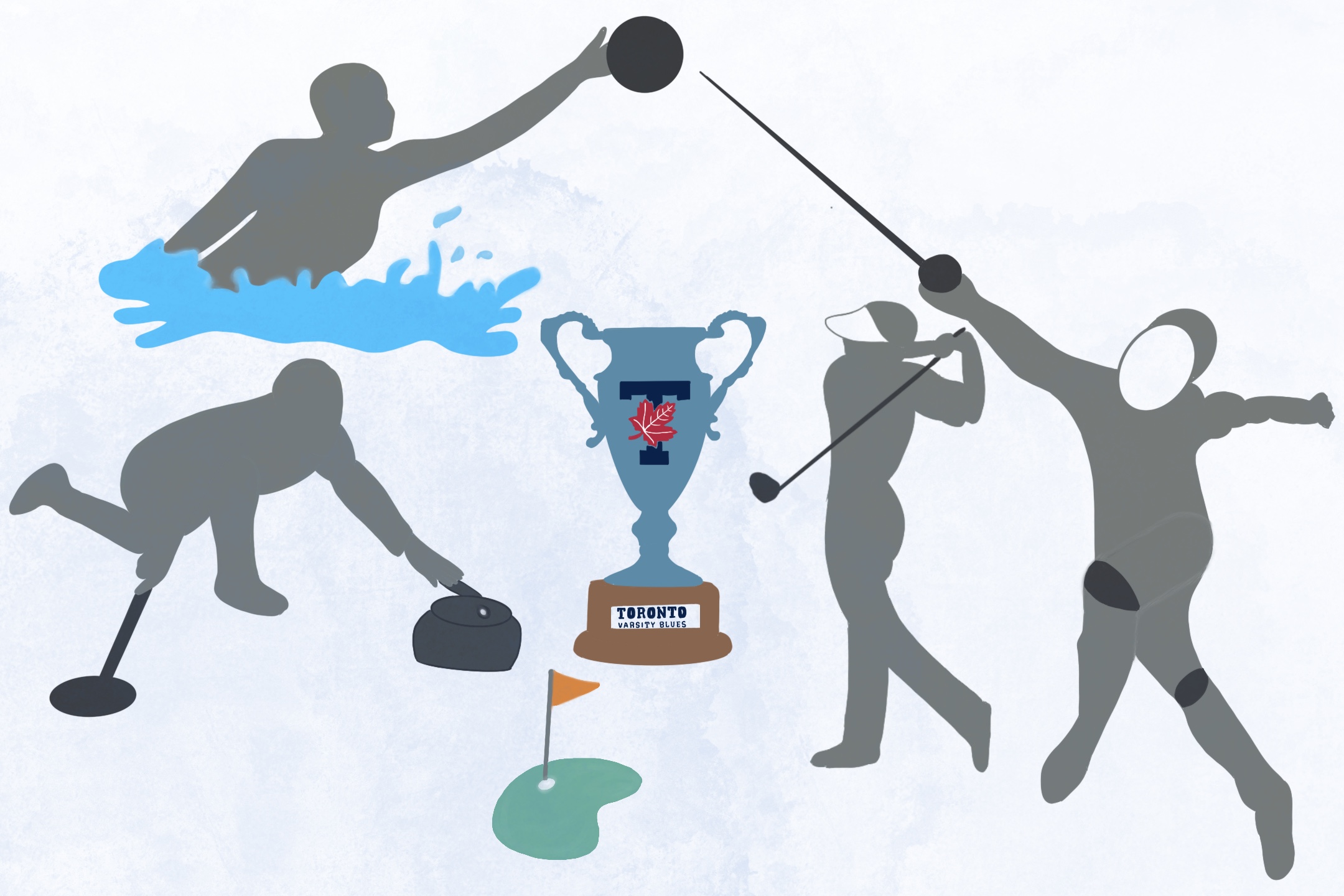
The weekend football games, hockey games, and soccer matches, we’ve all heard about them, and we’ve attended many. But they’re not the only games U of T has to offer.
In fact, some of our most successful Varsity Blues athletes are winning in sports that many students don’t even know have teams. U of T offers a wide range of competitive sports, but I’d like to shine a light on three underrepresented varsity teams to keep an eye out for this season: water polo, fencing, and curling.
Fencing
Once you grasp the basics, fencing becomes an exciting sport of coordination, speed, strength, and strategy. It’s divided into three weapons: épée, foil, and sabre. In épée, the whole body is the target and touches with the tip score points. Foil and sabre require right of way, with foil targeting only the torso and sabre allowing hits with the tip or side of the blade anywhere above the waist.
As a Blues fencer myself, I find most people are not always aware of the physical strength and speed necessary during a bout, which can last anywhere between 30 seconds and three minutes. During the bout, the athlete must maintain a proper ‘en garde’ position and be constantly ready to attack or defend, either through lunging at a split-second notice or defending in reaction to the opponent’s actions. Due to its difficulties, it may take weeks of training before a new fencer can start fencing properly on a strip.
Despite having a smaller team, our Varsity Blues fencing team has had an insane track record. For nine years in a row, the men’s fencing team has claimed the Ontario University Athletics (OUA) title, every year since 2016. The women’s team has had equal success with OUA championship banners every year since 2018, except for 2024.
This means that the Blues have finished highest in all three fencing disciplines amongst all Ontario universities. As the season begins in the upcoming weeks, the Blues are excited to train hard to maintain that streak.
Curling
For those unfamiliar with the sport, curling may seem calm. But once you understand it, both watching and playing can be exciting. Curling is normally a team sport with two or four players per side, and the goal is to slide a granite stone toward a target at the far end of the ice sheet. Points are determined by how close each team’s stones are to the target, called the House. As the stone travels, athletes sweep the ice to reduce friction and control its path.
The sport requires not only physical strength and agility, but also mental focus. “Every shot forces you to juggle a dozen variables at once,” wrote curler Nadia Jouaneh, a third-year student on the team, in a message to The Varsity. The sport demands “constant on-the-fly analysis like ice conditions, rock speed, line calling, and more.” Because of its challenges, making a shot can be thrilling not just for the players, but for the audience, too.
During the 2024–2025 season, the men’s curling team won the McMaster Invitational Bonspiel earlier in January, and later finished in the top eight at the OUAs. Although the women’s team did not qualify for advancement in last season’s OUAs after losing three of their four games, they learned valuable lessons and are preparing hard for the upcoming season.
Water polo
Last but definitely not least, one of the most successful Blues teams is the water polo team. The women’s squad went undefeated during the entire 2024–2025 season, capturing National Collegiate Water Polo (NCWP) gold for the 11th straight year. The men’s team also claimed both the OUA and NCWP championships, making U of T the top collegiate water polo program not just in Ontario, but in the entire country.
Water polo is a team sport played in a deep pool with two teams of seven players including a goalie, each competing to throw the ball into the other team’s net. The pool is usually three metres deep, preventing players from touching the bottom. Players must score within 30 seconds before the possession is passed to the other team.
First-time watchers are often surprised by how physical the game is. “A big part of the game is played with a hand on your opponent, ready to push or pull them to stop their movement, give yourself extra space, or wrestling them for possession of the ball or a better position,” said Julien Brandon-Renaud, a U of T water polo athlete, in a message to The Varsity.
The water polo team’s successes have come with relentless training. Practice times average around 12 hours a week. Most days include a warm-up of about an hour-long swimming set of three to four kilometres, followed by countless passing, shooting, and explosive drills, often while wearing weight belts or using weighted balls to build strength. As the Blues get back into the season, they are definitely a team to look out for, with the women’s team playing their first match on September 26 at the Varsity Pool.
These three teams are not the only underrepresented competitive groups worth noticing. Other notable mentions include badminton, wrestling, golf, and figure skating teams. The Varsity Blues hold incredible talent, and it would be a shame for it to go unnoticed. As this new school year begins, let’s explore new sports, connect with the athletes, and celebrate them at their next competitions.
Tian Tian Dong is a member of the Varsity Blues Women’s Fencing Team.
