
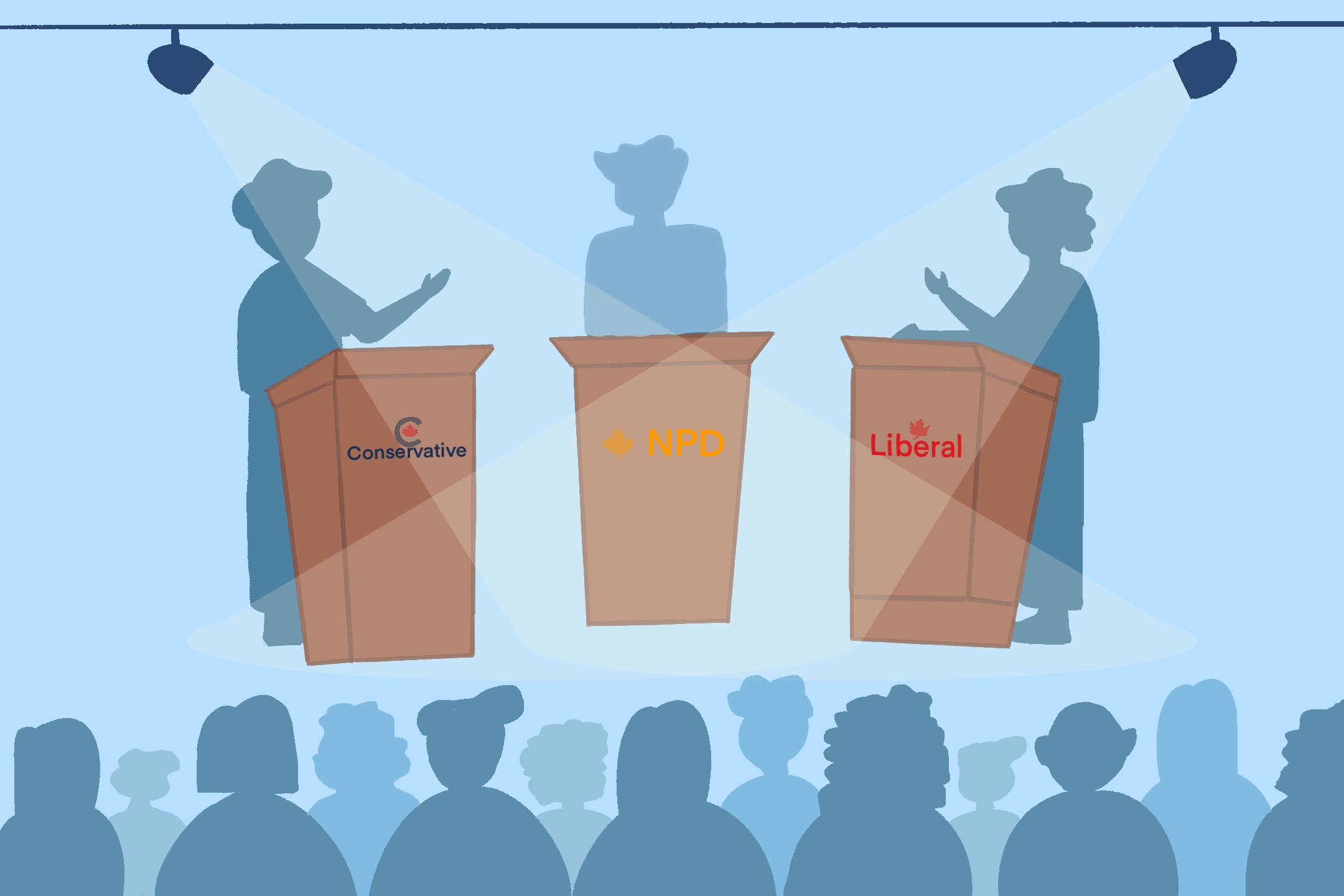
In the recent Canadian federal election, the New Democratic Party (NDP) was stripped of its momentum. They not only lost official party status, but also saw Jagmeet Singh resign as party leader after losing his seat in his riding of Burnaby Central.
For some, these changes may seem like part of a natural course in politics, where parties rise and fall all the time, but this isn’t just a story about one party losing power. I believe that the NDP’s collapse is a symptom of a deeper structural failure within Canadian democracy.
I believe that, during the 2025 federal election campaign, Singh threw mixed messages about the NDP’s previous and future support for the Liberal Party’s agenda, leaving voters feeling like they must vote strategically between two popular parties. I also feel that the NDP’s alienation from its voters and its identity crisis were exacerbated by the mainstream media’s failure to provide coverage on smaller parties, further reducing the ideological political spectrum within the Canadian democratic system.
This problem is larger than just the NDP; it lies within the core of our system.
The two-party system
The dilution of Canada’s multiparty system during this election wasn’t unpredictable. In theory, Canada’s electoral system should offer a chance for diverse parties to grow, evolve, and represent different voter interests. However, it was clear from the start that the choice in this election was between the Liberal and Conservative parties.
Currently, our political system has become largely divided between the Conservatives and the Liberals. The focus on these two parties shuts out other voices, leaving little chance for any other parties to garner attention. I think that as our elections become a fight between two sides, we lose the meaning of how Canada’s democratic system is supposed to work.
Many people don’t entirely support the Liberals or the Conservatives. Yet, they vote for one out of fear that the other may win. These voters worry that if they vote for a less popular party –– such as the NDP –– their vote won’t ‘count’ in the grand scheme of the election, leading to a win for a larger party that they dislike. So, instead of choosing the party that aligns with their values, voters cast their ballots for the lesser evil among the more prominent parties.
This kind of thinking implies that people’s true choices don’t matter, which prevents any real change from happening. When this pattern of voting persists, it leads to non-major parties losing power, such as in the case of the NDP.
NDP’s identity crisis
In addition to the impacts of strategic voting, I don’t think that the NDP’s identity crisis helped the party’s situation either. While the NDP has tried to appear as a more progressive alternative to the Liberal Party, their past support for Trudeau has entirely weakened this message. As a result, Singh’s recent attempt to attack Trudeau mostly came off as disingenuous.
On January 7, Singh, in a statement on Trudeau’s resignation, stated that the Liberal Party has “let down Canadians” and “do not deserve another chance.” Yet on March 22, 2022, he signed a deal to keep Trudeau in power until 2025 in exchange for progress on some of the NDP’s priorities, such as pharmacare and dental care.
By previously backing the Liberals, the NDP blurred the line between being its challenger and its partner. I believe that this confusion greatly hurt them in this recent election, allowing the NDP to go from being partners of the Liberal Party to barely holding on to power after losing party status.
The NDP’s mixed message regarding their support of the Liberals made it difficult for voters to trust the NDP’s leadership. Those who wanted the party to be a clear alternative to the Liberals felt betrayed or confused as to what they truly stood for.
At the same time, those who were skeptical of Trudeau’s government saw the NDP as part of the problem rather than the solution. Yes, they wanted to push their own policies while working with the Liberals. But in doing so, they surrendered their independence in the eyes of Canadians, giving voters the impression that the parties were too similar.
Media visibility
The NDP itself isn’t the only one to blame for its decline in votes. Political narratives are largely shaped by the media coverage; it’s easy to see that most of the mainstream coverage focused on emphasizing a race between the Liberals and Conservatives, sidelining the NDP.
Despite the NDP’s efforts to represent bold policy ideas such as wealth taxes, expanded health care, or climate justice, their messaging struggled to break through. Reporters often framed the election as a two-way fight, leaving less space for others to compete/participate.
Even during televised debates, moderators directed the attention towards Mark Carney and Pierre Poilievre, treating Singh like a third wheel. In the English-language debate, which was aired on April 17 by CBC, Singh spoke for the least amount of time, falling significantly behind Poilievre and Carney.
Media coverage doesn’t just reflect public interest; it shapes it. If people don’t hear about NDP policies, they may assume the party doesn’t have a relevant plan. Media visibility matters, and within this election, it was lopsided.
When alternative voices are sidelined, it contributes to a shallow form of democracy; one where bold ideas are ignored and only the most ‘electable’ stories are told. In such a climate, it’s no surprise that the NDP struggled to be seen as a serious voting option.
Moving forward, the NDP needs to rethink how it connects with voters and what it truly stands for. Instead of latching onto other parties, they need to establish a clearer message about their goals and values. If this pattern continues, it risks undermining the multi-party system at the core of our democracy.
People need to know exactly what the NDP has to offer that other parties can’t. This means standing firm on their promises and defining themselves again without confusion or compromise.
Jazmeet Saxena is a second-year student at UTSC studying journalism.

No comments to display.