
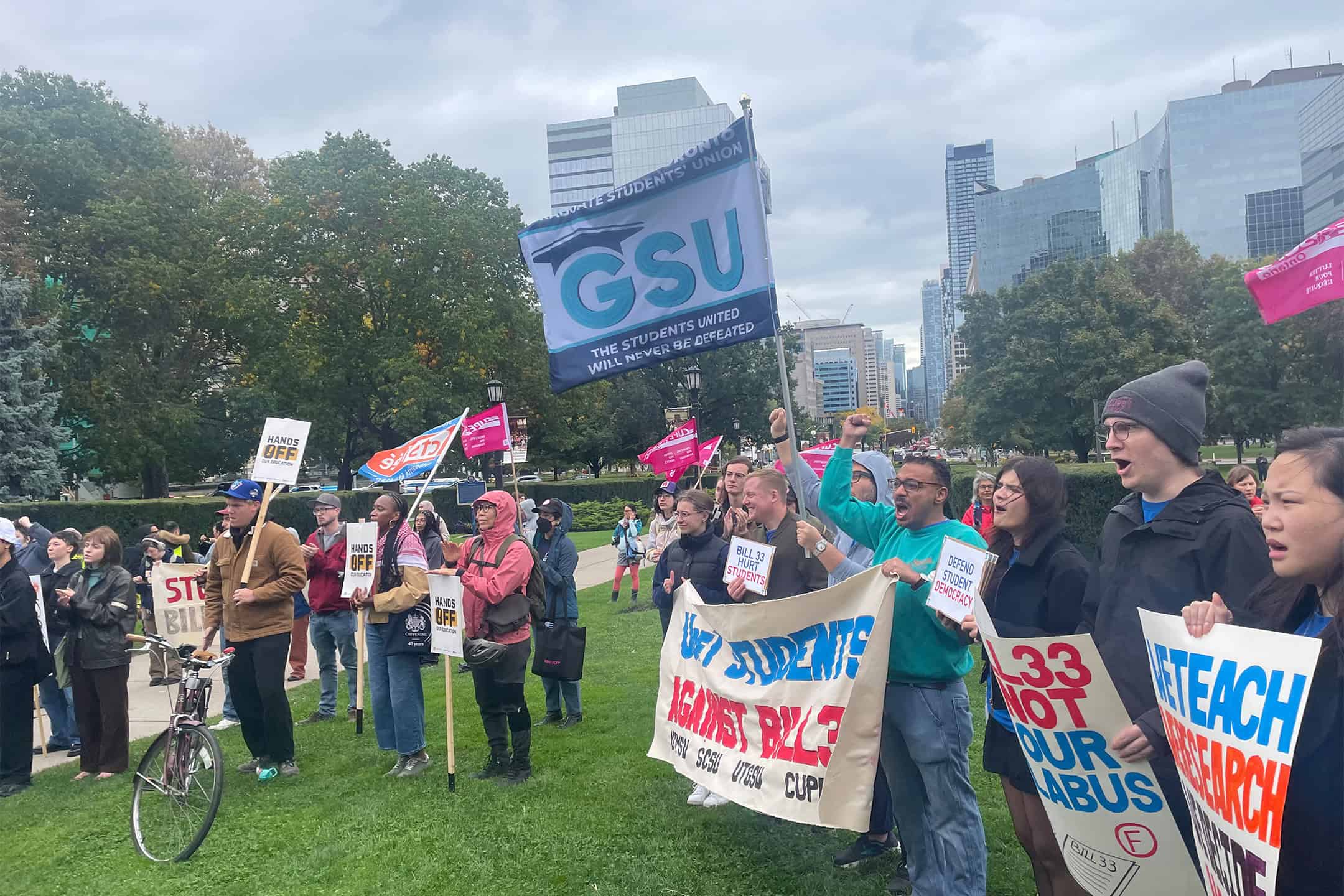
On October 20, community-based organization Policing-Free Schools held a small but lively “No to Bill 33” rally in Queen’s Park from 10:00 am to 2:00 pm, the same day Ontario’s Provincial Parliament returned from an extended summer break. The protest was led by Policing-Free Schools Director and founder Andrea Vásquez Jiménez and featured school board trustees, teachers, professors, students, and live music from DJ CUR8.
“Fund our schools, fund our communities — not policing-in-school[s],” was repeated by Jiménez throughout the rally.
The same day as the protest, Policing-Free Schools Canada and Vásquez Jiménez’s petition “Mandate the Removal of Police-in-School Programs and Policing-in-School Programs from Educational Spaces in Ontario” was submitted to Parliament by Member of Provincial Parliament (MPP) Kristyn Wong-Tam. Two other petitions against Bill 33 were also tabled, with “Save Public Education” presented by MPP Alexa Gilmour, and “Hands Off Our Education” by MPP Peggy Sattler.
Vásquez Jiménez wrote to The Varsity, “we will continue to organize here provincially even beyond Bill 33 until Policing-Free Schools Ontario is a reality and that includes a strong public education system that is properly funded, supported and resourced not policing-in-schools along with a Policing-Free Schools Canada.”
Leading the coalition
The University of Toronto Graduate Students’ Union (UTGSU) was in attendance. President Amir Moghadam wielded a large GSU flag while Vice-President Internal Dominic Shillingford and other union members held a painted banner that read, “U of T Students against Bill 33.”
“Defeating Bill 33 requires a united front,” wrote Moghadam in an email to The Varsity. “When the government unilaterally rewrites the entire education system without consultation, students and workers at every level need to fight back together.”
Graduate students are particularly affected by Schedule 3 of Bill 33, the Colleges and Universities Act, which mandates that universities “develop and implement a research security plan to safeguard, and mitigate the risk of harm to or interference with, its research activities.” If passed, the Act would allow the Minister of Education to control what elements the plan must include and set deadlines for completion and implementation.
Schedule 3 also would allow the Lieutenant Governor in Council to regulate “any fees” charged to students. This threatens the main source of income for student unions like the UTGSU.
In 2024–2025, the UTGSU reported nearly $20 million in revenue, all of which came from student fees. That same year, the union spent $17 million on students’ health and dental insurance, $526,994 on services and student groups, and $304,073 on programming and advocacy.
“This [regulation] means fewer research opportunities, delayed degrees, and defunded essential services. Ontario ranks dead last in Canada for per-student funding, yet the Ford government… wants to control how we spend our democratically-approved fees. This hurts our education now and our working conditions as future researchers,” Moghadam explained.
At U of T, the UTGSU has been at the forefront of student opposition to Bill 33. “We’re leading the UofT coalition,” wrote Moghadam. On September 15, the union released a statement opposing Bill 33. On October 22, it also hosted a town hall with University—Rosedale National Democratic Party (NDP) MPP Jessica Bell to explain how Bill 33 will impact post-secondary students.
“Many graduate students don’t immediately connect provincial legislation to their daily lives. Student power comes from members understanding what’s at stake and mobilizing together,” Moghadam wrote.
Raising the alarm
Beyhan Farhadi, an Assistant Professor of Educational Policy and Equity at the Ontario Institute for Studies in Education (OISE), also spoke at the rally about the threat to students posed by Bill 33’s requirement that police have access to school premises.
Reflecting on her experience, Farhadi wrote in an email to The Varsity that, “speaking at the rally was both grounding and galvanizing. It was powerful to stand alongside students, educators, and community members who are united in their vision for schools free from policing.”
Farhadi is currently researching the incorporation of surveillance technologies, like behaviour-tracking apps and threat-reporting software, in public education.
“I’ve seen firsthand how the presence of police and punitive systems in schools undermines the safety and dignity of students, especially those who are already marginalized. Bill 33 represents a dangerous escalation of these harms, and I felt a responsibility to raise the alarm.”
In particular, Farhadi focuses on the disproportionate impact these surveillance systems have on Indigenous, black, racialized, queer, trans, and disabled students.
“These technologies don’t address the root causes of harm in schools, like poverty, trauma, or systemic inequity. Instead, they normalize constant monitoring and teach students to perform compliance rather than experience true safety,” Farhadi wrote. “My work emphasizes that these systems are not neutral; they reflect and reinforce existing power structures. That’s why I oppose Bill 33: it’s not about safety, it’s about control.”
