
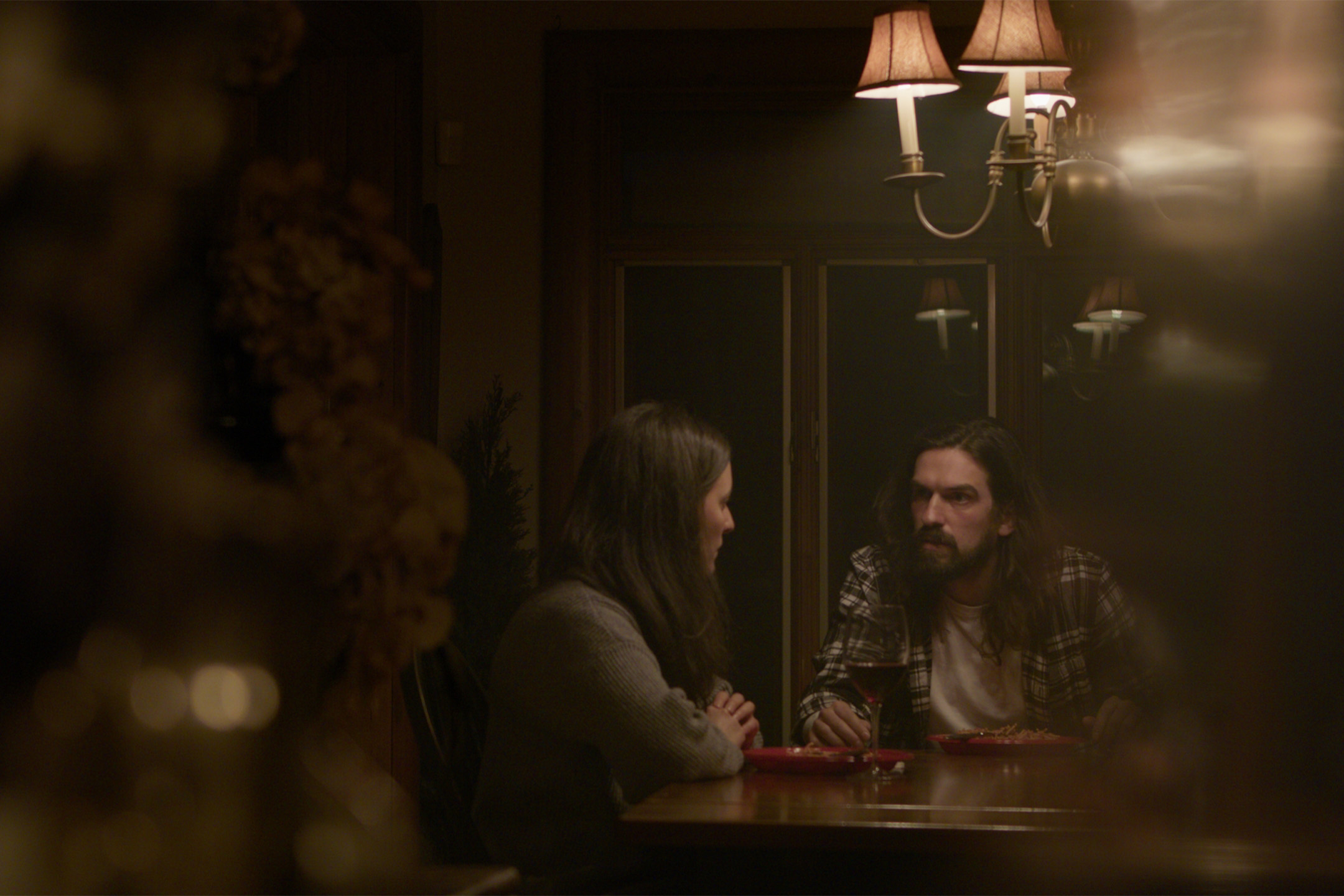
From a small indie production to being picked up by actor and producer Eli Roth’s media company, The Horror Section, Dream Eater is a found-footage horror film of a documentarian and her sleepwalking boyfriend on holiday in a cabin in the woods.
The Varsity had the opportunity to speak with the team behind the movie: Alex Lee Williams, Mallory Drumm, and Jay Drakulic on making films and what to watch during the Halloween season. The three worked as writers, directors, and actors for Dream Eater.
The Varsity: It’s incredible to see independent and low-budget films get wide theatrical releases. Could you tell us the journey of this film?
Mallory Drumm: We wrote the script for Dream Eater in August 2022. It was a nine-day shoot. We hit the festival circuit and then, in October of 2024, to our surprise and absolute delight, we won Best Feature at the HP Lovecraft Film Festival in Portland.
Alex Lee Williams: We were shocked.
MD: From there, it got a bit of buzz in the film circuit, and Unnamed Footage Festival, a found footage POV film festival, reached out to us wanting to screen it in March of this year.
As part of their promotion, they sent out a screener to a few influencers, one of whom was Chuck Shaughnessy (@yourmovie_guy412). He posted a review, we went to sleep and woke up, and it had gone viral — there were like four million views. From there, someone reached out to Eli Roth and was like, “Hey, have you seen or heard about this movie?”
ALW: I was checking our company’s DMs one day, and we clicked on this folder of spam, and it said “Real Eli Roth.” I was like, “Holy shit.” He asked, “Hey, do you have distribution? I’d love to see your movie.” So we thought, best case scenario, he was going to watch it, hopefully like it, and then we could ask to use his quote for the poster.
Within the time it took to watch the movie, he had come back saying, “I want to buy the movie.” Within two days, we were on a FaceTime call with one of our heroes, where he told us, “You scared the shit out of me.” So from there, everything changed.
TV: You are the writers, directors, actors, and editors of this film. Is there satisfaction in seeing a project like this come to fruition? Or next time, are you going to start hiring out some of those roles?
Jay Drakulic: It was funny, we had a feature before this where we worked with bigger crews. But while we were shooting Dream Eater, we were all saying, “Can we always make movies with eight people?”
There’s something about it that’s really exciting and satisfying. But you’re constantly waiting to get greenlit. It’s like you’re waiting for permission to tell these stories.
So for us, it was kind of a no-brainer; why don’t we put our money into a story we believe in? Mallory always called it “The little movie that could.”
Eli Roth champions indie filmmakers and storytellers. So to be working with one of your idols and get the mentorship he offers, it’s the cherry on top.
MD: The three of us don’t want children, and we didn’t do the grown-up thing and buy homes or mortgages.
TV: I feel like it’d be a hard film to explain to your kids.
ALW: Yeah, like “Daddy didn’t mean it.”
TV: You can go to sleep tonight!
MD: So, this is kind of our baby in a way. The fact that people are responding to it at all and want to see it is hugely satisfying.
ALW: To Jay’s point, I think it’s the people that you surround yourself with. Movie sets can be incredibly difficult or incredibly rewarding.
This was one of those experiences where everything clicked. The right people were there, and we had our crew, and we wanted that to continue to the next project. It takes a miracle to make a movie, if not dozens of them, and it’s only possible with a dedicated team of hardworking, incredible artists, which we were so fortunate to have for Dream Eater.
TV: The horror genre relies on a lot of tropes. Dream Eater has the secluded cabin, the cult, the nightmares. As filmmakers, was your approach to embrace these tropes or try to reinvent them?
ALW: I don’t think our intention is ever to reinvent them. I think as soon as you set out to do something like that, you’re going to fall on your face.
We wanted to pay respect to the titans before us, which is why we put in so many references to our inspirations. It’s “How do we embrace these inspirations in the way that we want this movie to flow?” And then “What are things that we want to desperately avoid?”
One of those things in found footage, a logic question that takes me right out of it is: why in the fuck is this character spinning the camera around to look at their own face just for them to respond to something? It doesn’t make any sense.
Mallory never does that in the film. Ever.
Michael Caterina was the camera operator, so he had to emote physically, and she had to emote audibly. That was something that was very, very important to us. Never sacrifice logic for the sake of showing something scary. It was always put the story first, put the characters first, put the logic first.
TV: It’s a really good narrative device to make a character a documentarian, so you can film on a nice Canon camera. But, there’s almost an inherent horror to movies like The Blair Witch Project and Paranormal Activity, where they’re filmed on old VHS and Handycams.
Did shooting on a more professional camera make it more difficult to make the images look scary?
MD: I don’t think so. We have such an incredible Director of Photography in Michael Caterina, and we really wanted to be able to exercise his skills. We took a lot of inspiration from The Visit.
But what took us out of that film was “This feels really clean for a 15-year-old.” And so we thought: let’s justify that a little bit further. Let’s make the character Mallory a documentarian.
JD: In found footage, so much of the cinematography is informed by the narrative. So for some of those gritty, handheld VHS-looking movies, that’s what suits those stories.
But even when you think about Blair Witch, part of it is shot on VHS, but a lot of it is shot on stunning film. That’s a fledgling cinematographer who’s still in school, but you’re getting that gorgeous grain. You’re getting that gorgeous texture and those rich images. So, even when you look at a movie like Blair Witch, it might be shaky, but it’s cinematically stunning to look at.
The B-roll that Mallory shoots almost feels like diary entries, how she’s blowing off steam or how she views the world. So it was very cool to craft that with our cinematographer to find the look and the feel of the character, which is the camera.
TV: What horror movies are you going to be watching this Halloween season, and are there any movies you would recommend to thoroughly scare people?
ALW: Dream Eater! That’s what I’m going to be watching. I can’t wait to watch that for the 4,000th time.
MD: Every Halloween out there. Trick or Treat also. I love a good anthology film. A film that came out recently that’s in my ‘top of 2025’ is The Ugly Stepsister.
JD: I’m really excited about Good Boy. Some classics to revisit during Halloween are Behind the Mask: The Rise of Leslie Vernon. There’s a Bob Clark film that was really influential personally for me, going into Dream Eater, called Dead of Night. Really, really cool film. Also deals a lot with how traumas can change you into something that you never intended to be.
ALW: I watch The Ring every Halloween. It’s one of my favourite movies ever made. It’s a perfect…
JD: You’ve got, like, Ring hair. You know what I mean?
ALW: This is my story.
This interview has been edited for length and clarity.
