
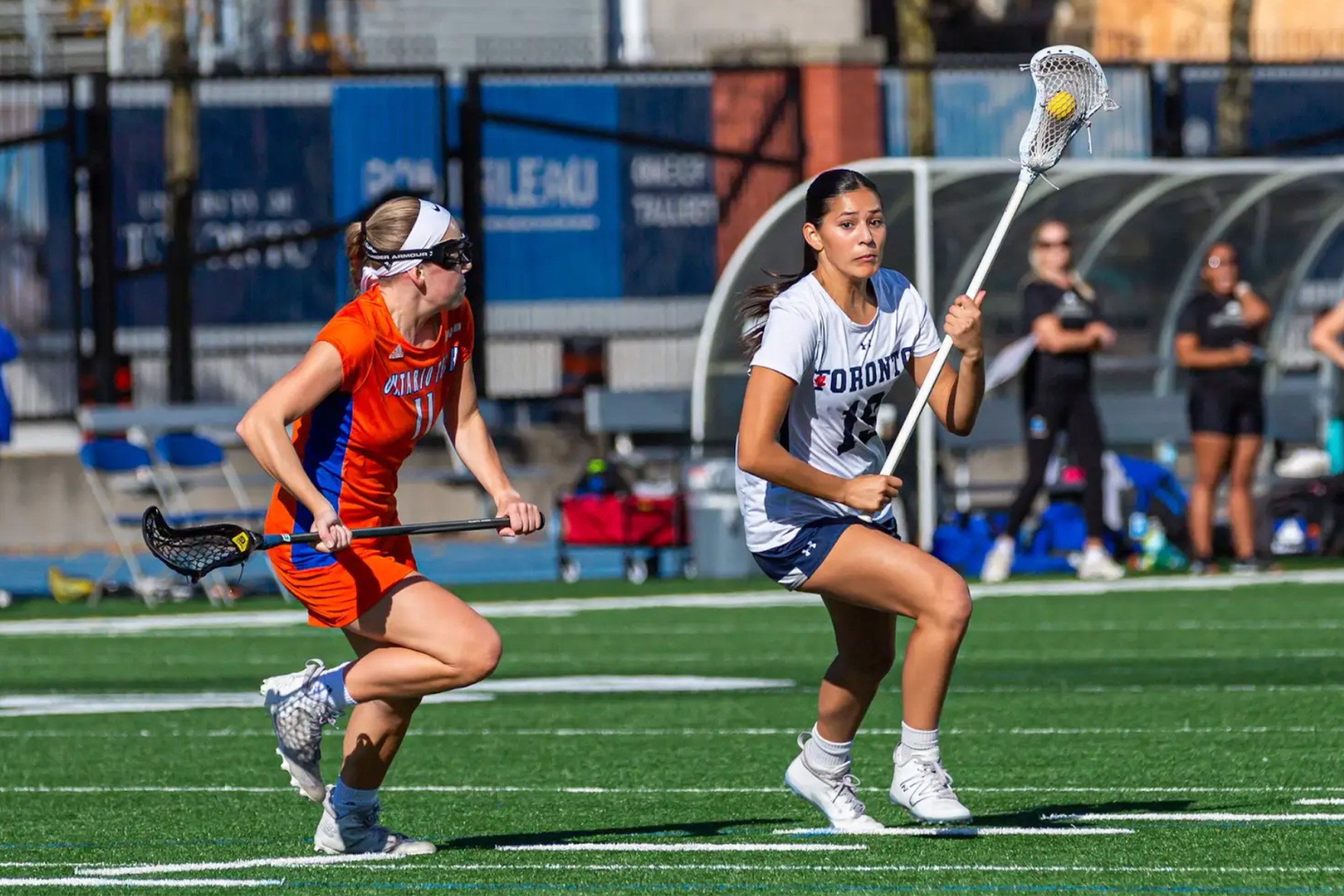
If you ask someone what they think Canada’s national sport is, the quick and instinctive answer would be ice hockey. Although ice hockey is half true, as Canada’s official winter sport, little do people know that the country also has another. Lacrosse is Canada’s official summer sport, and is deeply rooted in Indigenous history.
Though not as popular as its winter counterpart, Lacrosse is steadily growing in the realm of sports, gaining traction through viewership from professional leagues and collegiate athletics. On the U of T women’s lacrosse team, one of the program’s standouts is midfielder Alexei Dokis-Dupuis.
In an interview with The Varsity, Dokis-Dupuis spoke about her lacrosse journey and the importance of promoting Indigenous sports like Lacrosse through setting an example as an Indigenous athlete.
credit Mackenzie Gerry
Picking up lacrosse
Born and raised in Sudbury, Dokis-Dupuis started playing lacrosse at the young age of five, taking inspiration from her older brother. “I watched my brother play, so I begged my parents to let me play as well. Sure enough, I loved it,” she recalled.
Dokis-Dupuis suited up for the Sudbury Rockhounds, a local lacrosse club, as she competed in various circuits. Although she grew up playing box lacrosse, she made the transition to its outdoor counterpart, field lacrosse, and earned a spot on U of T’s varsity team.

Finding balance as a student-athlete
One of the selling points that made Dokis-Dupuis choose U of T was that they had a varsity lacrosse team. “I had reached out to the coach a few months before coming in, and we had talked. She invited me to the training camp [during] the last week of August,” she added.
Dokis-Dupuis’ biggest challenge was figuring out how to balance her schedule as an architectural student playing for the lacrosse team. When asked about her struggles as a U of T student-athlete, she responded, “Definitely, the first year — figuring out how to maintain the varsity schedule, and getting used to the first year and all it takes to be successful in Architecture — was challenging.”
Memorable moments at U of T
Dokis-Dupuis took part in the OUA bronze medal game a year prior, where she helped the women’s lacrosse team land a third-place finish. “That was a huge win for our team, and [it was] awesome to be a part of and be playing in that game,” she replied.
“I would say, definitely go for it. I think it could be a little bit intimidating at first, in terms of balancing everything, but I couldn’t imagine going through university without continuing to play sports. I think it’s important to stay active, and it definitely helps [me] maintain a good schedule,” Dokis-Dupuis explained when asked about her advice to aspiring U of T athletes.
Dokis-Dupuis stated that she plans to do a master’s in architecture once she finishes her undergraduate degree. She also provided an optimistic outlook regarding the future of her lacrosse career; “In terms of athletics, I hope to continue playing lacrosse, and just see where life takes us after my master’s,” she said.
credit Mackenzie Gerry
A role model to everyone
Dokis-Dupuis emphasized her pride in her Indigenous identity. She then pointed out the importance of having someone to look up to, not just for Indigenous youth, but also for other family members and people from her hometown.
Dokis-Dupuis highlighted the support she receives from the community, stating, “It’s been good so far. I definitely have a lot of support. I’m very fortunate that my coaches and teammates, [and] my professors have all been super supportive, and also eager to learn about [Indigenous] culture.”
Lacrosse is tied to its Indigenous origins, a connection that Dokis-Dupuis embraces. Her Indigenous identity did not present any challenges; rather, “being Indigenous, I’m proud to be playing lacrosse because of its origins from Indigenous people.”
She also emphasized the role that she plays in bringing forth representation in the sport of lacrosse: “ I think having representation within the sport is really important, and I’m happy to be part of raising awareness and recognition of the history and traditions of the sport.”

No comments to display.