
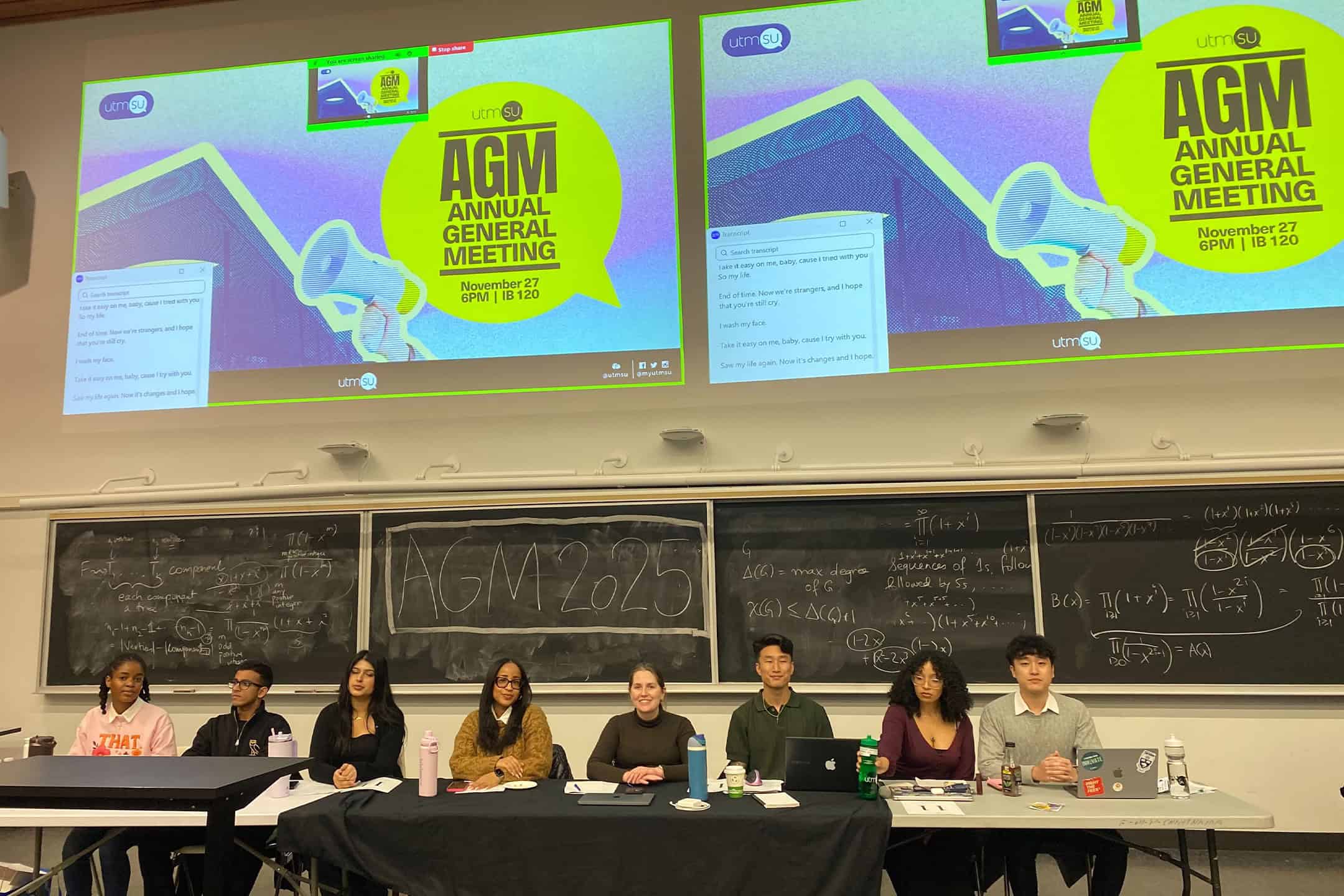
On November 27, the University of Toronto Mississauga Students Union (UTMSU) held its Annual General Meeting (AGM) in the Instructional Centre, reflecting on events and achievements from the past year and presenting its annual financial statements.
Attending students participated in voting on motions, with some speaking up about concerns regarding certain lobbying requests.
Ongoing campaigns and advocacy
Despite challenges, the UTMSU secured a meeting with Metrolinx to discuss a proposal to modify the GO Bus Route 21 Milton Line to include a direct stop at UTM. This proposal responds to the “some of the longest travel times” — often exceeding 90 minutes — experienced by UTM students commuting from Milton.
The UTMSU also noted the introduction of weekend service to the MiWay Route 110 University Express, which went into effect on September 1.
Although the UTMSU made efforts to combat Bill 33 through a “week of action,” the bill was passed by the Ontario government on November 19. In response, UTMSU President Andrew Park said, “We may have lost the battle, but the war is far from over.” He further added that the UTMSU will continue to fight and “resist this government that has made clear that education is not the priority.”
Statistics and financial statements
The UTMSU 2024–2025 financial statements ended with a $773,068 surplus outside of levies and the health and dental plan. Wages increased from $878,490 to $940,189, meeting expenses rose from $33,781 to $74,397, and services decreased from $137,810 to $124,643. Orientation revenue dropped significantly, from $181,459 to $89,874. Cash flow was also lower compared to the previous year, but net assets increased.
This year, The Blind Duck served a total of 55,000 students, with chicken wings as its best-selling item at 10,000 wings per month. Profits increased significantly, with a gross profit of $424,632. After expenses such as wages and serving supplies, the restaurant ran a deficit of $138,246. The student levy helped cover the deficit, allowing the Blind Duck to end the year with a surplus of $156.
Vice President Internal Rui (Owen) Zhang said this outcome is “intentional,” emphasizing that The Blind Duck is not meant to operate as a “profit-making business.” Instead, it “provides students with accessible [and affordable] food options.”
The Duck Stop, a convenience store at UTM, supported local businesses and recorded over 27,000 student purchases in the past year. The Duck Stop made $15,181 in gross profit and ended the year with a $12,150 deficit.
Student-submitted motions
This year, there were four student-submitted motions.
The first motion involved the UTMSU lobbying to improve ACORN’s accessibility and performance during periods of high volume, with course enrolment times specifically cited.
Two students objected: one argued that this was an IT Service issue and that the UTMSU should “focus their power on things that are important [to the] student movement,” while another student requested that the motion be tabled to the Board of Directors (BOD), which was passed.
The second motion called for the UTMSU to lobby for solutions to improve Wi-Fi reliability across campus. A student requested that this motion also be tabled to the BOD, a request that was passed.
The third motion requested that the UTMSU investigate funding options for students who require parking passes, noting that they may be unaffordable for those commuting from afar. One student commented that UTM is one of the most ticketed locations in Mississauga, and that parking tickets may be cheaper for students than a pass.
Two students opposed the motion, arguing it was a “pro-car” amid climate change concerns and that lower prices would inflate the already high waitlist for parking passes, while two others supported it.
The motion did not carry, with 118 votes in favour, 183 against, and 82 abstentions.
The fourth motion, which proposed that the UTMSU adopt online voting for all elections and referenda, was not discussed due to time constraints.
Update on previous AGM motions
In response to student motions concerning Indigenous rights and equality during last year’s AGM, the UTMSU established the Committee to Indigenous Justice and Collaboration (CIJC). The CIJC now has over 30 active members and will be formally recognized as a standing committee in the UTMSU’s bylaws.
A makerspace — a space for students to create using resources such as 3D printers and power tools — was proposed last year. While it would have benefits, Park said that the UTMSU will “probably not [be able to create their own makerspace], at least for the foreseeable future,” citing financial limitations and a lack of space in the student centre. He added that such a long-term project could be risky “in light of Bill 33.”
The UTMSU will also undergo an organizational name change to align its legal name, currently “Erindale College Student Union,” with its business name. This legal name dates back to when the campus opened in 1967 as Erindale College before becoming UTM in 1998.
One student raised concerns about the associated costs and questioned whether the change was necessary. A UTMSU executive explained that it was a “requirement put forward [on] advice of [their] lawyers,” adding that the cost would be only $150.
Editor’s note January 18: This article has been updated to reflect that the third motion was incorrectly stated to have been motioned to be tabled.

No comments to display.