
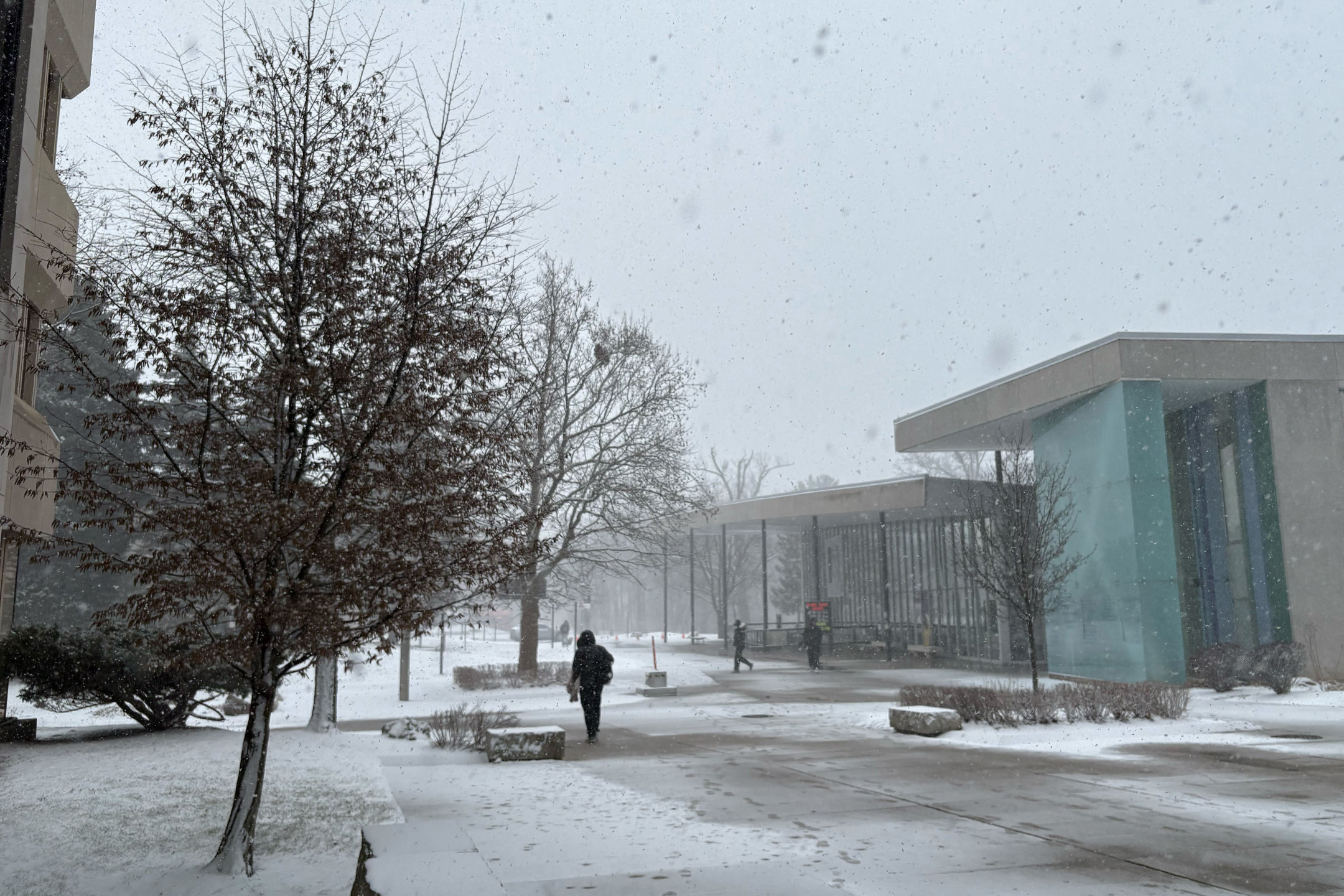
The University of Toronto Mississauga campus is laid out in a loop design, with academic buildings clustered inside Outer Circle Road, and parking lots lining the campus’ edges.
On weekday mornings, the loop can feel less like a functional campus and more like a slow carousel of students, all scrambling to find or make space for themselves.
Congestion is now a routine part of the student experience at the UTM. Second-year political science specialist Abdul Basheer Arifi believes that overcrowding affects everyday activities between classes, from finding food to securing study space.
Lack of space
Arifi wrote in an email to The Varsity that issues like “having one TIM [sic] Hortons for 100’s of students in one campus,” demonstrate how basic campus amenities struggle to keep up with the demands of the student population, which he feels is “very challenging.” Arifi argued that “they should really expand by creating [two to three] small booths for Tim Hortons,” so that students aren’t so limited.
UTM seems to be growing faster than campus infrastructure can keep up with. Between 2000–2020, the UTM campus population increased from 6,250 to 15,302 students.
To address this imbalance, UTM has expanded its infrastructure. For example, it is working on construction for new residence facilities, which seek to serve the growing campus population. The university has grown to approximately 190,000 gross square metres of facilities over the last decade. So why do students still feel the strain of inadequate space?
From crowded lecture halls and packed study spaces to long waits at campus intersections and overflowing recreation centers, UTM’s physical expansion has struggled to keep up with the influx of new students. It has instead served as a reactive response to the provincial guidelines that the campus previously failed to meet.
In 2011–2012, the UTM campus met roughly 80 per cent of the Council of Ontario Universities (COU) space standards. It was projected by U of T Campus & Facilities Planning that this would drop to 72 per cent by 2016, as space expansion has been unable to keep pace with population growth.
Third-year English major Elizabeth Perron exemplifies one strain of this lack of space in an email to The Varsity, explaining how the rush between classes often leaves little time to find space on campus to rest.
Frustrated at how difficult and time-consuming this can be, Perron often chooses to study “at home, or off-campus.” She wrote that she only studies on campus if she is there for a class. “Otherwise… I will leave. It just does not seem worth it to search for so long for somewhere to sit, that may not even be quiet or suitable for studying.”
Overcrowding and useless study spots
Students express that the crowding and competition persist at off-peak times, too. Arifi wrote that it can be “challenging to book a study room,” because UTM has limited space. The campus has 15 bookable study rooms and 665 total study spaces, which, when compared to the total student body, is evidently insufficient, which explains why competition for space and time wasted looking for space plagues many students.
Time wasted on just looking for a study spot can even impact academic productivity and performance. Sometimes Perron spends “longer looking for a place to study than actually studying.”
The Hazel McCallion Academic Learning Centre & Library is one of the campus’ most popular study spaces. However, it often reaches capacity during peak hours. “[T]he first floor of the library, which is a place for studying, is mostly very overcrowded, and it’s barely possible to study in that environment due to the high volume of noise,” wrote Arifi.
“[M]any students utilize quiet study areas for social gatherings disturbing other students.” This wouldn’t be a huge problem if UTM simply had a larger number of available study spaces. At UTSG, for example, students who are annoyed by chatty neighbours can simply pick up and move to another study spot. But this isn’t the case for UTM students, who have fewer options for study spaces.
Perron wrote that finding a place to study on campus often requires searching through multiple buildings.
She alternatively explained how it usually takes trips to more than one study space before she finds a suitable spot. “Usually… I have to search at least three different places before I can find somewhere [to study]. This is such a common experience for me… and I have my ways of getting around it.”
A noisy and cramped seat at the Starbucks across the library can be bought for the price of a grande hot chocolate and a muffin. That is to say, students must often pay to study at cafés, when ‘free’ study spaces are overcrowded.
Perron said, “I would much rather spend a few dollars at a quiet, cozy café that is guaranteed to have a space, rather than search for an extended period of time on campus.” But for students already navigating rising tuition and living expenses, this ‘pay-to-sit’ culture is an added burden.
The UTM Student Centre is similarly over capacity. It was originally designed in 1999 to serve a population of 6,000 students. As of the 2024–2025 academic year, it must now serve over 16,000 students. This popular hub for non-classroom study and social space is operating way over its intended capacity.
University-led expansion has occurred more slowly than student body growth. The University of Toronto Mississauga Students’ Union (UTMSU) members voted to self-fund a Student Centre expansion. Since fall 2024, UTMSU members have been paying a $10 per-session charge (which is increasing to $30 upon opening) specifically to create the study and community space that current institutional expansion measures have failed to provide.
Quality and quantity matter
The spatial shortage is not just about an insufficient number of spaces, but also about how those spaces are designed for practical and maximum use.
Arifi explained how UTM offers areas for social gatherings but lacks flexible seating where students can comfortably work for extended periods.“I assume there are enough spaces for students to sit and have a social gathering, but… the only issue we have is flexible seating or couches to sit comfortably and study.” For some students, the soft comfort of a couch rather than a rock-hard chair can make up for the stress of their studies.
Perron added that the issue is not only the number of spaces available, but the variety of spaces offered. The main ‘third space’ at UTM is the Blind Duck café, and although it is meant to be a space for socialization and relaxation, Perron complained that it is “incredibly overcrowded.”
Students often compare the UTM campus with UTSG when analyzing their frustrations with the lack of space. In addition to being able to easily switch locations if crowding or conversations make students lose focus, Perron observed how UTSG “seems to have one or more ‘third spaces’ in each of its buildings,” and with “flexible seating, charging stations, and an enjoyable atmosphere.” Third spaces are especially important for students who don’t live on campus and rely on them to rest, study, or socialize in between classes.
The imbalance between the size of the student body and the capacity for student services also manifests in inadequate student support services. Arifi explained how, at the Robert Gillespie Academic Skills Centre (RGASC), which is UTM’s academic advisory hub, it can be challenging to get a meeting with academic support staff because of lengthy waitlists.
“[Y]ou need to wait in the waitlist until an appointment gets cancelled, and [then] you get a chance to meet. So they should really support & expand places [like these],” explained Arifi. The Learning Strategy Appointment website (connected to the RGASC) indicates that there is a limit of two visits per student this semester, “to ensure that all students have an opportunity to access an appointment.” No such limits exist for visits to Student Life for Learning Strategy Appointments for UTSG students.
STEM-focused funding
Under the province’s 2025–2030 Strategic Mandate Agreement (SMA), a growing share of university operating grants is tied to performance outcomes. The province no longer funds universities based solely on enrolment numbers; it funds them based on the results students produce in the economy.
Funding in SMA is provided based on eight metrics, including graduate employment rate, graduate employment earnings, and investment. Those metrics incentivize prioritizing what Perron argues is STEM-focused development, like new buildings and research labs. Arifi explained how the New Science Building (NSB) is specifically allocated for STEM. “As a political science student,” he feels like social science students do not receive the same infrastructural investments conducive to producing similar research outputs.
The NSB added 15,550 gross square metres to support advanced laboratory research and STEM programming. It features 90,000 square feet of laboratory space, including the Centre for Medicinal Chemistry, and SpinUp, a dedicated wet lab incubator for early-stage startups.
STEM investments like these have strengthened UTM’s academic profile: expanded lab space to support competitive science programs, innovation hubs to foster industry partnerships, and new residences to increase on-campus occupancy and retention. As enrollment diversifies, these developments create more opportunities for scientific study and research.
But Perron explained that this can create inequality in spatial development for non-STEM students, who then become seen as less important or economically valuable. The Ontario government ties a portion of university funding to aforementioned SMA performance metrics, like research output, innovation, and graduate employment. “This is also why, under our current provincial government, we have seen more improvements and developments to STEM related services, rather than overall university services,” Perron wrote.
There is ultimately a tension between what universities are incentivized to build, and what students want and need. Specialized facilities seem to posit scientific investment as the key to important funding variables, like graduate employment earnings. However, students most frequently need accessible classrooms, open study tables, manageable commutes, and space to occupy on campus.
What students want
Looking ahead, Arifi wants UTM to invest in everyday campus infrastructure and support services as enrollment continues to grow. He wrote that expanding study space should be an immediate priority, along with stronger investment in arts and social science programs that currently lack dedicated collaborative environments.
“UTM should build more study spaces and expand departments and their activities. The university should also collaborate with other institutions to diversify opportunities for students.”
Perron wrote that key issues like lack of space and overcrowding can reflect the broader issue of how universities fail to prioritize student-centred infrastructure. Perron feels that while new science facilities and research buildings continue to expand, spaces that can be used by students across programs seem to be a relic of the past.
For example, the Maanjiwe nendamowinan building and the NSB are listed among UTM’s recent developments. The NSB is the most recent project, having opened in fall 2024. Meanwhile, the Maanjiwe nendamowinan building opened longer ago, in fall 2018, as a space for “the departments of English & Drama, Philosophy, Historical Studies, Language Studies, Political Science and Sociology,” featuring 29 classrooms and over 500 new study spaces.
“We have one library on campus, while other U of T campuses and Canadian universities often have several on each campus,” Perron wrote. “Even our coffee shops, which could be spaces to socialize or study, are mostly chains without much seating or atmosphere.”
She suggested UTM could call on its own student expertise when planning new infrastructure. “Get a team of student designers, engineers, architects, financial advisors, and let them give a projection for a space. These are the people who will be using it, anyway. Let them inform the university.”
For Perron, when asked what “enough space” on campus would look like, she argued it means more seating, charging stations, and a greater range of spaces — all of which should be accessible without reservations or long waitlists. “We need lots of seating, we need charging stations, we need different types of spaces (i.e. quiet, social, relaxation) and we need them to be available during ALL hours.”
As enrollment continues to rise, the physical footprint of UTM is also evolving. New research facilities, residences and innovation hubs reveal an institution positioning itself within a competitive research economy. But students say the everyday spaces that sustain academic life — study areas, advising offices, and flexible seating — must expand alongside those ambitions.
Without that balance, the pressures of growth will remain visible not only in campus planning documents, but in the daily routines of students searching for a seat, a quiet desk, or simply enough time to make it across campus.
