
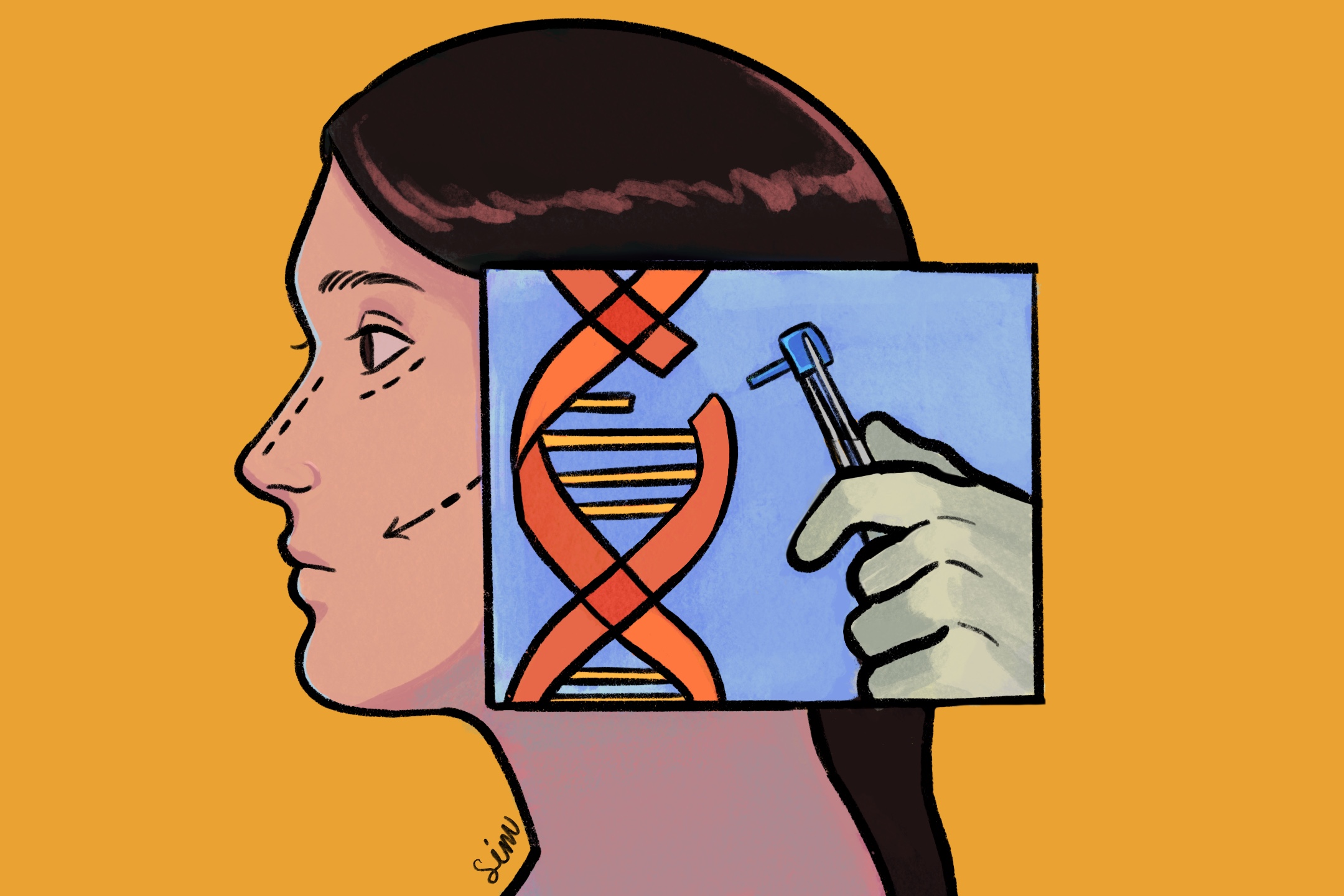
Evolution and genetic diversity gave us billions of faces, each with different characteristics, but social media trends have collapsed them all into one: ‘Instagram Face.’ An algorithmically ‘perfect’ look, whose homogenized aesthetic is characterized by high cheekbones, full lips, cat-like eyes, and a sculpted nose.
As genetic engineering technologies such as clustered regularly interspaced short palindromic repeats (CRISPR) improve and expand their applications, it’s possible that Instagram Face will simply become our new normal.
The normalization of Instagram Face reveals how aesthetic homogeneity runs rampant in society due to social media algorithms. This march towards “doomed, globalized sameness” is not an exaggeration. Social media algorithms aim to convince us that we would rather look like the AI-generated ‘avatar’ versions of ourselves than hold onto our individual features and cultural resemblances.
The convergence of CRISPR and cosmetic surgery may give rise to a troubling phenomenon of germline modification, using genome editing tools like CRISPR, to alter DNA in reproductive cells like sperm, eggs, or embryos. Unlike typical plastic surgery, which only impacts the individual, germline editing impacts every cell in a developing body, which means it has an impact on the resulting human and their descendants.
CRISPR and cosmetic surgery
The CRISPR-Cas9 system consists of guide RNA, which acts as a template that directs the Cas9 protein to the DNA sequence of interest. DNA’s structure is like that of a ladder, composed of two strands with base pairs in the middle, like rungs of a ladder, to connect those strands. Cas9 breaks the bonds between base pairs, effectively splitting the rungs of the ladder, allowing scientists to make edits on individual DNA base pairs.
This mechanism modifies the DNA, through inserting, removing or replacing genetic material, opening possibilities that range from eliminating genetic diseases to modifying inheritable traits, such as our physical features.
Over the past four years, the cosmetic procedure rate has exploded, with approximately 38 million aesthetic procedures such as liposuctions, rhinoplasty, and breast augmentations, performed globally in 2024, an almost 40 per cent jump since 2020.
What was once an industry that was restricted to the wealthy, which contributed to its lucrativeness, cosmetic surgery now has a high number of suppliers meeting an increased demand rate. This change represents what many celebrate as ‘democratized beauty,’ where meeting artificial beauty standards has become more accessible since cosmetic treatments are less expensive.
Beyond affordability, economic incentives continue to encourage patients to receive cosmetic procedures. According to economists at The University of Texas at Austin, good-looking people are generally happier than their counterparts, largely because of the higher salaries that come with beauty: according to the American Society of Plastic Surgeons, 13 per cent of women and 10 per cent of men cite earnings as a reason they would consider cosmetic surgery.
As the motivation for cosmetic enhancement grows, research is increasingly focused on producing innovative technologies that extend beyond surface-level surgical intervention. Historically, gene therapy has been characterized as a way to enhance cosmetics, and with CRISPR, there are more tangible and attainable applications in aesthetic surgery. Notably, CRISPR could enhance plastic and reconstructive surgery by modifying genetic targets associated with hair loss and skin aging.
The trajectory from cosmetic surgery to permanent genetic modifications is possible, and it remains to be seen whether cosmetic surgery will still feel optional when it poses financial and social benefits. As cultural historian Sander Gilman wrote, “In a world in which we are judged by how we appear, the belief that we can change our appearance is liberating.”
But what happens when we treat variations in the genetic code that make us unique as errors in need of correction? Where is the line between enhancement and erasure? What are the consequences if or when we cross that line?
If we accept modification of the human genome to be ethically sound for medical purposes, then the distinction between correction for ‘defects’ and optimization is far too ambiguous. The crux of the issue isn’t just about bodily autonomy; it is in recognizing that individual choices are determined by what power structures count as acceptable.
The consequences of CRISPR
History and time have shown the ebb and flow of beauty ideals, with different cultures and time periods having varying definitions of what is beautiful. According to the Innovative Genome Institute, human diversity in terms of race, gender expressions, interests, and abilities has intrinsic worth. The diversity in aesthetic preferences serves a crucial evolutionary purpose: to promote genetic differentiation, reduce the costs of inbreeding, and facilitate niches within species.
The concern regarding the rise of cosmetic procedures, coupled with the possibility of gene editing for aesthetic purposes, is the erasure of variation. Once certain physical traits become linked with desirability and others with genetic errors, do we risk permanently embedding these narrow aesthetic prejudices into the human gene pool?
The use of genetic engineering on humans demands a clear distinction between ethical enhancement and attribute erasure. The treatment of diseases like sickle-cell or hemophilia through genetic alteration to better the standard of living cannot be considered of equal priority with germline editing using CRISPR purely for aesthetic appeal.
Reclaiming our genome
While there are various technical and regulatory hurdles, such as clinical and Food and Drug Administration (FDA) approvals, between now and the advent of using CRISPR for aesthetic modifications, they may be relatively insignificant compared to social pressures. History teaches us that science moves faster than policy; it took almost 70 years to create a federal speed limit in the United States after the release of the Ford Model T. When it comes to our physical appearance, human vanity could be proven more powerful than our will to regulate it.
We must decide for ourselves: will we let aesthetic pursuit narrow human diversity into a single Instagram-worthy template?

No comments to display.