
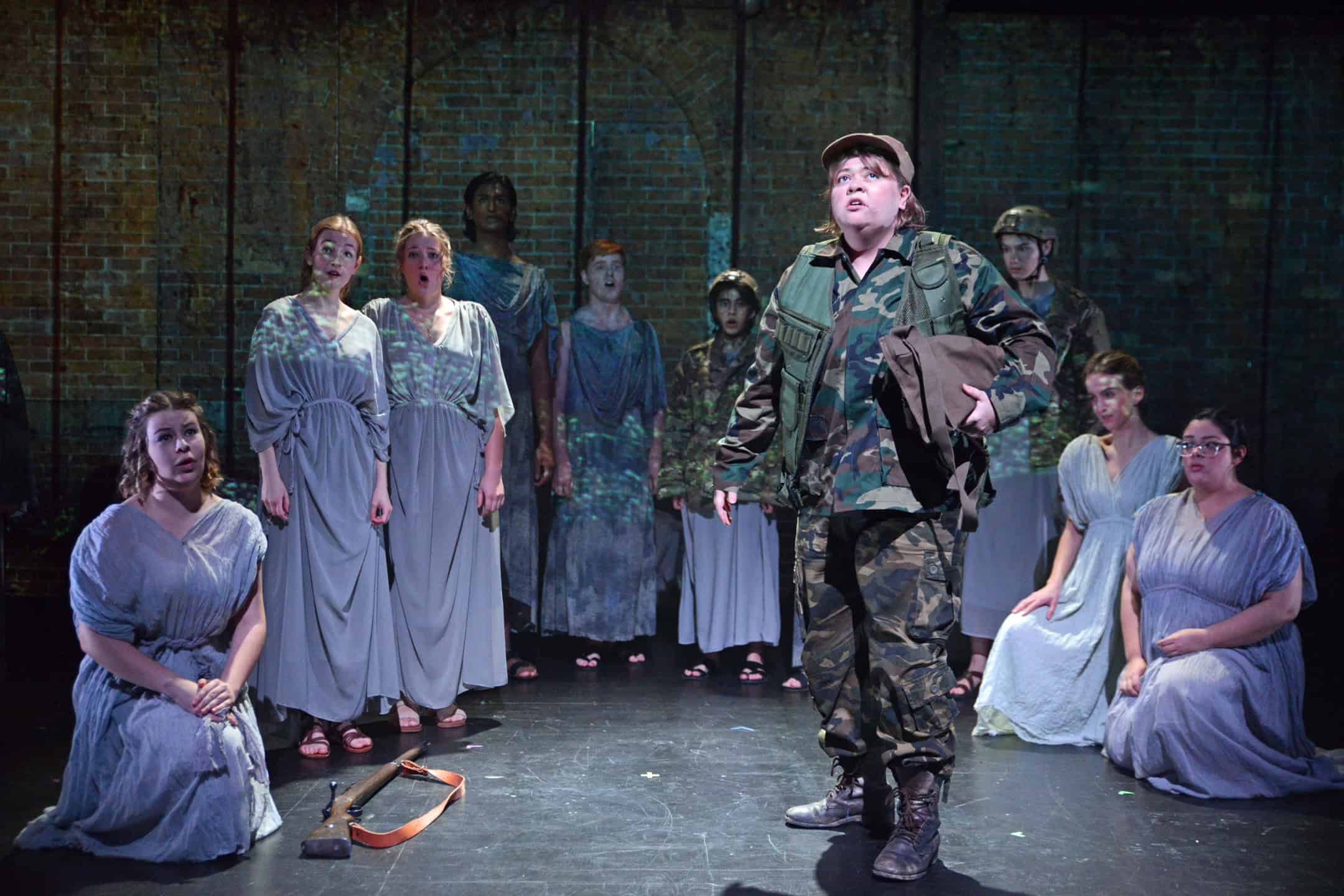
On January 18 at the Berkeley Street Theatre, I had the pleasure of attending With the Telling Comes the Magic: Tales from Antiquity to Present Day — a performance presented by the U of T Opera Student Composers Collective. The collective presented scenes from classic Greek mythology, first in their historical context, and then as a modern retelling. The scenes featured original operatic compositions by members of the collective.
As I’m completing a minor in classical civilizations, the classical inspiration for these opera scenes piqued my interest, and I was thrilled to be in the audience that night. U of T’s opera performances, which often allow free admission for U of T students, seemed like an appropriate setting to explore my interest in operatic adaptations of classical texts.
Master’s and diploma students in opera performance, with a supporting undergraduate chorus, debuted the opera scenes, hosting an evening showing and an additional matinee. The evening performance welcomed a nearly full house of opera enjoyers. In reimagining the setting of each classical text in a modern context, the scenes subtly enforced the relevance of ancient narratives in modern times.
The ‘scorned woman’ archetype flowed seamlessly between William Quan Cheng’s The vengeance of Medea and James Lowrie’s Medea in suburbia, emphasizing that these archetypes continue to resonate with audiences. The remaining scenes were composed by David Archibald, Pari Bahrami, and Kelly Du, each set to librettist Michael Albano’s witty text.
The creative vision behind this project, as well as the performances that brought it to life, were met with cheers from the audience during the final curtain call. Following all of their hard work, the cast, orchestra, and composers greeted an adoring crowd in the foyer of the theatre. It was compelling to see U of T artists celebrated for their hard work; as a part of the crowd cheering them on, I felt enveloped in community.
Though I admittedly know very little about opera, I was able to appreciate the performance in my own way. While I enjoyed Archibald’s Antigone in antiquity and Cheng’s The vengeance of Medea because of their classical familiarity to me, I found that modernized scenes like Lowrie’s Medea in suburbia provided fresh takes on antiquity that inspired me to imagine the stories that I had before assumed I was entirely familiar with, in new ways.
The scenes were written and presented in English, which removed the intimidating language barrier that often exists for opera newcomers, as many famous operas are performed in French, Italian, or German.
I can say with certainty that I will attend U of T opera events again in the future. Events like this make opera feel a bit less intimidating to students with other interests and areas of study, at a heavily discounted cost. I am committed to making use of the resources I’m offered as a U of T student while I can.
Upcoming, the University of Toronto Opera will present Benjamin Britten’s The Rape of Lucretia, in “a feminist, survivor-forward production” of the opera. The show will be presented at the Harbourfront Centre Theatre with four performances taking place from March 12–15.

No comments to display.