
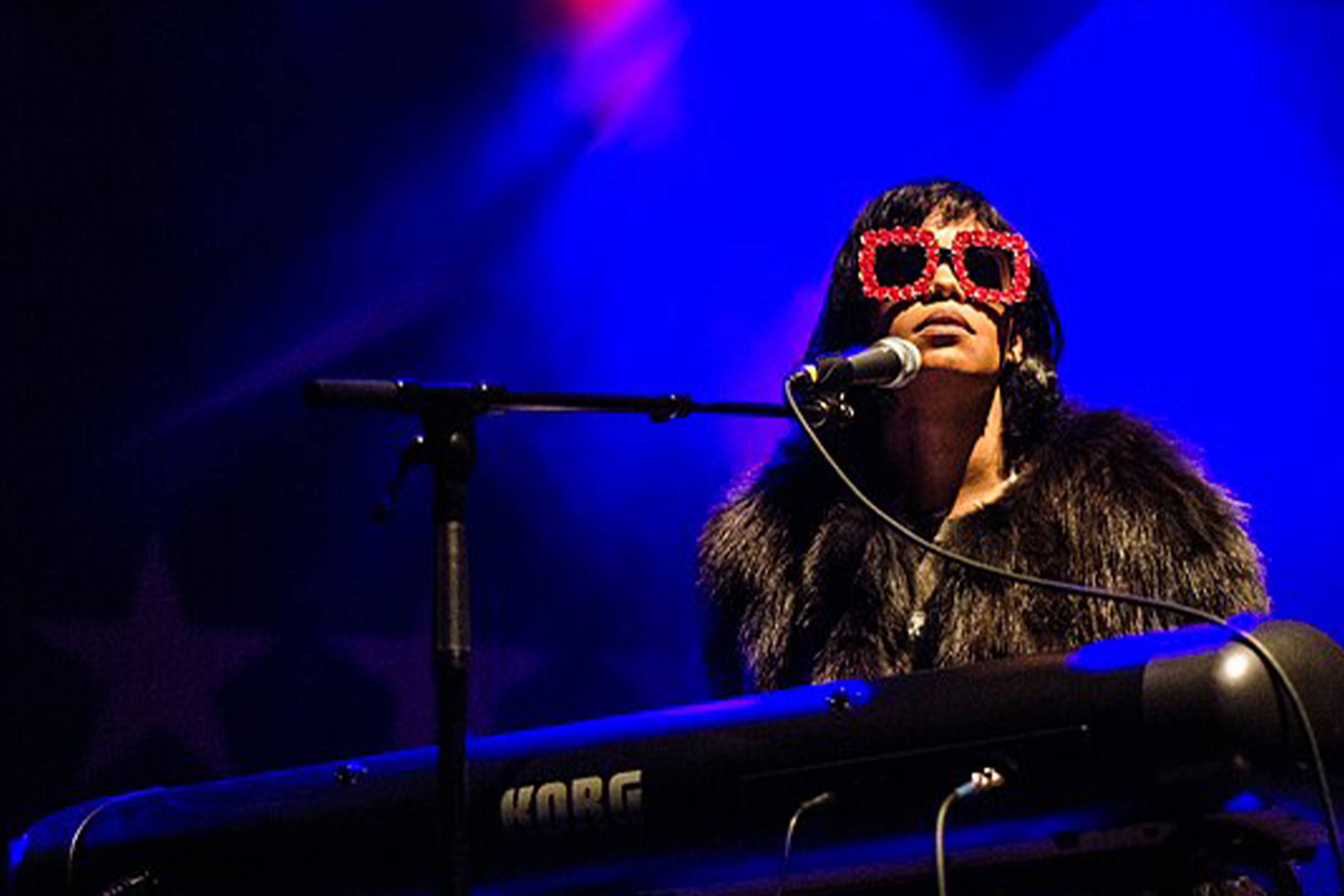
Paying tribute to Canada’s historic contributions to music, Rolling Stone released its list of the “50 Greatest Canadian Artists of all Time” in 2023. The article, however, had an uncomfortable detail that was hard to ignore: overwhelming whiteness.
While recognizing Black artists Daniel Ceasar, PARTYNEXTDOOR, the Weeknd, and Drake, the list failed to adequately represent Canada’s artistic multiculturalism. Detrimentally, it entirely disregarded the impact of an artist who, in her own right, broke barriers and reshaped Black Canadian music: Ontario singer-songwriter Fefe Dobson, who found global success as a Black woman in the 2000s Canadian Punk-Rock scene.
A brief history of Blackness in Rock and Punk music
The history of rock music cannot be adequately told without celebrating the Black artists whose contributions were indispensable to the genre’s development. For example, Bo Diddley’s alteration of traditional Blues melodies and instrumentals in the 1950s shaped what would now be recognized as Rock music. Alternatively, white artists like Elvis Presley and Janis Joplin gained notoriety through covering songs initially written for and performed by Big Mama Thornton.
The simultaneous exploitation and erasure of Black Rock music was done under the guise that Black musicians were not marketable. The following revisionist notion that Black artists self-segregated themselves away from the Rock scene absolves the responsibility of music industry giants who intentionally forced the genre to be white-exclusive.
As a subcategory of Rock music, Punk underwent a similar trajectory. The genre initially emphasized anti-establishment ideals related to anti-imperialism, anti-capitalism, and anti-racism in the 1970s.
However, by the late ’70s, artists began to seek appeal from wider and whiter audiences. Because of this, new punk movements turned away from their anti-racist beginnings and began aligning themselves more closely with white nationalist groups.
This shift in Punk and Rock music popularized the stereotype that Blackness and Rock were incompatible, and subsequently, Black Rock artists would face unfounded accusations of ‘racial betrayal.’ Jimi Hendrix and Tina Turner were among the Black Rock artists who were subjected to this, as these claims framed both their racial identity and musical expression as fraudulent.
From Scarborough to Island Records
Febe Dobson’s career delineation illustrates the preservation of white supremacist ideologies in the contemporary music industry. Skepticism regarding potential success in commercializing multidimensional Black artistry limited the support and opportunities she was offered.
Born in 1985 to a white Canadian mother and a Jamaican father, Dobson grew up in Scarborough. Her mother introduced her to musical legends like Phil Collins and Bob Marley, and her older sister’s love for Guns N’ Roses and Nirvana helped establish Dobson’s loyalty to the Rock sound.
Despite a clear opportunity in the market to capitalize on the popularity of teen idols in the 2000s like Avril Lavigne, labels struggled to conceptualize Dobson’s Blackness and punk-rock leaning, pop-esque voice. Dobson finally found an agreement which prioritized her creative freedom in a contract with the American label Island Records.
At only 17, Dobson released her debut self-titled album in 2003. The self-title stands as a metaphor in itself, as the album clearly and authentically illustrates her being. Her teenage desires, woes, and frustrations are communicated through a sound she insisted on maintaining, despite — similarly to those before her — having faced constant discouragement.
Understanding that Black women are rarely permitted expressions of anger and chaos adds an additional layer to this metaphor, rooted in defiance and resistance. Black women have used art as a medium to represent and thus legitimize their long-denied right to feel rage. As the album reached Platinum certification — one million copies sold — and had multiple singles charting in Canada, the United States, and the United Kingdom, Dobson deservedly became a global sensation.
Despite the success of her first album, the failure of her follow-up singles caused her record label to terminate her contract and shelve her second studio album. Other songs she had written for the album were instead given to other non-Black rising stars like Miley Cyrus and Selena Gomez. The historical parallel with Black musical innovation being stolen for white artists’ benefit is glaring.
Dobson’s other songs would be transformed into R&B ballads and given to Jordin Sparks, whose soft and traditional sound arguably better fit norms associated with Black woman artistry and was thus more palatable to wide audiences.
Almost seven years after her contract termination and having to relocate back to Toronto, Dobson was re-signed with Island Records and released her certified Gold — 500,000 sold — album Joy in 2010. In a 2021 interview with CBC Music, she spoke in appreciation of the various successes and setbacks in her career. The latter, having fueled her motivation, cultivated both her patience and determination.
Paving the way for Black alternative artists
Dobson’s persistence subdued caricatured expectations of Black women’s art but also highlights the resilience of character. Even as a teen, she maintained loyalty to her personalized sound and expression. Not only did this permit her to preserve her dignity, but also her agency as she refused to conform to racist ideas of Black woman artistry, attitudes, and presentation.
Her openness and pride resist popular respectability politics, which have forced many Black women to remain stoic and likable to appear palatable to the white masses. Seeing the recent rise of Black alternative artists like FKA Twigs and Willow Smith, I frame Dobson’s role as that of a guiding older sister whose unapologetic dedication to her craft has created new avenues for Black girls. For musicians and non-musicians alike, Dobson shows them how to sever themselves from imposed expectations of behaviour, feeling, and expression.

No comments to display.