
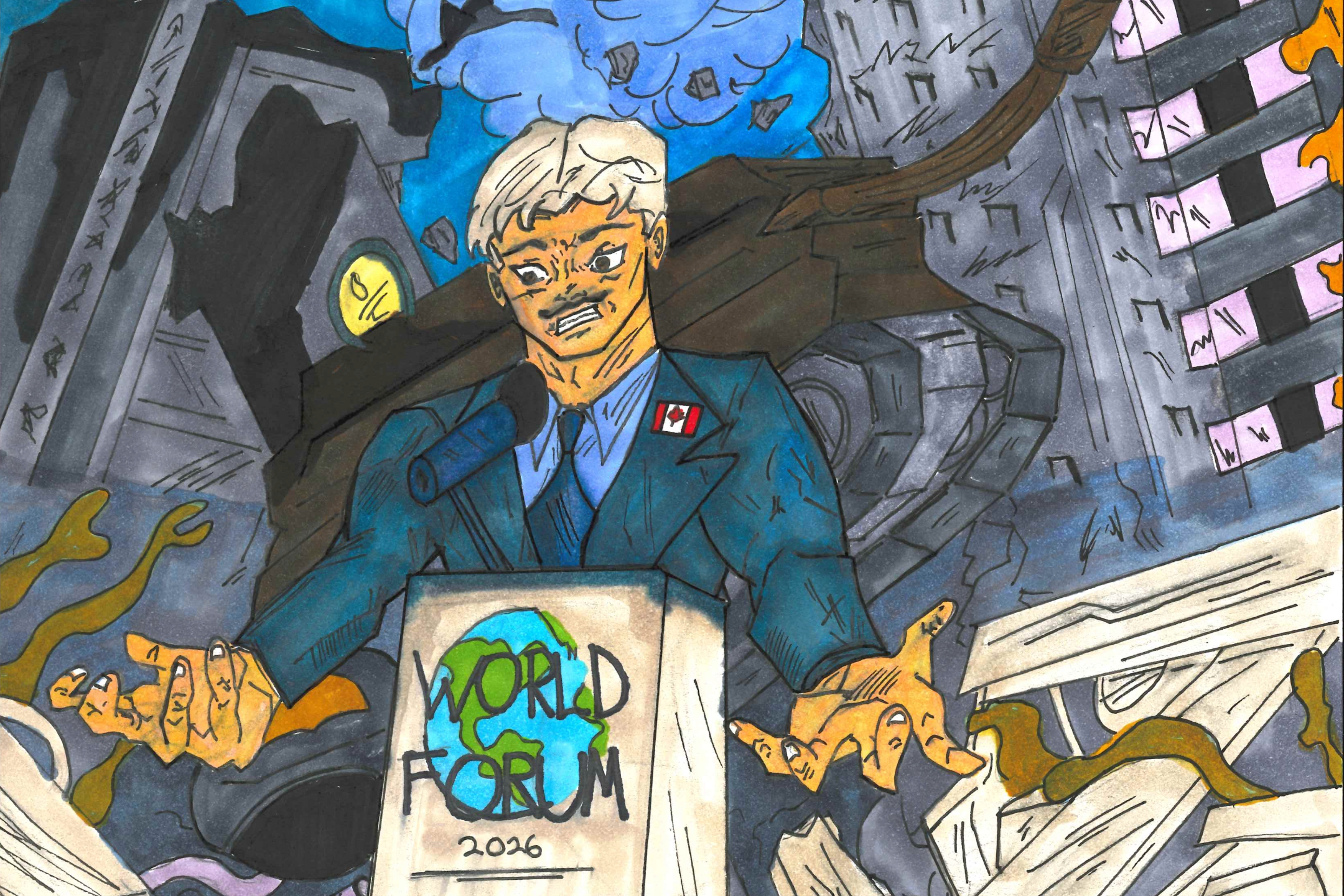
In January, Canadian Prime Minister Mark Carney spoke at the World Economic Forum (WEF) in Davos, Switzerland. There, he argued valiantly, that the framework of laws meant to promote peace and manage conflict was illusory. In his speech, he argued that “the story of the international rules-based order was partially false.”
US President Donald Trump’s threats to acquire Greenland, bombing Venezuela, and being an unreliable trade partner with Canada have forced political leaders like Carney to strengthen connections with Asian and European nations.
The benefits that American institutions have granted Western nations, in Carney’s words, have “helped provide public goods: open sea lanes, a stable financial system, collective security.” I believe the current American hegemony truly “no longer works” as the US proved to be an unreliable superpower.
Do “middle powers” really exist?
The heightened instability from this revelation encouraged Carney to urge countries with similar ties and connections with the US to “diversify to hedge against uncertainty.” He encourages risk management and strength building, and that “middle powers must act together.” Middle powers are, as the WEF defines, “influential states that sit below superpowers and great powers.”
Carney’s speech functions as a call for Western nations to sever ties with the once beneficial US order, the institutions that protected it, and the nation that maintained it. His speech acknowledges that the world order has reached a breaking point, and urges nations to rebuild it together.
The premise of the speech, and the reason it elicited both praise and shock across the country, was the argument that the world order was rupturing. Carney received a standing ovation at Davos for this insight, and the Liberal Party saw a boost in popularity following the speech.
I think acknowledging the world order as “partially false” and advocating for a separation from the US is positive. However, I disagree with Carney’s premise that middle powers exist in the first place and that the US was the stronghold for the world order. While the US has one of the largest militaries, which makes it an intimidating opponent to smaller powers, I argue that solely citing the US as a superpower for world order is a form of scapegoating to deflect criticisms that Canadians have about the economy.
Each Western nation that calls itself a “middle power” has benefited from colonialism. Canada, for one, owes its creation to British and French settler colonialism.
Currently, Canada still holds remnants from that colonial era — like our constitutional monarchy and being part of the commonwealth. Canada fought as much as the US to maintain the world order, such as being a part of the Allied efforts during the World Wars. Canada and the Western nations attending the WEF are not coasters, nor bystanders.
Colonial context alters how we analyze history. It allows middle power countries like Canada to maintain their image as the nicer alternative to the US, thus concealing their problematic pasts and safeguarding the wealth accumulated via the US-led world order.
Canada’s past and present ties to colonialism
An important makeup of Canada’s wealth is in real estate. It was responsible for adding around $300 billion to the Canadian economy in 2022. As Carney increases conversations between the federal and provincial governments on building an oil pipeline, we can expect oil and gas to contribute significantly to Canada’s economy.
This means Canada is heavily reliant on profits from the land — the very land Indigenous people were forced off of. The unfair treaties drafted, like the 1923 Williams Treaties, and Canada’s connection with the UK empire contribute to why Canada holds its current wealth.
The power Canada and its allies held created the contracts that benefitted Canada and institutions like the United Nations, which helped maintain the world order. This is why Canada and its allies could continue to exploit natural resources, for example, in marginalized communities without solid reprimand.
In 2023, Canadian mining companies were accused of compromising Congolese people’s human rights to construct a mine. Once again, there were few consequences for this because of Canada’s position of power in comparison to Congo.
When Carney calls Canada a “middle power,” he subtracts Canada’s participation in creating the system. Moreover, it is a slap in the face to the nations that have had to endure the subjugation that Canada has directly or indirectly supported.
I believe that the updated version of the world order will maintain the current hierarchy, and that nothing will change for marginalized communities and nations because powerful countries rely on their relegation. Canada was only able to be a middle power because it relied on and supported more powerful nations as they subjugated others.
Some Canadians or Westerners may see no reason to care that Canada or Canadian companies are complicit in neo-colonialist efforts elsewhere. To them I say, when you ignore what your nation does to others, others will ignore what it does to you.
It is important to understand your history. To remain knowledgeable. If not, you open yourself to propaganda from the state, allowing the state to manufacture your consent to perpetuate more harm against others or against yourself.
Emmanuella Nwabuoku is an Opinion Domestic Affairs Columnist majoring in political science and women and gender studies, while minoring in African studies.
