
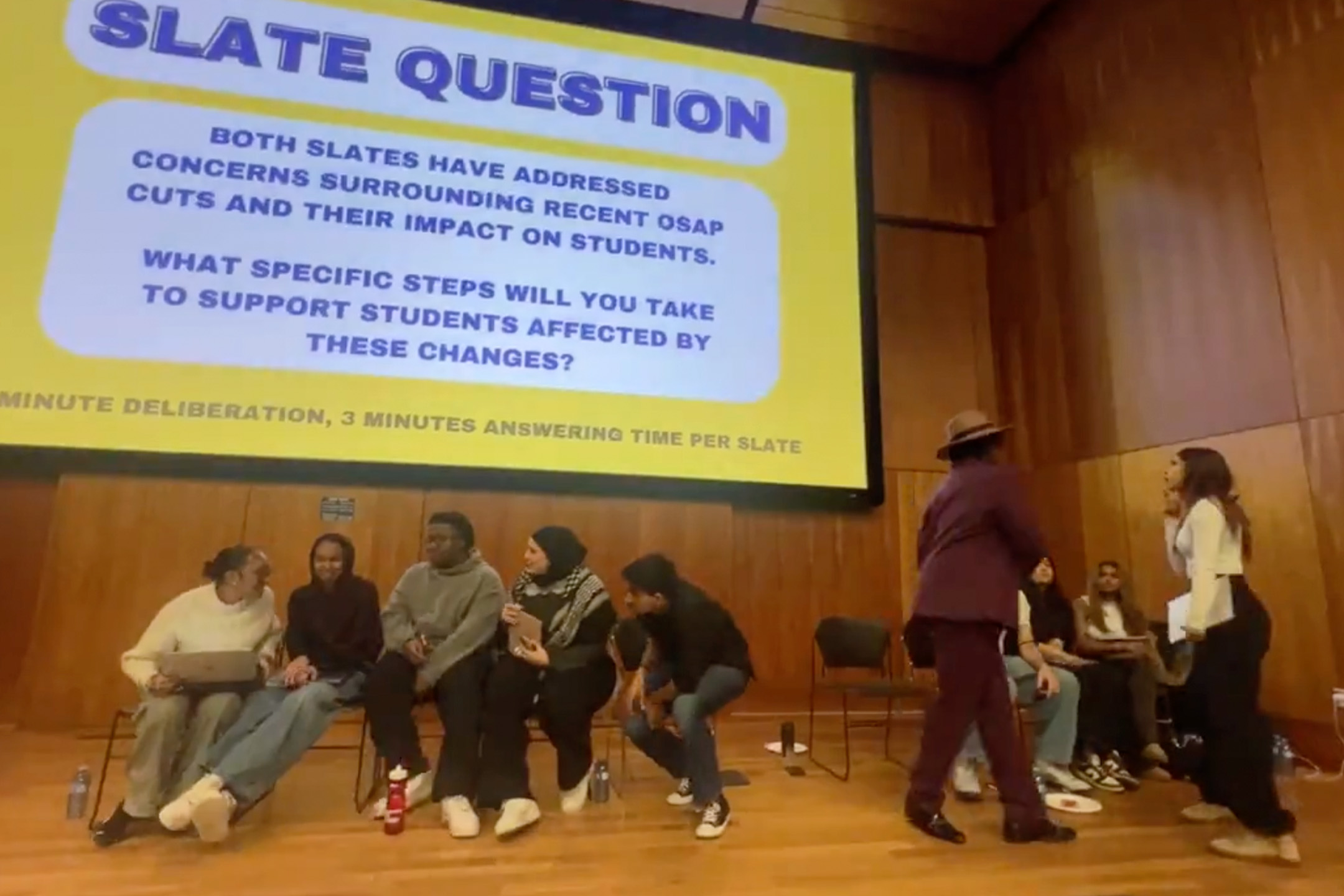
Team Impact and Team Amplify are facing off in the SCSU election. On March 4, executive candidates from each team debated transit issues, campus engagement, and financial transparency ahead of the election. The full debate can be watched on the SCSU’s Instagram.
Voting will take place on campus from March 9–11, 2026, with polling stations open each day from 10:00 am to 5:00 pm.
Presidential candidates
The presidential candidates were asked about what accountability measures they would put in place so the SCSU executives would effectively execute their jobs.
Amplify’s Kai Sealy said she would “make sure that all executives have clear written mandates at the beginning of the summer semester, the fall semester, and winter semester.” She continued, saying, “I will schedule one-on-one executive meetings, so I can track the progress of each of my executives and make sure that I’m following through with their promised deliverables, so that we are not making false promises to students.”
Impact’s De-Mario Knowles said next, “One good way to make sure we are doing our job is that the people that we are meant to serve are at the table as well. It’s one thing if you are working internally, it’s another thing if the people that are watching you do your job are either seeing you do what you’re supposed to do or seeing you not do what you’re supposed to do.”
The next question asked how the candidates would ensure the SCSU represents students who both support and critique the SCSU.
Knowles said he believed in analyzing through the framework of “intent versus impact.” He added, “At the end of the day, we’re all here to serve the students. And there may be a time where, as SCSU executives, we believe that this may be right, because we’re big union executives, we have so much experience. We can sometimes overlook how certain decisions that we make affect the students that we serve.”
When someone comes with criticism, “That’s not an opportunity for me to feel attacked. That’s an opportunity to see how I can reflect and express humility so I can get their input and better serve students,” Knowles concluded.
Sealy stepped up next. “In order for us to amplify the voices of students, we need to be collecting that data. When we’re taking that to the admin, we have to have quantifiable measures. We go to a research university, and this university loves having metrics, so making sure that I have that data available, making sure that we’re running the relevant surveys, we’re going through the anonymous feedback loops.”
Sealy added, “Additionally, making sure that we’re bringing students into those spaces, like the International Student Centre, making sure that students are actually engaging with the supports they create.”
VP Operations
The VP Operations candidates were asked what measures they would implement to ensure transparency in the union’s spending and budgeting.
Amplify’s Rakshit Hegde began: “First of all, I would make Bistro, the restaurant itself and the safe space of Bistro more accessible to clubs and student groups, because at the end of the day, the Student Center and the Bistro are a student space.” This included lowering the fee for the student groups to book the Bistro.
Additionally, he will “make sure that all the steps the money goes through from wherever it’s coming from, to the students or to clubs, would be extremely transparent and extremely easy to access for all students in all clubs.”
Impact’s Athisayaa Prabagar added that she wants to create a section of the website with the union’s fees, budget and finances, and create visual printouts and infographics for students to easily understand how money is being allocated. Prabagar also wants to standardize and publish funding criteria for clubs.
“Transparency isn’t just about publishing numbers, it’s about making sure students feel informed and involved in decisions that affect their experience. So my goal is to make sure that your next finances are more visible, understandable and accountable,” Prabagar concluded.
VP Academic and University Affairs
One question asked of the VP Academic and University Affairs candidates is how they would support co-op students in securing meaningful employment opportunities.
“I want to champion the integration of structured experiential learning programs in every UTSC undergraduate program,” said Impact’s Maya Khan. Her ultimate goal is “to connect classroom learning with hands-on experience.”
Khan wants to implement initiatives like “hosting targeted networking events with alumni and local employers from the GTA, expanding workshops on resume building, interview skills specific to each field, and partnering with different companies, creating more diverse, high-quality co-op placements.”
If elected, Khan will “track co-op outcomes and the positions that are open right now so we can continuously improve opportunities and make sure every student finds a placement in UTSC that truly helps them grow professionally.”
Amplify’s VP Academic and University Affairs candidate, Kaitlyn Gallagher, was not present at the debate.
VP External
To the VP External candidates, one question asked how they would strengthen relationships with external stakeholders and advocate for students with the rising costs of housing, transit, and tuition.
Amplify’s Fawzia Elhag highlighted the SCSU’s pre-established transit bursary program, but argued that the demand from students exceeds the funding that has been allocated for the program.
“One thing about the services we have here at the SCSU is the TTC bursary, or transit bursary,” Elhag said. “There’s a lot more that needs to be done, and there has to be an expanded budget for these bursaries. We have over 150 students applying per round, and the budget isn’t reflective of the amount of students that we have.”
She also brought up discussions around a broader youth transit pass initiative that would allow UTSC to connect with multiple post-secondary institutions and work together to reduce transit fares for students.
“However, to bring in the youth pass, we would need a two-year plan of bringing together different colleges and different universities,” Elhag said.
Impact’s Khadijah Khan was not present at the debate.
VP Equity
The VP Equity candidates were asked how they would ensure the union enforces a safe environment for students of all spiritual belief systems, sexual orientations, gender identities, and racial backgrounds.
Impact’s Sukaina Abass proposed regular forums and engagement opportunities where students could share ideas directly with union leadership “to make sure students actually feel safe, heard, and supported when they speak up.”
Abass also wants to “actively rebuild the support that makes it easier to participate, share their experience, and feel like there’s safe people on campus.”
Amplify’s Amal Elcharbini began with, “Creating a safe and inclusive campus starts with making sure that equity policies are not just symbolic, but actually enforced. One of the first steps is strengthening how discrimination and harassment [are] reported and addressed.”
“The important part of my role is to give them a platform to champion the conversation, not necessarily to take any kind of conversation away from their voices,” Elcharbini added.
VP Campus Life
The two VP Campus Life candidates were asked how they would ensure SCSU’s club funding allocation is fair and transparent.
Amplify’s Emeka Okolo wants the Club Funding Committee to approve funding by itself so club reimbursements don’t have to wait until the next Board of Directors meeting. He also wants to increase committee meetings to between three and four meetings a month, “so that the clubs can get the money instead of having to wait at least two weeks from the end of the month, they can get their money within a single week.”
Impact’s Tarek Dennaoui said, “Emeka and I probably have the same goals. We just offer different perspectives, or we just have different personalities.”
“I’m just gonna increase the frequency of board meetings to stay on top of things as the year progresses, and to make sure that these reimbursements are always on time […] At the end of the day, I want to maximize the efficiency of clubs producing events through the efficiency behind closed doors,” Dennaoui concluded.

No comments to display.