
Honesty and rigour are essential to science. As a centre for scientific innovation, U of T proudly carries the torch of science forward. In its Principles of Research Integrity, the university clearly espouses these principles.
But honesty and rigour can be inconvenient when managing a business. Since U of T is also essentially a corporation, it is thus riven by a tension. The implication: when the administration’s business interests prevail, dishonesty and imprecision can supersede the principles of science.
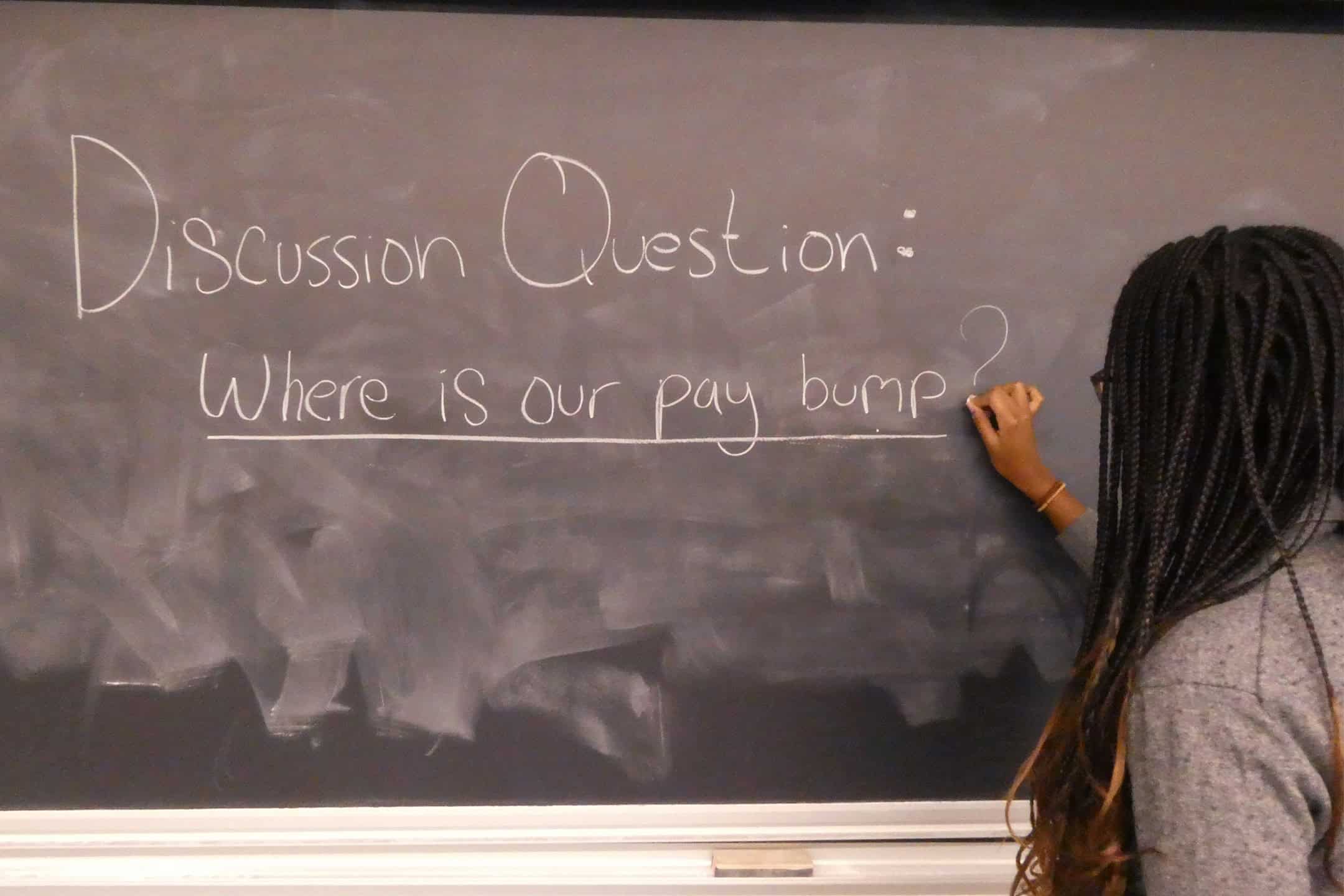
As faculty and librarians, we currently pursue science amid harsh crosswinds. One big issue here is that the university administration failed to issue a pay raise to some of our junior colleagues last year, and has obscured this with dishonesty and imprecision. We think this constitutes a case of wage theft. And because the administration has obscured it, we think it also threatens the university’s commitment to science.
Last academic year, after an extended period of negotiations with the U of T Faculty Association (UTFA), an arbitrator finally stepped in and mandated that the university administration issue Across-The-Board (ATB) pay increases to faculty members and librarians, excluding faculty in their first year who, as UTFA put it, are “not eligible for retroactive ATB.” The arbitrator required that one ATB increase base salaries by 3.5 percent and another by 2.5 percent. ATBs are the main way pay is indexed to the cost of living, although the arbitrator recognized these raises did not compensate for recent inflation.
Last year, a representative from the Academic Human Resources Department (HR) told a room of newly-hired faculty members that they receive an ATB pay increase every year. This was almost certainly what junior colleagues wanted to hear.
And it would have been great!
But it has turned out simply not to be true. Some of our colleagues in their second and third years of employment did not receive the raise last year. Indeed, over 700 professors and librarians signed a petition, released in October 2025, to call attention to this issue, following a successful petition of a similar nature from 2023. UTFA also issued a statement regarding the administration’s refusal “to back down from its position that recent hires should be excluded from ATB increases awarded in their year of hire.”
The administration sometimes obscures such situations with wordplay. In their messaging, they marked the two subparts of this raise “2023” and “2024,” respectively, even though they were only paid out in 2025. The administration often uses the term “retroactive,” and has even called a similar case “retroactive ATBs.” Beyond verbiage, pay raises may arrive on time, or they may arrive late.
In other words, when we subtract the wordplay, the administration denies early-career colleagues’ ATBs.
The university administration has not addressed the problem. As far as we are aware, other than the HR representative’s inaccurate statement, the administration has only obliquely mentioned the problem of last year’s early-career ATBs one other time. In their recent memorandum, two university leaders stated that starting salaries “already incorporated anticipated ATB increases.”
That would be great!
But this does not appear to be true either. The amount of the ATBs had not been arbitrated when most — if not all — of the relevant starting salaries were negotiated. The only way ATB increases could have been “incorporated” is if the employer knew in advance the size of the increase the arbitrator would later award.
To be clear, we only mean to convey what would need to be the case for this statement to be accurate; we have no evidence of actual employer collusion with the arbitrator and make no claims about it.
Our claim is that HR has not been honest and rigorous in its statement that faculty and librarians receive an ATB every year. At first glance, this might appear to be an oversight. But the memorandum, at least when paired with the petitions, suggests the administration is aware of the issue. So it seems more accurate to conclude that the administration has been dishonest and imprecise, saying one thing — that faculty and librarians receive an ATB every year — but doing another: denying ATBs to our early-career colleagues.
What are we to make of this situation? We think this is a case of wage theft, and that, as such, it contravenes the scientific principles of honesty and rigour to which the university is officially committed.
Wage theft is when an employer refuses to pay the wages owed to their employee(s), regardless of intention or mechanism, and regardless of whether the workforce takes note.
Wage theft is more common than sometimes thought. Drawing on official complaints, one study estimates that, in the past 10 years, Ontario employers have stolen nearly $200 million dollars from their employees. Professors often earn considerably more than others suffering from wage theft, who tend to cluster in the lower end of the labour market. But this quantitative difference does not itself make the distinct cases of wage theft categorically different. In all cases, wage theft is a way businesses can make extra money from their employees.
Wage theft is typically veiled by dishonesty and inaccurate claims, perhaps because it is widely held to be unjust or even taboo. Whenever we observe employer dishonesty and inaccuracy about pay, it is possible we are looking at wage theft. We have seen employer dishonesty and inaccuracy about ATBs; we think it’s a case of wage theft.
Wage theft is common. What makes this situation unique?
It is at odds with U of T’s commitment to the principles of science. Since HR’s claim — that all faculty and librarians receive an ATB every year — is dishonest and inaccurate, it goes against the university’s commitment to science. But this doesn’t have to be the end of the story.
If science and U of T’s principles of research are to prevail, the administration would have to issue ATBs to those early-career professors and librarians who did not receive them last year. The administration would have to actually do what HR claims it already does. Until then, the university seems to have a wage theft problem.
Concerned Faculty is a group of professors who are alarmed by the administration’s behaviour.

No comments to display.